


AI medical imaging is the use of neural networks and deep learning algorithms to detect patterns, textures, and structural anomalies in medical scans that are too subtle or too numerous for the human eye to catch reliably at scale. It does not replace radiologists. It makes them faster, more consistent, and more accurate by handling the computational labor so clinicians can focus on judgment.
That framing matters. Most conversations about AI in radiology either oversell the technology or stoke fear about job displacement. The reality is more grounded and more interesting: AI is becoming the radiologist's most capable colleague, one that never gets tired, never misses a queue, and can simultaneously read a CT scan while a radiologist is still dictating the previous report.
This guide covers how the technology actually works, where it delivers proven clinical value, what it costs, and where its limits are.
At a Glance
| Topic | Key Facts |
|---|---|
| What it is | Neural networks trained on millions of labeled medical images to detect, segment, and classify findings |
| Primary modalities | CT, MRI, X-ray, ultrasound, PET, mammography |
| Core use cases | Triage, lesion detection, tumor volumetrics, stroke detection, plaque analysis |
| Accuracy benchmark | AI matched or exceeded radiologist performance in specific tasks per The Lancet Digital Health |
| FDA-cleared devices | Over 1,000 AI radiology devices cleared as of late 2025 |
| Biggest limitation | Black-box explainability; clinical context still requires a trained radiologist |
| 2026 frontier | Generative AI for synthetic training data; multimodal fusion with genomics |
Seeing the Unseeable: What AI Medical Imaging Actually Does
AI medical imaging gives radiologists a quantitative second reader capable of processing every pixel in a scan in under a second.
The human visual system is extraordinary, but it operates under real constraints. A radiologist reading 80 to 100 studies in a single shift can experience perceptual fatigue, and subtle findings such as a 3mm pulmonary nodule on a chest CT or early cortical thinning on a brain MRI are easy to overlook. AI does not get fatigued. It applies the same mathematical scrutiny to scan number one as to scan one hundred.
More precisely, modern AI imaging systems act as force multipliers. They pre-flag abnormalities, rank studies by urgency, pre-segment anatomical structures, and generate quantitative measurements that would otherwise take a radiologist several minutes per scan to produce manually. The radiologist then reviews, contextualizes, and signs off. The division of labor is complementary, not competitive.
How Deep Learning Differs from Older Computer-Aided Detection
Computer-aided detection (CAD), the predecessor to modern AI imaging tools, was a rules-based system. Engineers manually coded features such as density thresholds, shape parameters, and contrast gradients, and the software flagged regions that exceeded those predefined criteria. It worked, but it was brittle: change the imaging protocol slightly and the false-positive rate would spike.
Deep learning is fundamentally different. A convolutional neural network (CNN) learns feature representations directly from data. Feed it millions of labeled mammograms with confirmed malignancies and the network learns, without explicit programming, which pixel patterns correlate with cancer. It discovers its own features at multiple levels of abstraction, from edges and textures at the pixel level to complex structural patterns at the organ level. The result is a system that generalizes better, degrades more gracefully, and can be fine-tuned on institution-specific data.
What Imaging Modalities AI Currently Analyzes
Current AI imaging tools have been validated across all major diagnostic modalities. CT analysis is the most mature, with strong evidence across pulmonary, neurological, and cardiovascular applications. MRI analysis is more computationally demanding but well-established in neuroimaging, musculoskeletal assessment, and prostate evaluation. Plain X-ray AI has seen enormous deployment for chest pathology, particularly pneumothorax, fracture detection, and tuberculosis screening. Ultrasound AI is growing rapidly in obstetric, cardiac, and point-of-care settings where real-time guidance adds immediate clinical value. PET and nuclear medicine AI is earlier stage but showing strong results in oncology staging workflows.
Speeding Up MRI and CT Acquisition
One of AI's most direct and measurable contributions to patient experience is making the scans themselves faster and safer.
AI-Powered MRI Reconstruction
MRI scans are long. A standard brain MRI can take 30 to 45 minutes. Patients must remain still throughout, which is distressing for children, elderly patients, and anyone with claustrophobia. Scan time is also a throughput bottleneck for imaging centers with high demand and limited scanner availability.
AI reconstruction algorithms address this by learning to reconstruct high-quality images from undersampled k-space data, meaning the scanner collects less raw data during acquisition and the AI fills in the missing information. FDA-cleared tools using this approach, including Philips Compressed SENSE and GE AIR Recon DL, have demonstrated scan time reductions of 30 to 50 percent without clinically significant loss of diagnostic quality. According to research published in PMC, deep learning reconstruction approaches consistently improve signal-to-noise ratio while preserving diagnostic accuracy across multiple anatomical regions.
Low-Dose CT Enhancement
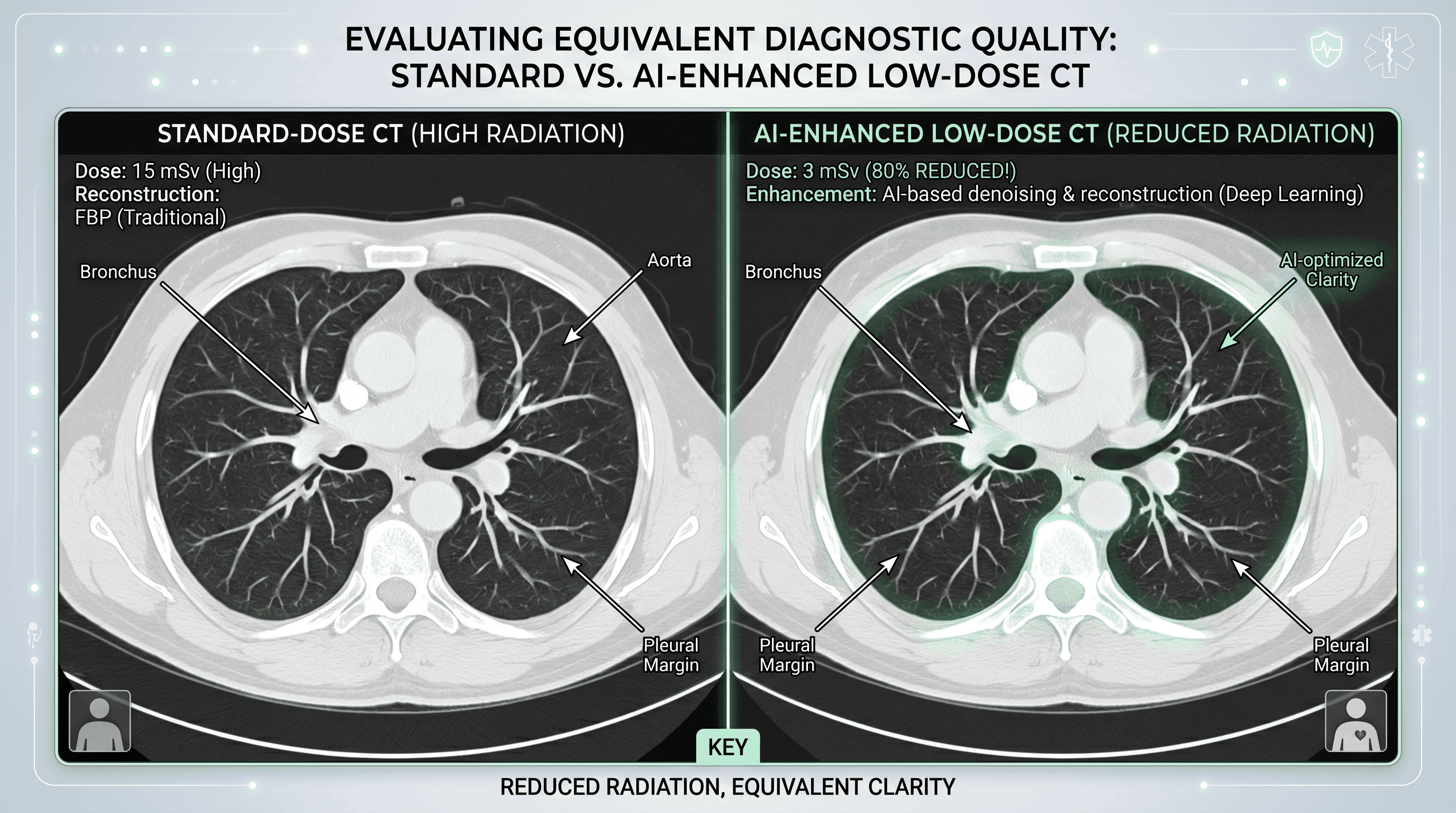
CT scans use ionizing radiation. Reducing radiation dose is a persistent priority in radiology, particularly for pediatric patients, repeat imaging protocols, and screening programs where patients receive multiple scans over years. The challenge has always been that lower radiation doses produce noisier images, which can obscure subtle findings.
AI denoising algorithms, trained on paired high-dose and low-dose image sets, have learned to suppress noise while preserving diagnostically relevant signal. The practical result is that AI-enhanced low-dose CT scans can match the image quality of standard-dose acquisitions, allowing institutions to reduce patient radiation exposure without compromising diagnostic confidence. Research in the European Journal of Radiology has documented these quality improvements across multiple scanner platforms and anatomical applications.
Automated Detection and Triage: The Always-On Sentinel
AI triage tools function as an always-on background process, scanning every incoming study and instantly escalating the ones that cannot wait.
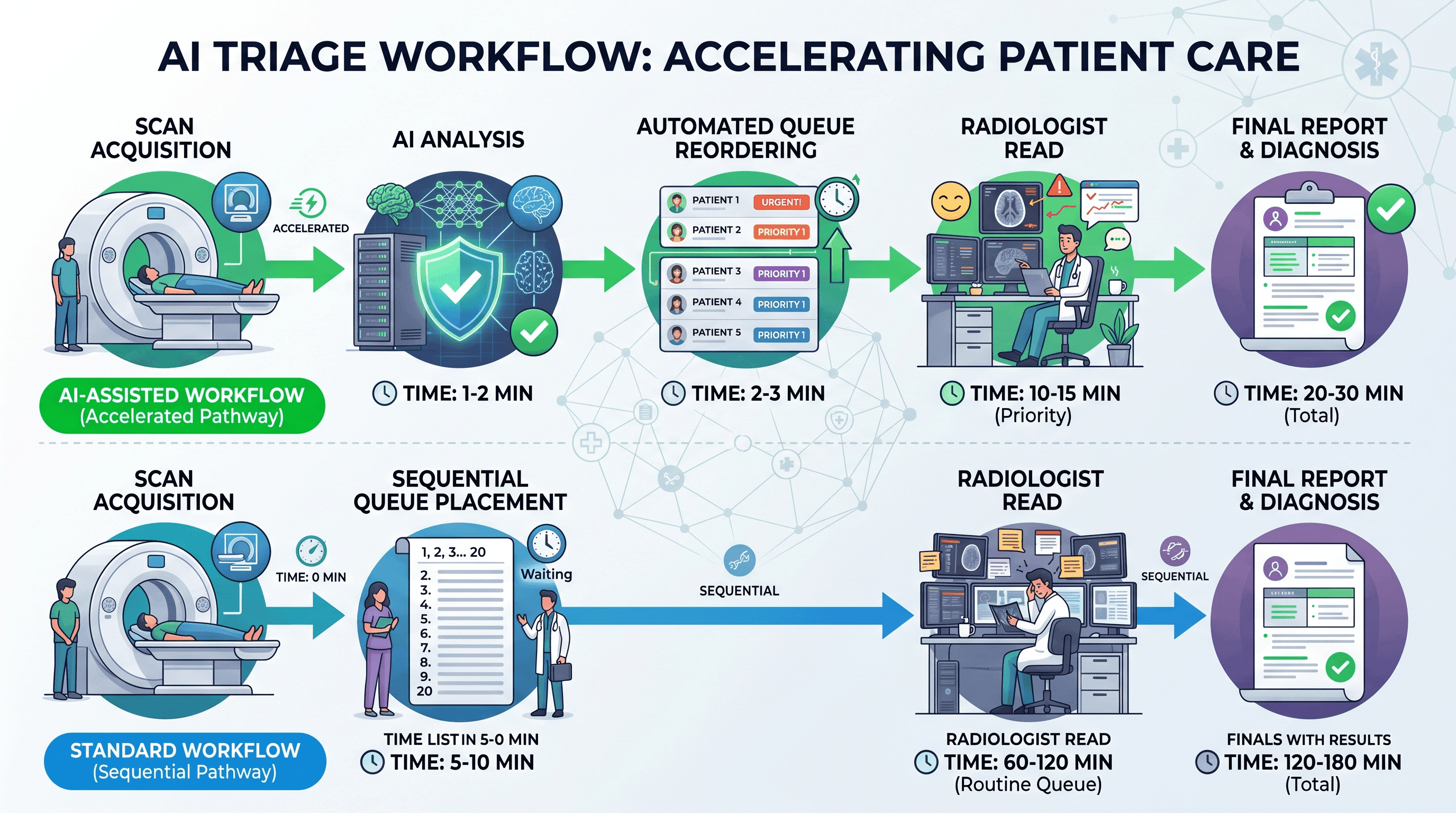
In a busy radiology department, scan orders arrive faster than reads can be completed. Studies sit in a queue ranked by order of arrival, not clinical urgency. A stroke patient's brain CT might wait behind a routine knee MRI simply because it arrived later. AI worklist prioritization solves this. The moment a scan is acquired, the AI analyzes it in the background. If it detects a hemorrhage, a large vessel occlusion, a pulmonary embolism, or a tension pneumothorax, it flags that study and moves it to the top of the radiologist's queue within seconds.
This is not hypothetical. NHS England reported in late 2025 that AI-assisted stroke triage significantly increased rates of timely thrombectomy by accelerating the identification of large vessel occlusions on CT angiography scans. Time to treatment in stroke is not an abstract clinical metric; every minute of delay in treatment corresponds to measurable neurological deficit.
Beyond emergencies, AI triage tools add value in screening programs. When thousands of low-risk chest X-rays need to be read each week, AI can confidently mark normal studies as low priority, freeing radiologist attention for the studies where findings are present. Research cited in PMC supports AI-based prioritization as a viable strategy for managing high-volume imaging workflows without increasing staffing.
What Conditions AI Can Flag in Real Time
The strongest evidence exists for a focused set of time-sensitive findings. Brain hemorrhage detection on non-contrast CT is among the most mature applications, with multiple FDA-cleared tools operating at high sensitivity. Pulmonary embolism flagging on CT pulmonary angiography is well-validated and reduces the risk of a critical finding sitting in a queue. Pneumothorax detection on chest X-ray, particularly tension pneumothorax, has strong clinical evidence. Aortic dissection on CT angiography is a newer but rapidly maturing application.
Oncology: Tracking Tumor Volumetrics with Quantitative Precision
AI transforms tumor measurement from a time-consuming manual task into a reproducible, sub-millimeter quantitative output.
Assessing whether a tumor is responding to treatment has traditionally depended on radiologist-measured longest-axis diameters using RECIST criteria. This approach has known limitations: it requires manual caliper placement on each target lesion, it reduces a three-dimensional structure to a single linear measurement, and inter-reader variability is well-documented. Two radiologists measuring the same lesion can produce meaningfully different numbers.
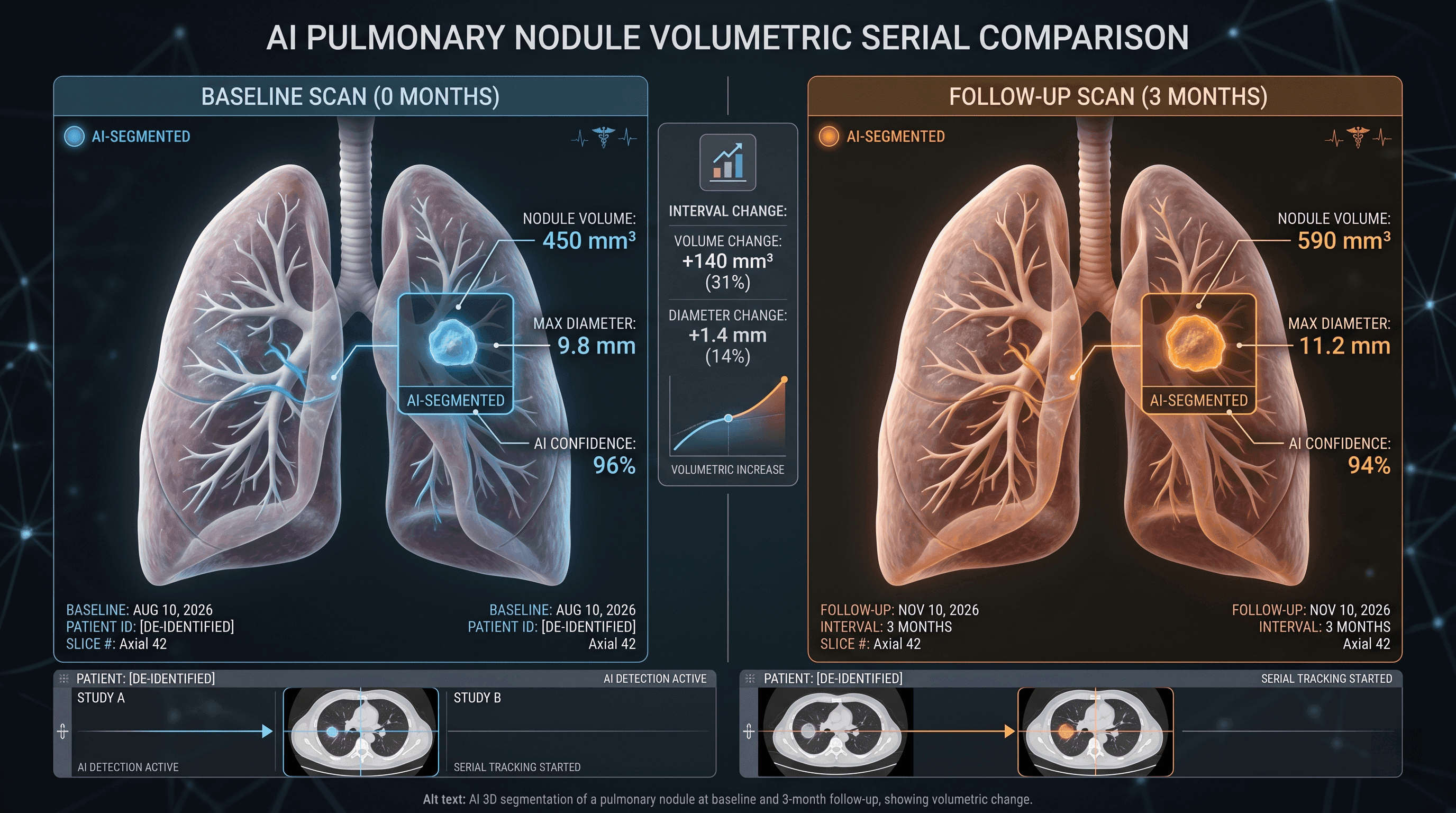
AI-powered 3D segmentation tools address all three problems simultaneously. The AI automatically contours the tumor in three dimensions, calculates volumetric measurements with sub-millimeter precision, and does so in a reproducible manner that is not subject to the attention state of the person doing the measurement. When the same patient returns for a follow-up scan three months later, the AI recalculates volume and expresses the change as a percentage, making treatment response assessment faster, more objective, and more sensitive to small changes.
This matters in oncology because early detection of treatment failure allows for faster protocol changes. A 2 percent reduction in longest diameter is within inter-reader variability and might be dismissed as stable disease. A volumetric reduction or increase of that same 2 percent, measured precisely, tells a more reliable clinical story. According to Nature Medicine's AI and oncology imaging collection, AI-assisted volumetric analysis is showing particular promise in lung cancer screening, where nodule growth rates over serial scans are a key determinant of biopsy decisions.
Cancer Screening: Mammography and Lung
Breast cancer screening with AI assistance has produced some of the most cited evidence in the field. Research published in Nature Medicine in early 2025 found that AI-assisted mammography reading improved cancer detection rates by 17.6 percent compared to standard double reading, while simultaneously reducing radiologist workload by approximately 44 percent by allowing AI to serve as the first reader for normal studies. The finding has clear implications for screening programs in countries where radiologist shortages limit double-reading capacity.
Lung cancer screening with low-dose CT is another high-evidence area. AI tools trained on large lung nodule datasets can detect and characterize nodules that meet size and morphology criteria for follow-up, assign Lung-RADS categories, and flag high-suspicion findings for expedited review.
The Rise of Generative AI and Synthetic Training Data
Generative AI addresses one of the fundamental bottlenecks in building reliable medical imaging models: the scarcity of labeled training data for rare diseases.
Training a high-performing diagnostic AI requires thousands to millions of labeled examples. For common conditions such as chest X-ray pneumonia or knee osteoarthritis, this data exists and can be assembled from large hospital archives. For rare conditions, the math does not work. A tertiary center might see 30 confirmed cases of a rare sarcoma per decade. No amount of effort can manufacture real-world scans for conditions that simply do not occur frequently enough.
Generative adversarial networks (GANs) and, more recently, diffusion-based generative models offer a way around this constraint. A GAN consists of two neural networks trained in opposition: a generator that learns to produce synthetic images and a discriminator that learns to distinguish synthetic from real. Over thousands of training iterations, the generator improves until the discriminator can no longer reliably tell them apart. The output is a model capable of producing high-fidelity synthetic CT, MRI, or X-ray images that are statistically indistinguishable from real acquisitions.
The Lancet Digital Health paper on AI and medical imaging highlights that data augmentation through generative approaches is one of the most active areas of current research, with particular relevance for pediatric imaging and rare oncology subtypes where real-world training data is inherently limited.
Beyond rare disease training, generative AI is also being used to synthesize alternative imaging sequences. An AI trained on paired MRI and CT datasets can generate synthetic CT images from MRI acquisitions, which has direct clinical applications in radiation therapy planning where CT-based attenuation correction is required but repeat CT exposure is undesirable.
Diffusion Models and the 2026 Frontier
Diffusion models, a newer generative architecture that underlies tools like Stable Diffusion, are beginning to outperform GANs on medical image synthesis tasks. Where GANs can suffer from mode collapse (producing limited variety in outputs), diffusion models generate more diverse and structurally coherent synthetic images. Research programs at Stanford, CMU/UPMC, and Mayo Clinic are actively exploring diffusion model approaches for pathology augmentation in training datasets, with early results suggesting that models trained on diffusion-augmented data outperform those trained on real data alone when real data is scarce. According to recent ScienceDirect research, synthetic data generation using these approaches is maturing rapidly and showing clinical-grade utility.
Cardiovascular Imaging and Plaque Analysis
AI analysis of coronary CT angiography is transforming how clinicians identify which patients are at highest risk of a near-term cardiac event.
Traditional coronary CT angiography reports describe stenosis severity in terms of lumen narrowing. A 70 percent stenosis in the left anterior descending artery gets the radiologist's attention. But stenosis severity alone is an imperfect predictor of which lesions will cause a heart attack. Pathologically, most acute myocardial infarctions are caused not by the most obstructive plaques but by plaques with specific high-risk features: a thin fibrous cap, a large lipid-rich necrotic core, and evidence of positive remodeling. These features are present in plaques that may only cause 40 or 50 percent stenosis on conventional assessment.
AI tools trained on histologically validated plaque datasets can now characterize plaque composition from standard coronary CT angiography images, identifying which plaques have the structural features associated with vulnerability. This shifts cardiac CT interpretation from a binary stenosis severity report toward a risk stratification tool that identifies the right patients for aggressive preventive therapy before an event occurs.
The European Journal of Radiology has published recent work supporting AI-based plaque characterization as a reproducible method for identifying high-risk coronary anatomy, with findings that align with earlier histopathological validation studies.
If a high-risk plaque pattern is identified on AI-assisted coronary CT, the clinical follow-through often involves a broader cardiovascular risk discussion, including management of hypertension as a modifiable driver of plaque progression. Understanding how hypertension, heart disease, and stroke interconnect provides useful context for that conversation.
Radiology Meets Omics: Multimodal Diagnostic AI
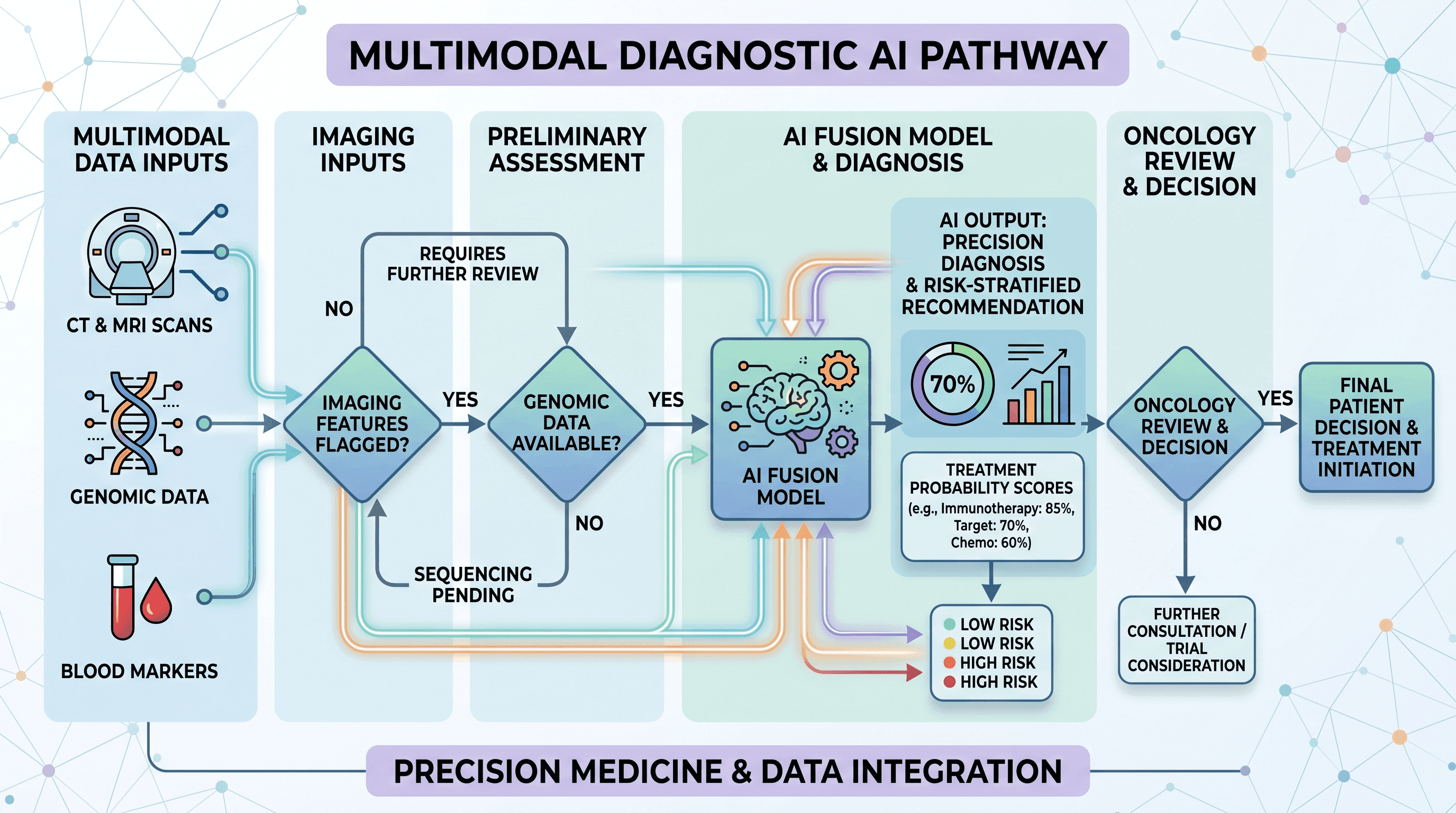
The next horizon in AI medical imaging is not analyzing images in isolation. It is fusing imaging data with genomic, proteomic, and metabolomic information to produce a diagnostic output that is more precise than any single modality alone.
This approach, sometimes called radiomics or multimodal AI, starts with the observation that imaging features are not random. The appearance of a lung adenocarcinoma on CT reflects its underlying biology: its mutational profile, its metabolic activity, its immune microenvironment. An AI trained to correlate imaging features with molecular data from thousands of annotated cases can learn to predict, from the scan alone, which tumors carry EGFR mutations, which are likely to respond to immunotherapy, and which have a high probability of early metastasis.
In 2026, this is moving from research to early clinical deployment. NYU Langone's radiology AI program, detailed in their research overview, has been a leading site for multimodal AI development, integrating imaging phenotypes with pathology and clinical outcome data to build models capable of treatment response prediction. The Norwegian research consortium MIRA at NTNU, described on their program page, is similarly advancing multimodal approaches for oncology and neurodegenerative disease imaging.
The practical implication for clinicians is significant. A lung CT read that currently answers "is there a nodule, how large is it, and does it have suspicious features" may, within five years, routinely answer "is this nodule malignant, what is its likely genomic subtype, and which treatment pathway has the highest probability of response based on imaging biomarkers."
The Limits: Where the Radiologist's Word Is Final
AI provides the data. The radiologist provides the context. That distinction is not a disclaimer; it is the foundational design principle of every evidence-based AI imaging system in clinical use.
The most commonly cited limitation of deep learning in medical imaging is the black-box problem: a CNN can output a high-confidence prediction without being able to articulate, in human-interpretable terms, why it reached that conclusion. Explainability tools such as gradient-weighted class activation maps (Grad-CAM) can highlight which image regions contributed most to a prediction, but these visualizations are approximations of the model's internal logic, not full explanations. A radiologist reading an AI flag must always ask: is this a real finding, or is the model responding to an artifact, a positioning anomaly, or a scanner-specific acquisition parameter it was not trained on?
Model drift is a related and underappreciated problem. An AI system validated on a hospital's scanner fleet in 2024 may begin to perform differently if scanner hardware is upgraded, imaging protocols change, or patient population demographics shift. Performance monitoring is not optional; it is a required component of responsible AI deployment. Research from Wipro's analytics group has outlined practical frameworks for continuous performance monitoring in deployed medical AI systems.
Algorithmic bias is a real concern in AI imaging. Models trained predominantly on data from well-resourced academic centers may perform differently on populations with higher rates of comorbidities, different body habitus distributions, or imaging equipment that differs from the training dataset. A PMC review of AI in radiology found that performance gaps across demographic subgroups are documented across multiple AI imaging applications and that prospective validation on local patient populations before clinical deployment is a clinical and ethical requirement, not a formality.
The human element also matters for findings that require contextual interpretation. A brain MRI showing mild white matter hyperintensities in a 72-year-old with well-controlled hypertension is likely a normal aging finding. The same pattern in a 38-year-old nonsmoker with new neurological symptoms is a different clinical question entirely. AI can detect and flag the finding. The radiologist decides what it means in the context of this specific patient.
If a scan raises questions about a finding and next steps are unclear, connecting with a primary care provider through a virtual visit is a practical way to discuss imaging results, understand what follow-up is needed, and avoid unnecessary delays in care.
Frequently Asked Questions
How is AI used in medical imaging?
AI is used in medical imaging for automated detection and flagging of abnormalities, prioritization of urgent studies in radiologist worklists, quantitative measurement of lesions and structures, image quality enhancement for faster or lower-dose acquisitions, and increasingly for multimodal analysis that integrates imaging findings with genomic or clinical data. The overarching function is to assist radiologists by handling computationally intensive tasks, allowing clinical judgment to focus on interpretation and context.
What is the difference between CAD and AI in radiology?
Traditional computer-aided detection (CAD) relied on manually engineered rules and feature thresholds programmed by engineers based on domain knowledge. Modern AI in radiology uses deep learning, where the system learns features directly from labeled training data without explicit programming. Deep learning-based AI generalizes better to real-world variation, produces fewer false positives in most validated applications, and can be fine-tuned on institution-specific data, which older CAD systems could not do.
What types of scans can AI analyze?
Validated AI tools currently cover all major imaging modalities including CT, MRI, plain X-ray, ultrasound, PET, and mammography. The depth of evidence varies by modality and application: CT-based AI for pulmonary and neurological findings has the most extensive evidence base, while real-time ultrasound AI guidance and PET-based AI are in earlier but rapidly maturing phases of clinical deployment.
Can AI speed up imaging?
Yes, in two distinct ways. First, AI reconstruction algorithms allow MRI scanners to acquire less raw data and reconstruct diagnostic-quality images from it, reducing scan time by 30 to 50 percent on validated platforms. Second, AI denoising allows CT scans to be performed at lower radiation doses while maintaining image quality, which does not reduce scan time directly but improves the risk-benefit ratio of repeated imaging.
How accurate is medical imaging AI compared to human radiologists?
Accuracy comparisons depend heavily on the specific task, modality, and patient population. For narrow, well-defined detection tasks such as diabetic retinopathy grading or large vessel occlusion detection in stroke, AI has matched or exceeded average radiologist performance in controlled studies. A landmark Lancet Digital Health analysis found that AI performed comparably to radiologists across a range of imaging tasks when evaluated on held-out test datasets. In clinical deployment, AI typically performs best as a complement to radiologist review rather than a standalone reader.
What are the biggest risks of AI in medical imaging?
The main risks are algorithmic bias across demographic subgroups, model drift as imaging protocols and equipment change over time, over-reliance on AI outputs leading to skill erosion among trainees, black-box opacity that limits explainability of individual predictions, and data privacy exposure if patient imaging data used for training or operation is not adequately protected under HIPAA and GDPR frameworks. These risks are manageable with proper validation protocols, continuous monitoring, and institutional governance.
If a recent imaging result has raised questions or produced an unexpected finding, using Momentary's AI health navigator to explore what the finding might mean and what questions to bring to a specialist can help bridge the gap between a confusing report and an informed clinical conversation.
References
- PMC / National Library of Medicine — Deep learning reconstruction approaches for MRI, signal-to-noise improvements and diagnostic accuracy.
- European Journal of Radiology (ScienceDirect) — AI denoising for low-dose CT, image quality outcomes across platforms.
- Nature Medicine AI and Cancer Imaging Collection — AI volumetric analysis in oncology imaging and lung nodule assessment.
- PMC / National Library of Medicine — AI-based worklist prioritization for high-volume radiology workflows and demographic performance gaps.
- Wipro Analytics — Frameworks for continuous performance monitoring in deployed medical AI.
- European Journal of Radiology (ScienceDirect) — AI-based coronary plaque characterization and high-risk plaque identification.
- ScienceDirect — Synthetic medical image generation using diffusion models and clinical-grade utility.
- NYU Langone Radiology AI Research — Multimodal AI integrating imaging phenotypes with pathology and clinical outcomes.
- The Lancet Digital Health — Comparative analysis of AI vs. radiologist performance across imaging tasks; synthetic data augmentation.
- NTNU MIRA Research Consortium — Multimodal AI approaches for oncology and neurodegenerative disease imaging.
- Wiley Interdisciplinary Reviews — Additional reference for AI imaging research outcomes.


