


Artificial intelligence in healthcare has moved well past the hype cycle. Radiologists in major academic centers now read scans with AI flagging anomalies they might otherwise catch only in a second pass. Surgeons at teaching hospitals review AI-generated risk scores before the first incision. Clinic administrators watch autonomous agents reschedule appointments, close prior authorization loops, and reconcile billing codes, all without a human initiating each step. This is the state of AI in healthcare in 2026, and the pace of change is only accelerating.
This guide covers the real-world applications that are already producing measurable results, the emerging technologies redefining what is possible, and the governance questions every healthcare organization needs to answer before moving forward.
At a Glance
| Topic | Key Facts |
|---|---|
| Global AI in healthcare market (2025) | $37.98 billion, projected to reach $928.18 billion by 2035 at a 37.66% CAGR |
| Physician AI adoption | 66% of US physicians now use AI tools, up from 38% in 2023 (AMA) |
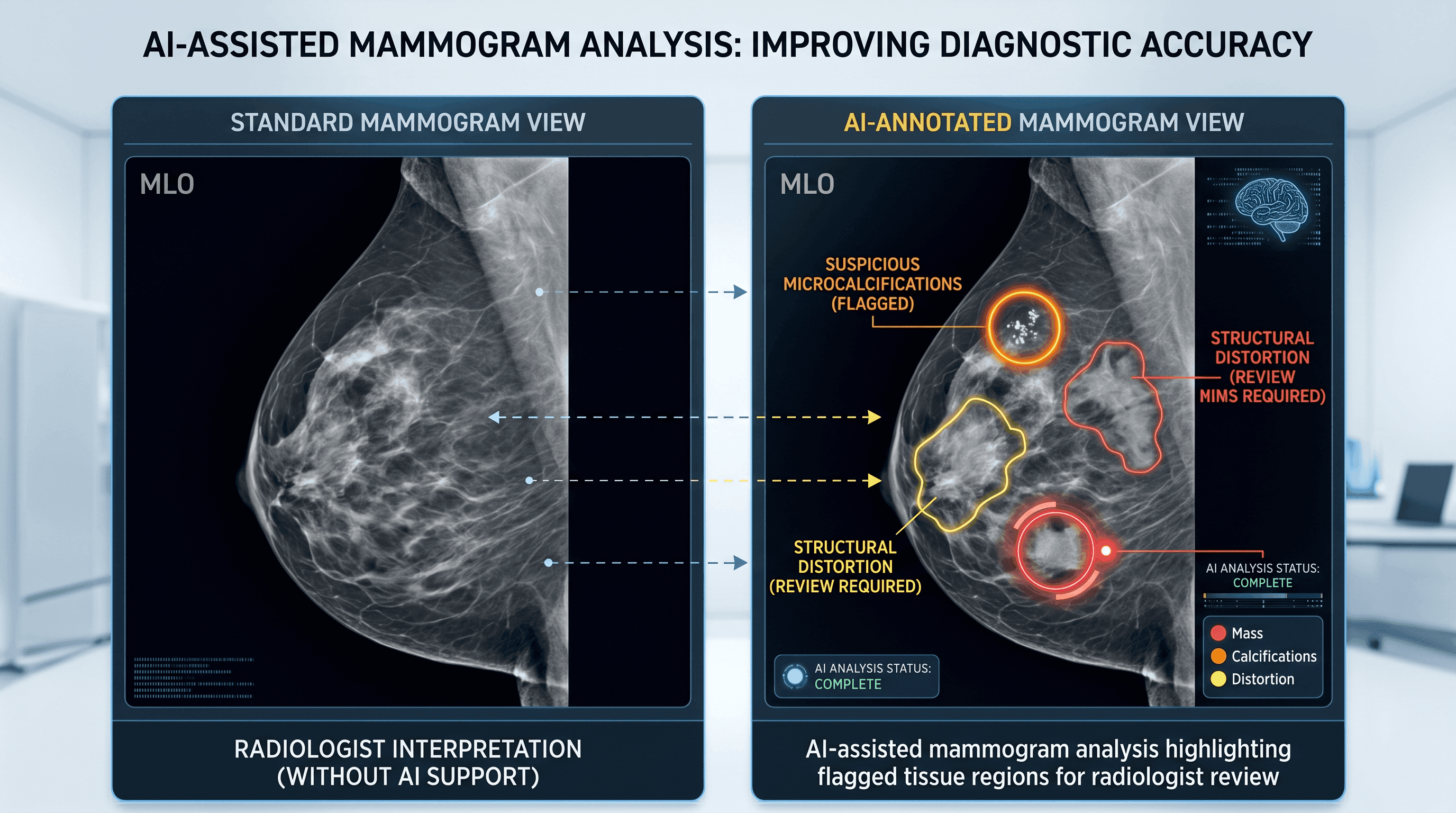
| Diagnostic imaging accuracy | AI mammogram evaluation approaches 99% accuracy in peer-reviewed studies |
| Ambient scribe impact | Reduced EHR documentation time by 13.4 minutes per encounter (JAMA, 2025) |
| FDA-cleared AI/ML devices | Approximately 950 cleared as of 2025 |
| Documentation reduction | Mass General Brigham reported a 60% cut in documentation time using AI copilot |
| Venture funding signal | AI-first companies captured 62% of digital health venture funding in H1 2025 (Rock Health) |
From "Digital Search" to "Digital Partner": What AI in Healthcare Actually Means in 2026
AI in healthcare has a working definition that keeps expanding. At its most basic, it covers rule-based clinical decision support tools that flag drug interactions or remind clinicians to order preventive screenings. At its most advanced, it describes agentic AI systems that autonomously coordinate care workflows across multiple departments without waiting for a prompt. Between those poles sit machine learning models for risk stratification, generative AI for clinical documentation, computer vision for medical imaging, and large language models powering patient-facing chat tools.
What unites all of these is the same underlying shift: healthcare organizations are moving from systems that store and retrieve information to systems that analyze, act on, and continuously learn from it.
According to an American Medical Association survey, 66% of US physicians now use at least one AI tool in their practice, compared to 38% just two years ago. That adoption curve reflects not just enthusiasm but practical pressure. Clinicians face rising patient volumes, staffing shortages, and documentation burdens that leave less time for the work only a human can do.
The $37.98 billion market in 2025 is not being driven by curiosity. It is being driven by organizations that have seen what happens when AI takes documentation burden off a physician, flags a sepsis case six hours earlier than a manual review would have, or prevents a denial by catching a missing code before a claim is submitted.
Diagnostic Precision and Medical Imaging
AI's most validated application in healthcare is diagnostic imaging, and the performance numbers are no longer incremental.
What AI Sees That Humans Miss
Computer vision models trained on millions of annotated scans can now identify mammographic anomalies with accuracy rates approaching 99%, according to peer-reviewed studies. AI-assisted colonoscopy tools have demonstrated a 50% reduction in missed polyp cases compared to unassisted procedures. In radiology, models like MedSAM-2 handle segmentation tasks across imaging modalities that previously required specialist review.
The AI medical imaging market itself reflects this confidence, growing from $1.67 billion to a projected $26.23 billion at a 34.8% compound annual growth rate. Companies like DeepMind, PathAI, and Qure.ai have moved from research pilots to clinical deployment in major health systems.
Predictive Analytics in Clinical Decision Support
Diagnostic AI extends beyond imaging into clinical decision support. Systems at institutions like UCSF now integrate national guidelines with local protocol data to generate real-time recommendations at the point of care. Predictive sepsis detection tools analyze vital signs, lab trends, and nursing notes together to flag deteriorating patients hours before traditional scoring systems would trigger an alert. Risk stratification models identify patients at high probability of hospital readmission, allowing care coordinators to intervene before a preventable return.
Ambient Clinical Intelligence: Giving Clinicians Back Their Time
Clinician burnout is one of the most documented crises in US healthcare, and a significant driver is documentation. A physician seeing twenty patients in a day may spend as much time writing notes as seeing patients. Ambient clinical intelligence, often called ambient scribes, addresses this directly.
How Ambient Scribes Work
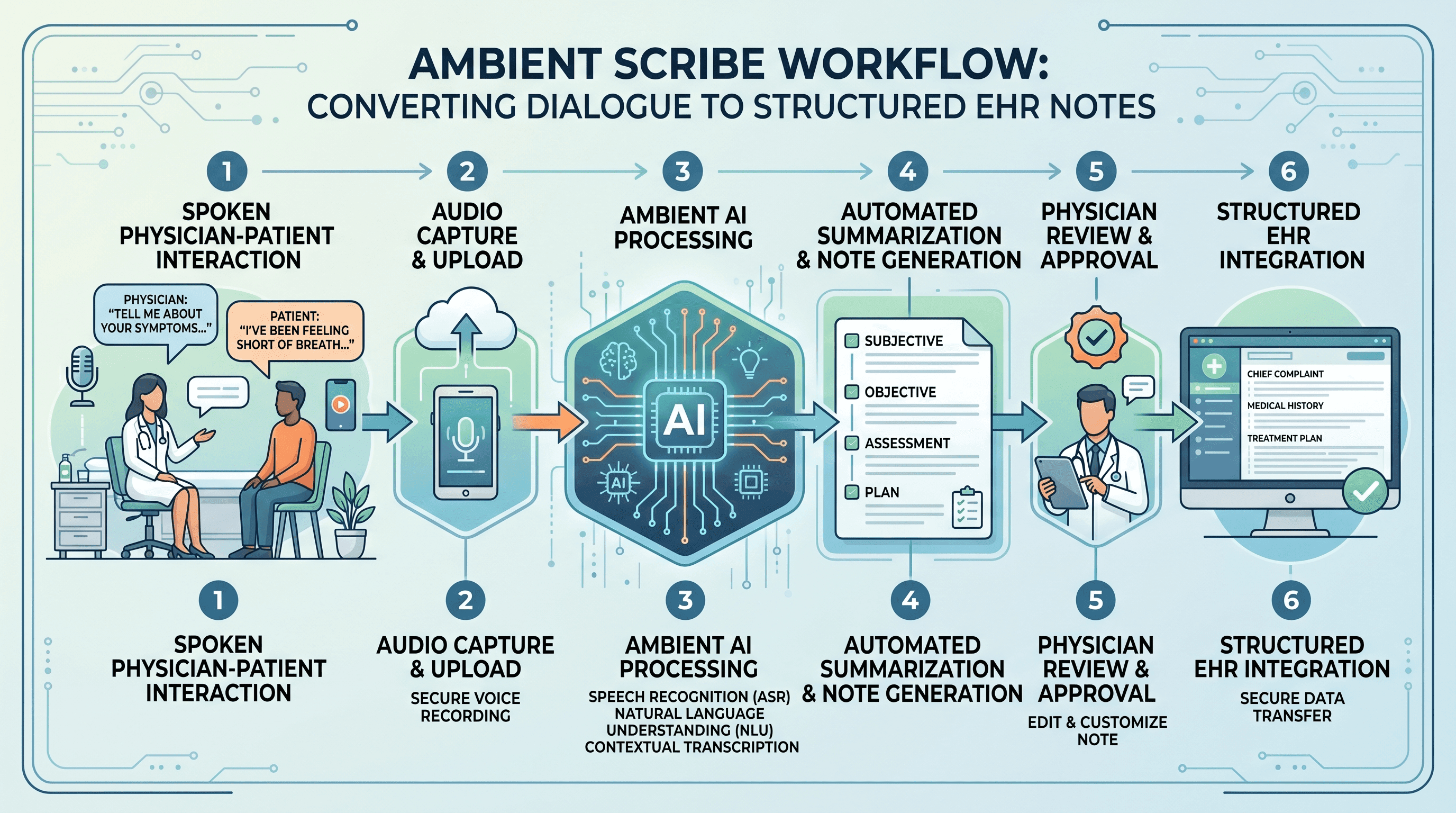
Ambient scribe tools use natural language processing to listen to the patient-physician encounter in real time and generate a structured clinical note automatically. The physician reviews and approves the note rather than dictating or typing it from memory. Tools like Dragon Copilot and Nuance's ambient documentation suite are deployed at scale across major health systems.
A 2025 JAMA multi-center study found that ambient scribes reduced EHR documentation time by 13.4 minutes per encounter and added approximately 0.49 additional patient visits per clinician per week. At scale, across a hundred-physician practice, that translates to meaningful capacity recovery and measurable revenue impact.
Automated Medical Coding and Revenue Cycle
The same natural language processing that generates clinical notes can also extract billing codes with high accuracy. Automated medical coding tools reduce the manual review burden on revenue cycle teams and catch omissions before claims reach payers. According to an IBM 2025 survey, 34% of healthcare executives are already using AI in revenue and budget cycle management, and 67% see the greatest near-term opportunity in payer-provider coordination.
Agentic AI in Care Coordination: The 2026 Frontier
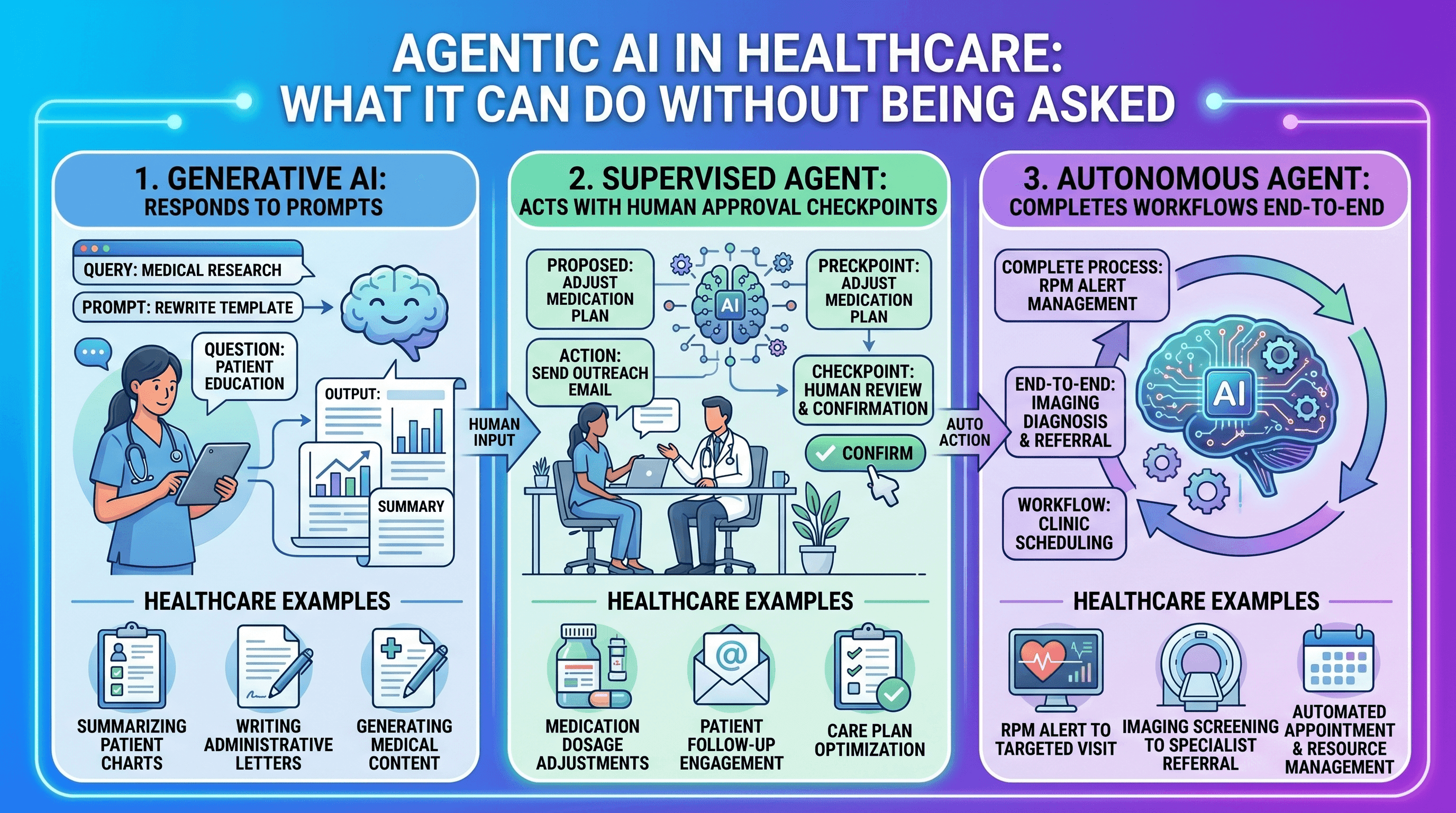
Of all the developments in healthcare AI, agentic systems represent the sharpest departure from what most people picture when they hear the term. A generative AI assistant responds when prompted. An agentic AI system takes initiative.
What Makes AI "Agentic"
Agentic AI operates on a spectrum of autonomy. At one end, a human-in-the-loop agent surfaces a recommendation and waits for approval. At the other, a fully autonomous agent completes a complex multi-step workflow without requiring a human to initiate or confirm each action. Most healthcare deployments in 2026 sit toward the middle of that spectrum, where agents handle routine orchestration tasks autonomously while escalating exceptions to a clinician or coordinator.
The distinction from generative AI matters practically. A generative model can draft a prior authorization letter when asked. An agentic system can monitor incoming orders, identify which ones require prior authorization, draft the supporting documentation, submit it to the payer, track the status, and flag denials for human review, all without a coordinator manually managing each step.
Real Agentic Deployments Already Running
The most frequently cited example in 2025 and 2026 is Amazon Connect Health, where one health system freed 630 hours per week from patient verification workflows after deploying an agentic system. Mayo Clinic's VoiceCare AI pilot integrates voice-activated agents into clinical workflows for order entry and documentation. Epic has released AI agents covering clinical assistance, scheduling, and after-visit summary generation. Atropos Health's Evidence Agent answers clinical questions by querying real-world data sources autonomously.
Mass General Brigham reported a 60% reduction in documentation time after deploying an AI copilot system. MUSC Health and Humana have both deployed agents in contact center operations, handling prior authorization and routine member inquiries at scale.
These are not pilot programs with carefully selected edge cases. They are production deployments handling high volumes of routine work, and they represent the direction the entire sector is moving.
Digital Twins and Precision Oncology: Personalizing Care at the Biological Level
Precision medicine has long been a goal in oncology. Digital twins are bringing it closer to clinical reality.
What a Digital Twin Is
A digital twin in healthcare is a virtual biological model built from a specific patient's genomic data, imaging results, biomarkers, and clinical history. Researchers and clinicians use it to simulate how that patient's body is likely to respond to a given treatment before that treatment is administered. In oncology, this means a care team can run a simulated chemotherapy regimen on a patient's digital model, observe the projected response, and adjust the protocol before the first dose is given.
This is not speculative. Clinical programs using digital twin methodologies are running at academic cancer centers, and the NIH has funded research into their validation and clinical utility. AI-driven precision oncology combines digital twin modeling with large-scale genomic databases to identify treatment pathways that population-level data alone would not surface.
Personalized Medicine Beyond Cancer
The same synthesis of genetic, lifestyle, and EHR data that powers precision oncology is being applied across chronic disease management. AI models now stratify cardiovascular risk at an individual level that goes beyond traditional Framingham-style scoring, incorporating wearable data, social determinants of health, and genomic markers. For patients managing conditions like diabetes alongside cardiovascular risk, this level of personalization changes what "evidence-based care" means in practice.
AI-Powered Drug Discovery: Compressing the Development Timeline
Drug discovery has historically been one of the most time-intensive and expensive processes in all of medicine. A single approved drug averages over a decade from target identification to market. AI is compressing that timeline in ways that were not technically feasible five years ago.
From Target Identification to Phase I in Under a Year
DeepMind's AlphaFold changed protein structure prediction permanently. Its database of predicted protein structures has been used by researchers across hundreds of drug development programs to identify binding targets and screen candidate molecules computationally. DSP-0038, a drug candidate for Alzheimer's disease, moved from AI-assisted target identification to Phase I clinical trial in under a year, a timeline that would have been considered impossible with conventional methods.
Industry analysts project that AI could reduce overall drug development costs by as much as 70% as these tools become standard across major pharmaceutical R&D pipelines. The mechanism is straightforward: computational simulation of molecular interactions replaces or substantially reduces the number of failed wet-lab experiments required to advance a candidate.
Predicting Clinical Trial Outcomes
AI is also being applied to clinical trial design and patient recruitment. Predictive models analyze historical trial data to identify patient populations with the highest probability of response, improving trial efficiency and reducing the time required to reach statistical significance. For rare diseases, where trial populations are inherently small, this capability has direct implications for how quickly treatments can reach approval.
The Ethics of "Black Box" AI and Data Privacy
The performance gains from AI in healthcare are real. So are the risks, and responsible deployment requires taking both seriously.
Algorithmic Bias and Health Equity
AI models trained on historically collected healthcare data inherit the biases present in that data. A model trained primarily on data from well-resourced academic medical centers may underperform for populations that were underrepresented in training datasets. Canada's 2025 regulatory watch list specifically flags algorithmic bias in clinical AI as a priority surveillance concern.
Mitigation is not just possible but increasingly standardized. Techniques include diverse and representative training datasets, regular auditing of model performance across demographic subgroups, and prospective monitoring for model drift as deployment populations shift over time. The framing matters: bias in healthcare AI is a solvable problem, not a permanent disqualifier.
Retrieval-Augmented Generation and Hallucination Prevention
Generative AI models can produce confident-sounding output that is factually incorrect. In a healthcare context, this risk is not theoretical. Retrieval-Augmented Generation (RAG) is the primary architectural approach for managing it. RAG-powered clinical support systems ground every response in a verified external knowledge base, such as clinical guidelines, drug databases, or peer-reviewed literature, before generating output. This substantially reduces the probability of hallucinated content while maintaining the fluency advantages of large language models.
HIPAA-Compliant Generative AI and FDA Oversight
Deploying AI in a US healthcare context requires navigating both HIPAA and FDA regulatory frameworks. HIPAA compliance for AI systems depends on proper data de-identification, business associate agreements with AI vendors, and audit logging for any system that processes protected health information. According to IBM's 2025 healthcare survey, 53% of healthcare executives identify cybersecurity as their greatest AI-related challenge.
The FDA has cleared approximately 950 AI and machine learning-enabled medical devices as of 2025. Procurement decisions for clinical AI tools should include verification of FDA clearance status and a clear understanding of what the clearance does and does not cover.
If you are managing a patient with cardiovascular conditions alongside any of these AI-assisted care pathways, it is worth understanding how hypertension, heart disease, and stroke interconnect, since AI risk stratification tools are frequently applied across this cluster of conditions.
The Limits: Keeping Humans in the Loop
AI can process data at a scale and speed no clinician can match. It cannot replace what a clinician brings to the room.
The 10-20-70 Rule in Practice
A useful operational framing for AI in healthcare is the 10-20-70 rule: roughly 10% of a healthcare workflow's success depends on having the right data, 20% on having the right algorithms, and 70% on the human processes, communication, change management, and clinical judgment that surround the technology. Organizations that deploy AI without addressing the 70% consistently underperform against their projected outcomes.
This is not a limitation unique to healthcare. It reflects how any complex system changes: technology enables, but humans execute. The AI systems generating the highest measurable ROI in healthcare are the ones designed from the start with clear human escalation pathways, robust staff training, and feedback loops that allow clinicians to flag errors and improve model performance over time.
Proven ROI: What the Data Says
Organizations that have moved from pilot to production report measurable returns. IBM's 2025 healthcare AI survey found that 77% of healthcare executives believe AI delivers clear, measurable competitive advantage. McKinsey's Q4 2024 survey found that 85% of healthcare leaders are exploring or actively adopting generative AI.
The returns tend to cluster in three areas: documentation time recovery (Mass General Brigham's 60% reduction), administrative workflow automation (Amazon Connect Health's 630 hours per week freed at one system), and diagnostic accuracy improvements that reduce downstream costs from missed or delayed diagnoses.
Only 3% of healthcare data is effectively used today, according to GE Healthcare and NIH estimates. The operational opportunity in the remaining 97% represents the clearest argument for continued investment.
If symptoms or health concerns come up during your organization's AI-assisted patient interactions, patients can connect with a primary care provider through Momentary's virtual care platform to get professional clinical guidance alongside the information AI tools can provide.
A Practical Implementation Roadmap for Healthcare Organizations
Starting an AI program is not primarily a technology problem. It is an organizational one.
Identify the Right Use Case First
The highest-probability path to a successful first deployment starts with high-impact, low-risk workflows. Scheduling optimization, insurance verification, prior authorization status tracking, and automated medical coding all offer measurable ROI with limited clinical risk. These use cases also generate clean performance data that makes the business case for expanding into higher-acuity applications.
Define KPIs before the pilot launches, not after. Organizations that retroactively try to measure success find it harder to demonstrate value and harder to course-correct when performance falls short of expectations.
The Governance Framework Every Deployment Needs
A functional AI governance framework for healthcare covers four areas. First, data pipeline requirements: what data the model needs, how it is cleaned and de-identified, and how access is controlled. Second, human-in-the-loop checkpoints: which decisions the AI can execute autonomously and which require human review or override capability. Third, change management and staff buy-in: clinician and administrator trust is the variable most likely to determine whether an AI deployment succeeds or fails at the organizational level. Fourth, monitoring for model drift: AI models trained on historical data can degrade as patient populations, documentation practices, and clinical protocols change over time.
McKinsey, Deloitte, and GE Healthcare have each published AI governance frameworks specifically for healthcare organizations. The common thread across all of them is that governance structure must be built before deployment, not treated as a remediation task when problems surface.
The Future of AI in Healthcare: 2026 and Beyond
Multimodal AI models that can simultaneously analyze imaging, genomic data, clinical notes, and wearable sensor streams are moving from research labs into early clinical deployment. Multi-agent coordination, where separate AI systems handling different departments share context and hand off tasks autonomously, represents the next operational frontier. The same pattern playing out in US academic medical centers is beginning to appear in global health contexts, where AI diagnostic tools are being deployed to extend specialist coverage in regions with limited access to trained clinicians.
The FDA's regulatory pipeline for AI-enabled devices will continue to grow. Health equity considerations are moving from an afterthought to a procurement criterion, as payers and regulators increasingly require evidence that AI systems perform consistently across demographic subgroups.
What is not changing is the fundamental relationship between the technology and the people using it. The health systems producing the best outcomes from AI investment are the ones that started with a clear problem, chose tools with verified performance data, built governance around human judgment, and treated adoption as an ongoing process rather than a go-live event.
To explore symptoms, understand a diagnosis, or get guidance on next steps before a clinical visit, use Momentary's AI health navigator for personalized, evidence-informed health information available any time.
Frequently Asked Questions
How is AI used in healthcare? AI in healthcare covers a wide range of applications including diagnostic imaging analysis, clinical decision support, ambient documentation (ambient scribes), drug discovery, predictive analytics for sepsis and readmission risk, revenue cycle automation, and agentic workflow coordination across administrative functions. Each application uses different underlying technology, from computer vision for imaging to large language models for documentation, but all share the goal of reducing error and improving efficiency in clinical and administrative settings.
What is agentic AI in healthcare, and how is it different from standard AI? Standard AI tools respond to prompts: a physician queries a model, and the model returns a recommendation. Agentic AI operates autonomously across multi-step workflows without requiring a human to initiate each step. In healthcare, agentic systems are being used to manage prior authorization workflows, coordinate discharge planning, handle patient scheduling, and monitor lab results for flagged values, all without a coordinator manually managing each task. The defining feature is end-to-end autonomous execution with human escalation built in for exceptions.
What are the biggest risks of AI in healthcare? The primary risks are algorithmic bias (models trained on non-representative data underperforming for specific patient populations), hallucination in generative AI outputs (AI producing confident but incorrect clinical information), data privacy and HIPAA compliance failures, and insufficient human oversight. All of these risks are manageable with the right governance framework, but they require deliberate design choices rather than default reliance on the technology's accuracy.
How does HIPAA apply to AI in healthcare? Any AI system that processes, stores, or transmits protected health information (PHI) must comply with HIPAA. This requires vendor business associate agreements, data de-identification standards for model training, access logging, and breach notification procedures. HIPAA-compliant generative AI typically uses de-identified or synthetic data for training and RAG-based retrieval systems that query PHI only within compliant environments. A healthcare organization's legal and compliance team should review any AI vendor contract before deployment.
What is the ROI of AI in healthcare? Measured returns vary by use case. Documentation tools like ambient scribes consistently show time savings of 10 to 15 minutes per patient encounter and capacity increases of roughly half a patient visit per clinician per day. Agentic administrative tools have freed hundreds of staff hours per week in documented case studies. According to IBM's 2025 survey, 77% of healthcare executives report that AI delivers measurable competitive advantage, and McKinsey found 85% of healthcare leaders actively exploring or adopting generative AI, reflecting broad confidence in the business case.
Can AI replace a physician? No. AI can outperform physicians on specific narrow tasks, such as screening a mammogram for a particular type of anomaly, but it cannot replace the clinical judgment, communication skills, ethical reasoning, or relational capacity that define physician practice. The most effective AI deployments in healthcare treat the technology as a tool that handles high-volume, pattern-recognition tasks so that clinicians can spend more time on the work that requires human presence.
References
- American Medical Association (AMA) — 2025 physician AI adoption survey: 66% of US physicians using AI tools, up from 38% in 2023.
- JAMA — Ambient Scribes Study (2025) — Multi-center study reporting 13.4-minute reduction in EHR documentation time per encounter and 0.49 additional patient visits per clinician per week.
- DeepMind — AI Co-Clinician — Overview of AI diagnostic applications and DeepMind's clinical AI development.
- NIH / PubMed — Digital Twins in Healthcare — Research on digital twin methodologies and clinical validation in oncology and personalized medicine.
- NIH / PubMed — AI in Clinical Decision Support — Peer-reviewed research on AI-assisted clinical decision support systems and predictive analytics.
- NIH / PMC — Machine Learning in Healthcare — Review of machine learning applications across diagnostic and administrative healthcare settings.
- NEJM — AI in Medicine — New England Journal of Medicine editorial and research series on AI clinical applications and governance.
- Johns Hopkins — AI in Healthcare: Applications and Impact — Overview of AI applications and their measured clinical and operational impact.
- Google Cloud — AI in Healthcare — ROI and implementation case studies for AI in healthcare operations and clinical workflows.
- WHO — Harnessing Artificial Intelligence for Health — Global guidance on AI deployment, health equity, and governance frameworks in healthcare settings.


