


Medicine has spent the last century building its greatest strength around population averages. A drug works in 60% of patients, so it gets prescribed to all of them. A dosing guideline fits most adults, so it becomes the standard. That approach saved millions of lives. But it also left millions more cycling through treatments that were never quite right for their biology, their genes, or their lives.
AI personalized medicine represents the most significant departure from that model in modern clinical history. By the time a patient sits across from a physician in 2026, AI systems have already processed layers of data that were previously impossible to synthesize together: genetic variants, protein expression, microbiome composition, wearable biometrics, and electronic health record history. The result is not a smarter average. It is, increasingly, a treatment plan built for one person.
This article explains what AI personalized medicine looks like in practice today, what technologies are driving it, where it genuinely works, and where real limitations remain.
At a Glance
| Topic | Key Facts |
|---|---|
| What it is | AI-driven care that tailors treatment to an individual's genomic, clinical, and lifestyle data |
| Core technologies | Digital Human Twins, agentic AI, pharmacogenomics, multi-omics integration, wearable sensing |
| Where it works now | Oncology, pharmacogenomics, diabetic retinopathy screening, rare disease diagnosis |
| Key limitation | Algorithmic bias, explainability gaps, and uneven access |
| Regulatory context | 38% of FDA new drug approvals in 2024 were personalized medicines |
| Patient access | Expanding but uneven; some tools consumer-accessible, others require academic medical centers |
From "Population" to "Individual" Health
Personalized medicine in the AI era means that treatment is shaped by who a patient is at the molecular, physiological, and behavioral level, not by which category they fall into.
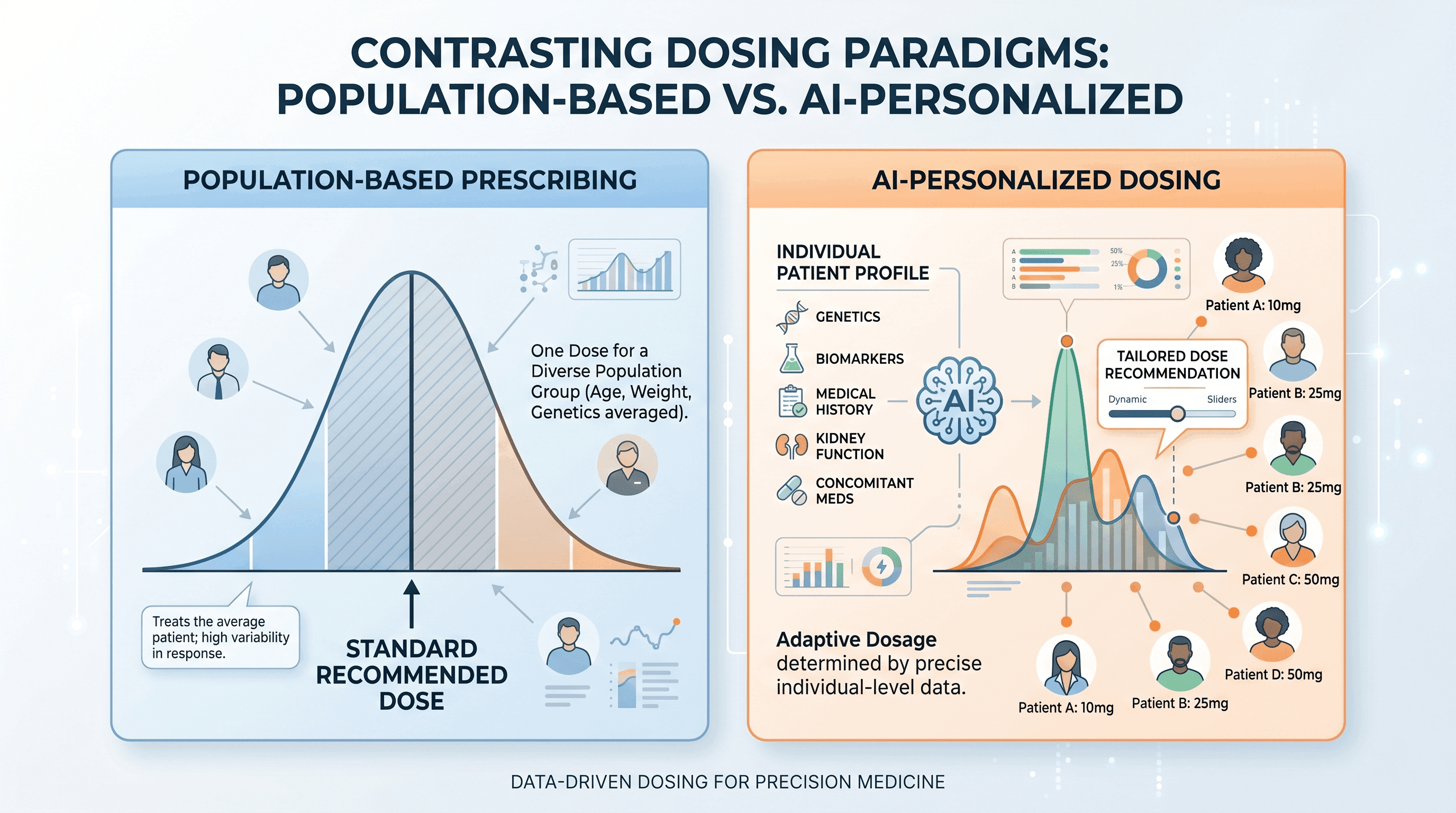
Traditional medicine groups patients by diagnosis. A person has Type 2 diabetes, so they follow the Type 2 diabetes management protocol. A person has depression, so they try an SSRI. The problem is that both of these disease labels contain enormous biological heterogeneity. Two patients with the same diagnosis can have completely different underlying mechanisms, and what works powerfully for one may do nothing for the other.
The numbers behind this mismatch are significant. According to the NIH, most drugs are effective in only 30 to 50% of patients who take them, depending on the condition. Adverse drug reactions account for more than 100,000 deaths in the United States annually and contribute to over 700,000 emergency department visits each year. These are not rare edge cases. They are the predictable cost of prescribing to an average that no single patient actually represents.
AI changes the underlying logic of the clinical question. Instead of asking "what works for people with this diagnosis," an AI system trained on genomic and clinical data asks "what will work for this patient, given these specific variants, this metabolic profile, and these comorbidities." The distinction sounds subtle. The clinical outcome difference is not.
"Precision medicine offers the promise of better outcomes for all patients by enabling us to deliver the right treatment to the right patient at the right time." National Institutes of Health
Digital Human Twins (DHT)
The concept of a digital twin originated in aerospace engineering, where manufacturers would build a virtual replica of a physical system to run simulations without touching the real thing. Clinical medicine has adapted this framework in a way that may be its most transformative application yet.
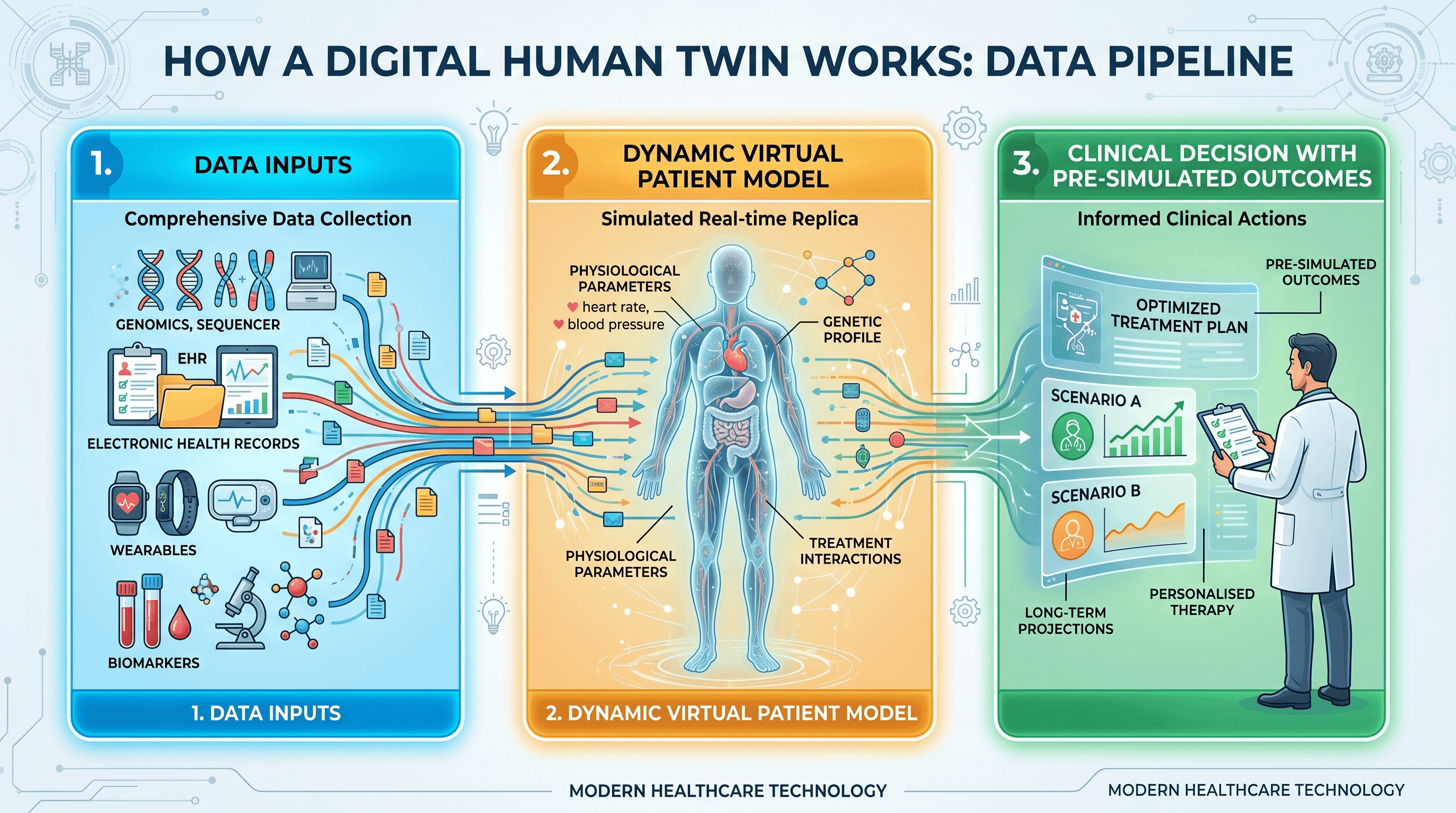
A Digital Human Twin (DHT) is a dynamic computational model of an individual patient's physiology, built from their genomic data, biomarkers, imaging, clinical history, and real-time physiological signals. The model is not static. It updates continuously as new data arrives, reflecting how the patient's biology actually changes over time.
The practical implication is that a DHT allows clinicians to run what-if scenarios in a digital environment before applying them to a patient. A cardiologist considering two different medication regimens for a patient with heart failure and a specific genetic variant can observe how each option performs within the model before committing to either. An oncologist can simulate how a particular chemotherapy protocol is likely to affect a tumor's genomic architecture, and whether resistance is likely to develop, without exposing the patient to the drug first.
According to a 2025 review published through Springer Nature, digital twin technology in personalized medicine is advancing rapidly from theoretical frameworks to active clinical pilots, with early applications in oncology, cardiology, and metabolic disease management showing particular promise. The review notes that federated learning approaches are increasingly used to build richer twin models while preserving patient data privacy across institutions.
In silico clinical trials, sometimes called virtual clinical trials, are an adjacent application. Rather than recruiting a cohort of real patients to test a dosing hypothesis, researchers use computational models to simulate thousands of virtual patients with varying genetic and physiological profiles. This approach compresses timelines, reduces cost, and can identify subgroup-specific risks before a single real participant is enrolled.
The limitation worth naming honestly: DHTs are computationally intensive, require deep integration across data systems that many hospitals still keep siloed, and are currently available mainly through academic medical centers and specialized research programs. Consumer access to DHT-based care planning is limited in 2026. That is changing, but slowly.
Agentic AI in Care Planning
The transition from AI as a passive analytical tool to AI as an active participant in care coordination represents one of the sharpest shifts in clinical AI since the technology entered healthcare.
Agentic AI refers to systems capable of autonomous, multi-step action in pursuit of a defined goal. In a traditional clinical AI model, the system surfaces a recommendation, and a human decides what to do with it. In an agentic model, the AI can take sequential actions: read a lab result, compare it against a pharmacogenomic profile, identify that a medication adjustment is indicated, update the patient's electronic health record, notify the prescribing physician, and flag the pharmacist simultaneously, all without waiting for a human to initiate each step.
A 2025 analysis published in ScienceDirect describes the emergence of agentic AI architectures in healthcare as a fundamental shift in how AI moves from decision support to workflow execution, with early deployments focused on chronic disease management, post-discharge monitoring, and medication reconciliation.
From a patient perspective, this means care that does not fall silent between appointments. An agentic AI monitoring a patient with atrial fibrillation can identify early signal changes in wearable data overnight, cross-reference them against the patient's medication schedule and recent lab values, and prepare a clinical summary for the care team before the patient has called the office. A patient managing a complex oncology regimen does not wait three days for someone to notice that two of their medications now interact with a newly reported genomic variant.
The governance question here is not trivial. When an AI system can act autonomously, the question of what it is permitted to do without explicit human approval becomes both clinically and ethically important. Current frameworks generally position agentic AI within a supervised autonomy model: the system executes defined actions within a scope approved by the overseeing clinician, and escalates anything outside that scope for human review. Full autonomy in clinical decision-making remains outside what responsible deployment looks like in 2026.
Pharmacogenomics and AI Drug Response Prediction
For decades, prescribing a psychiatric medication meant starting a patient on the most commonly tolerated first-line agent and waiting four to six weeks to find out whether it worked. If it did not, the process restarted. For patients managing depression or anxiety or bipolar disorder, this trial-and-error cycle is not just inefficient. It can cause real harm.
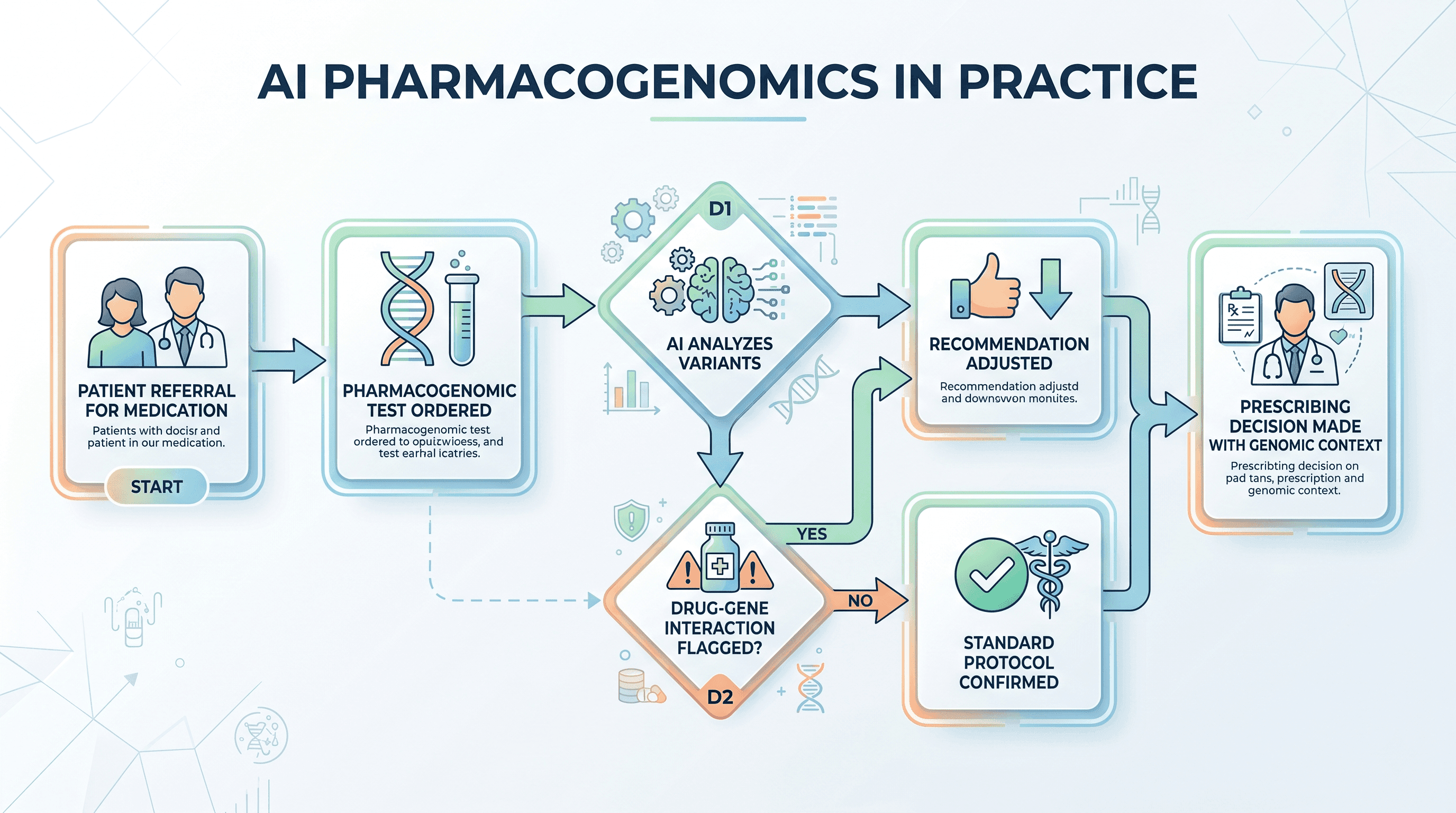
Pharmacogenomics is the study of how an individual's genetic makeup affects their response to drugs. AI pharmacogenomics applies machine learning to predict, from a patient's genomic data, how they will metabolize a specific medication, whether a standard dose will produce a therapeutic effect or a toxic one, and which drug within a class is most likely to work.
According to the NIH National Library of Medicine, genetic variation in drug-metabolizing enzymes is one of the most clinically significant sources of individual drug response differences, with variants in genes like CYP2D6, CYP2C19, and CYP2C9 affecting the metabolism of hundreds of commonly prescribed medications including antidepressants, antipsychotics, anticoagulants, and pain medications.
Platforms like GeneSight perform pharmacogenomic testing for psychiatric and neurological medications and use AI to match results to specific medication recommendations. Color Health offers broader genomic screening with clinical integration. These tools are increasingly accessible to patients through primary care referrals, and some insurers cover testing for specific indications.
The "right dose, right time, right patient" principle that has long been an aspiration of clinical medicine is now, in a meaningful number of cases, operationally achievable. A patient with a CYP2D6 poor metabolizer status does not need to experience codeine toxicity or SSRI non-response before a clinician learns that standard dosing was never appropriate for their biology.
The Precision Oncology Revolution
Cancer treatment has been the flagship application of AI personalized medicine, and for good reason. Oncology is a domain where molecular heterogeneity is not a complication but a defining feature. Two patients with "breast cancer" may have tumors driven by completely different genetic mechanisms, requiring completely different treatments.
AI-powered tumor profiling reads the genomic, epigenomic, and transcriptomic signature of a patient's cancer and maps it against a database of known variants, biomarkers, and treatment responses to identify the targeted therapies most likely to be effective. This approach has moved from research settings into clinical practice at a meaningful scale.
A PubMed-indexed review covering precision oncology platforms published in 2025 notes that machine learning models now demonstrate reliable performance in identifying clinically actionable biomarkers from both next-generation sequencing data and standard pathology imaging, with platforms progressively reducing the infrastructure barrier for community oncology practices that lack specialist genomics labs.
Platforms applying machine learning to standard pathology slides to identify biomarkers represent an important equity advance: they can extend access to biomarker-guided oncology to community hospitals that do not have the infrastructure for comprehensive genomic profiling. A patient at a regional cancer center should not have a less molecularly informed treatment plan than a patient at a major academic medical center.
Liquid biopsy technologies that detect circulating tumor DNA in blood are another AI-driven advance in precision oncology, enabling earlier detection of recurrence and real-time monitoring of treatment response without requiring repeated tissue sampling.
The FDA has approved multiple companion diagnostics paired with targeted therapies, reinforcing that precision oncology biomarkers are not experimental adjuncts but a regulatory and clinical standard of care in specific cancer types. In 2024, 38% of FDA new molecular entity approvals were for personalized medicines, the highest proportion on record.
Functional Genomics and Protein Folding
Understanding why a genetic variant causes disease requires knowing what it does to the protein that gene encodes. For most of the history of molecular biology, determining a protein's three-dimensional structure from its amino acid sequence required years of experimental work. AlphaFold changed that.
AlphaFold, developed by DeepMind and now in its third generation, uses deep learning to predict 3D protein structures with accuracy that rivals experimental methods. For personalized medicine, this matters because disease-associated genetic variants often work by distorting protein structure, disrupting binding sites, or creating new ones. AI protein structure prediction allows researchers and clinicians to assess not just whether a variant is present, but what it is likely to do at the molecular level.
This has direct implications for drug design. If a patient carries a variant that changes the shape of a specific binding site, AI can identify that structural change and evaluate which drug candidates are most likely to bind effectively to the altered form. Drug development that previously required years of trial-and-error synthesis can now be guided by AI-generated structural models.
A 2024 PMC publication on multi-omics and AI-driven drug response prediction describes how integrating protein structure prediction with transcriptomic and metabolomic data creates a more complete picture of disease mechanism than genomics alone, enabling drug response predictions that account for both the variant's presence and its functional consequence.
For patients, the near-term clinical application is primarily in rare disease diagnosis and in oncology, where functional variant interpretation informs treatment selection. The longer horizon includes AI-designed drugs targeted to individual patient variants, a model already advancing in clinical trial settings.
Passive Sensing and Real-Time Biometric Tracking
The clinic visit captures a patient at one moment in time. Chronic disease is not a snapshot. It is a trajectory shaped by sleep, stress, activity, nutrition, inflammation, and dozens of other variables that fluctuate continuously and are invisible in a standard quarterly check-in.
AI integration of continuous wearable data into clinical care closes a significant gap. Devices tracking heart rate variability, sleep architecture, blood glucose trends, physical activity, and SpO2 now feed into AI models capable of identifying patterns that predict clinical events before they become emergencies.
In cardiac care, AI systems connected to continuous ECG monitors can identify atrial fibrillation episodes and arrhythmia precursors with sensitivity that exceeds standard clinical surveillance. AI-connected insulin delivery systems in diabetes management use continuous glucose monitor data to adjust insulin dosing in real time, approaching a closed-loop artificial pancreas model that dramatically reduces both hypoglycemic and hyperglycemic excursions.
According to a 2025 paper on agentic AI in personalized care frameworks, the integration of real-time biometric data streams with AI models capable of dynamic treatment adjustment represents a shift from episodic care to continuous care, with early evidence of improved outcomes in heart failure monitoring, post-surgical recovery, and chronic pain management.
Proactive alerts for conditions like early sepsis signals, autoimmune flare precursors, and hypertensive urgency are active areas of clinical development. The challenge is not primarily technological. It is the integration of wearable-sourced data into clinical workflows in a way that generates actionable signals without overwhelming care teams with noise.
For patients who want to begin understanding their own health data in the context of their symptoms and conditions, connecting with a care provider is a meaningful first step. You can see a doctor online through Momentary's virtual primary care service to discuss how your wearable data and health history might inform a more personalized approach to your care.
The Limits: The Human at the Center of the Data
A complete account of AI personalized medicine requires a clear-eyed look at where it falls short. The hype cycle in health AI tends to outpace clinical deployment by several years, and patients deserve an honest picture.
Algorithmic Bias and Health Equity
AI models learn from historical data, and historical data in medicine reflects historical inequities. Training datasets for many foundational clinical AI models have been disproportionately derived from patients of European ancestry at large academic medical centers. When those models are applied to patients from underrepresented populations, their predictive performance is measurably lower.
A 2025 review published in PMC examining multi-omic AI models notes that dataset diversity is one of the most pressing methodological challenges in the field, with bias in training cohorts producing systematic underperformance for populations with less representation in genomic reference databases.
This is not a minor technical footnote. In pharmacogenomics, a model trained predominantly on European-ancestry data may miss clinically significant variants that are more common in West African, East Asian, or South Asian populations. In oncology, biomarker prevalence and drug response profiles differ across ancestral backgrounds in ways that require diverse training data to capture accurately.
Responsible inclusive dataset design, federated learning approaches that pool data across diverse institutions without centralizing patient records, and explicit equity audits of AI model performance across demographic subgroups are all active areas of development. They are also areas where the gap between current practice and what is needed remains wide.
The Explainability Problem
When an AI model recommends against a particular chemotherapy regimen for a patient, the clinician and patient need to understand why. Not as a general statement that "the model analyzed genomic and clinical data" but as a specific, interpretable explanation of which features drove the recommendation and how.
Many high-performing AI models in medicine are deep learning architectures that do not generate interpretable explanations by default. This "black box" quality creates real problems for clinical trust, for informed consent, and for identifying when a model is wrong.
Explainable AI (XAI) refers to a class of approaches designed to make model reasoning interpretable to humans without sacrificing predictive performance. Methods like SHAP values, attention visualization in transformer models, and counterfactual explanation frameworks are being integrated into clinical AI tools at an increasing rate. The FDA's framework for AI/ML-based software as a medical device increasingly expects explainability as a component of clinical deployment.
The practical state in 2026 is that explainability has improved meaningfully but remains incomplete in the highest-stakes applications. Clinicians using AI tools in oncology and pharmacogenomics are generally working with systems that provide feature importance alongside recommendations, even if the full reasoning chain is not transparent.
The 10-20-70 Rule
A widely cited framework in enterprise AI implementation holds that the technical component of AI success represents roughly 10% of the challenge, organizational infrastructure accounts for approximately 20%, and people and process change accounts for the remaining 70%. Healthcare AI personalization is not an exception to this pattern.
The most sophisticated genomic AI platform does not improve patient outcomes if clinicians are not trained to interpret and act on its outputs, if EHR integration means results sit in a separate portal no one checks, or if patients do not have access to genetic counseling to contextualize their pharmacogenomic test results. The human systems that translate AI outputs into clinical decisions are as determinative as the algorithms themselves.
Final ethical and clinical decisions remain a human responsibility. AI systems in personalized medicine are designed to expand what clinicians can know and consider, not to replace the judgment that integrates that knowledge with a patient's values, circumstances, and preferences.
What Comes Next: The Near-Future Horizon
The trajectory of AI personalized medicine over the next three to five years points toward deeper integration, broader access, and new capabilities that are already visible in research pipelines.
Federated learning will expand the diversity and scale of training data available to clinical AI models without requiring institutions to share raw patient data, addressing both privacy concerns and the cross-institutional data access barriers that currently limit model performance. Multi-institutional consortia applying federated approaches to genomic and clinical data are already producing models with stronger generalizability than single-center studies.
The convergence of wearables, genomics, and large language models is creating a new class of AI health tools capable of integrating continuous biometric data with genomic context and communicating findings in plain, patient-accessible language. This is the foundation of what patient-centric AI algorithms are increasingly designed to deliver: not just a recommendation for the clinician, but an explanation the patient can understand and act on.
Digital Human Twins will move from academic pilots toward broader clinical deployment, starting in high-acuity domains like oncology and cardiac care before expanding into chronic disease management. As computational costs fall and data integration infrastructure matures, the patient population with access to twin-based clinical planning will grow substantially.
AI companions for chronic disease management, functioning as continuous between-visit support tools that monitor symptoms, reinforce adherence, and flag concerns to care teams, are advancing from early pilots into broader deployment. Their role is not to replace the care relationship but to extend its continuity into the daily life of patients managing conditions that do not pause between appointments.
If you want to understand how these technologies may be relevant to your own health situation, you can explore your symptoms and health questions with Momentary's AI health navigator to get personalized guidance on what steps to consider next.
Frequently Asked Questions
What is personalized medicine in AI?
AI personalized medicine uses machine learning and other AI approaches to tailor medical treatment to an individual patient based on their specific genomic, clinical, lifestyle, and biological data, rather than applying population-level treatment guidelines uniformly. It encompasses pharmacogenomics, precision oncology, digital human twins, and AI-driven clinical decision support systems that synthesize data layers a human clinician could not integrate manually.
What can AI be used for in medicine?
AI is used across a broad range of medical applications including diagnostic imaging analysis, pharmacogenomic testing and drug-matching, tumor biomarker profiling, clinical decision support, predictive modeling for disease risk, real-time patient monitoring through connected wearables, protein structure prediction for drug design, and electronic health record analysis. In personalized medicine specifically, AI serves as the computational engine that makes it possible to act on multi-omic data at the individual patient level.
What are the 4 types of AI?
The four commonly cited types of AI are reactive machines (which respond to inputs without memory or learning), limited memory AI (which learns from historical data to inform current decisions, the type used in most clinical AI tools today), theory of mind AI (a still-theoretical category concerned with understanding mental states), and self-aware AI (a hypothetical future category). Clinical and personalized medicine applications currently operate within the limited memory category, using machine learning and deep learning models trained on large datasets to generate predictions and recommendations.
What does personalized medicine mean?
Personalized medicine, also called precision medicine, refers to a medical approach that tailors prevention, diagnosis, and treatment to the individual patient based on their unique biological, genetic, environmental, and lifestyle characteristics. Rather than applying a single treatment protocol to all patients with a given diagnosis, personalized medicine aims to identify what will work best for a specific person. AI enables personalized medicine at scale by making it computationally feasible to integrate and act on the complex, multi-layered data required to make genuinely individualized clinical decisions.
Is AI personalized medicine accessible to regular patients today?
Access is expanding but remains uneven. Consumer-accessible tools include direct-to-patient pharmacogenomic testing through platforms like GeneSight and Color Health, AI-powered continuous glucose monitoring and insulin delivery systems, AI-enhanced cardiac rhythm monitoring through wearables, and AI health navigation tools. Capabilities like Digital Human Twin-based treatment simulation, comprehensive multi-omic profiling, and AI-guided rare disease diagnosis are primarily available through academic medical centers and specialized research programs. Cost and insurance coverage remain significant access barriers for many genomic and AI-guided diagnostic services.
What role does health equity play in AI personalized medicine?
Health equity is one of the central challenges in clinical AI deployment. Many AI models have been trained on datasets that underrepresent non-European ancestries and lower-income populations, producing models that perform less accurately for those groups. Addressing this requires deliberately diverse training datasets, equity audits of AI model performance across demographic subgroups, and equitable access to the tools and testing that AI personalized medicine depends on. The promise of personalized medicine is only realized equitably if its benefits are distributed across patient populations rather than concentrated among those who already have the most clinical access.
References
-
Relling MV, Evans WE. Pharmacogenomics in the clinic. Nature. 2015. — Cited for statistics on drug efficacy rates across populations and the clinical significance of pharmacogenomic variation.
-
Artificial Intelligence in Personalized Medicine. PubMed. — Cited for the role of machine learning in identifying actionable oncology biomarkers and advancing community access to precision cancer care.
-
Agentic AI frameworks in personalized care. PubMed. — Cited for the integration of real-time biometric data streams with AI treatment adjustment models and outcomes evidence in chronic disease monitoring.
-
Multi-omics and AI-driven drug response prediction. PMC. — Cited for the role of multi-omic integration in drug response prediction and for bias in training cohort data as a challenge in AI personalized medicine.
-
Digital twins in personalized medicine: frameworks and clinical applications. Springer Nature. — Cited for the state of digital twin technology in clinical settings and federated learning applications.
-
Agentic AI in healthcare workflows. ScienceDirect. — Cited for the characterization of agentic AI's shift from decision support to workflow execution in clinical environments.


