


Modern telehealth is no longer a video call with a doctor. AI telemedicine in 2026 functions more like a continuously active care layer — one that monitors, anticipates, documents, and coordinates across the full care continuum. For healthcare leaders evaluating adoption, the question has shifted from "should we use AI?" to "which capabilities are ready to deploy, and at what organizational cost and benefit?"
This guide breaks down the eight most consequential AI telemedicine capabilities shaping clinical operations right now, with evidence-backed detail on outcomes, governance requirements, and implementation realities.
At a Glance
| Topic | Key Facts |
|---|---|
| AI telemedicine market trajectory | Projected to grow from $27B (2024) to $156B+ by 2030 |
| Physician AI adoption | 66% of U.S. physicians report using AI tools (AMA, 2025), up from 38% in 2023 |
| Fastest-growing AI telemedicine segment | Remote patient monitoring (RPM), CAGR ~38.4% |
| Top operational benefit | 4 to 6 hours of documentation time saved per clinician per week |
| Core governance principle | Human-in-the-loop: AI prepares, clinician decides |
| Regulatory milestone | FDA issued updated guidance in January 2026 reducing oversight for low-risk AI health software |
The Shift from Reactive to Proactive Care
Traditional telemedicine solved one problem well: access. A patient in a rural county with no nearby specialist could see one from their living room. That was meaningful progress.
But access alone did not change the underlying care model. Patients still had to know they were sick. They still had to book an appointment. The system remained reactive, designed to respond to health problems once patients recognized and reported them.
AI telemedicine changes that equation. The 2026 model operates as an always-on surveillance and coordination layer, analyzing continuous streams of biometric data, flagging risk signals before symptoms surface, preparing the clinical encounter before it begins, and following up after the clinician signs off. A patient with poorly controlled Type 2 diabetes does not wait for a quarterly check-in to learn their glucose is trending upward overnight. Their RPM-connected AI flags the pattern, their care coordinator receives an alert, and the telehealth visit is scheduled before an emergency department visit becomes necessary.
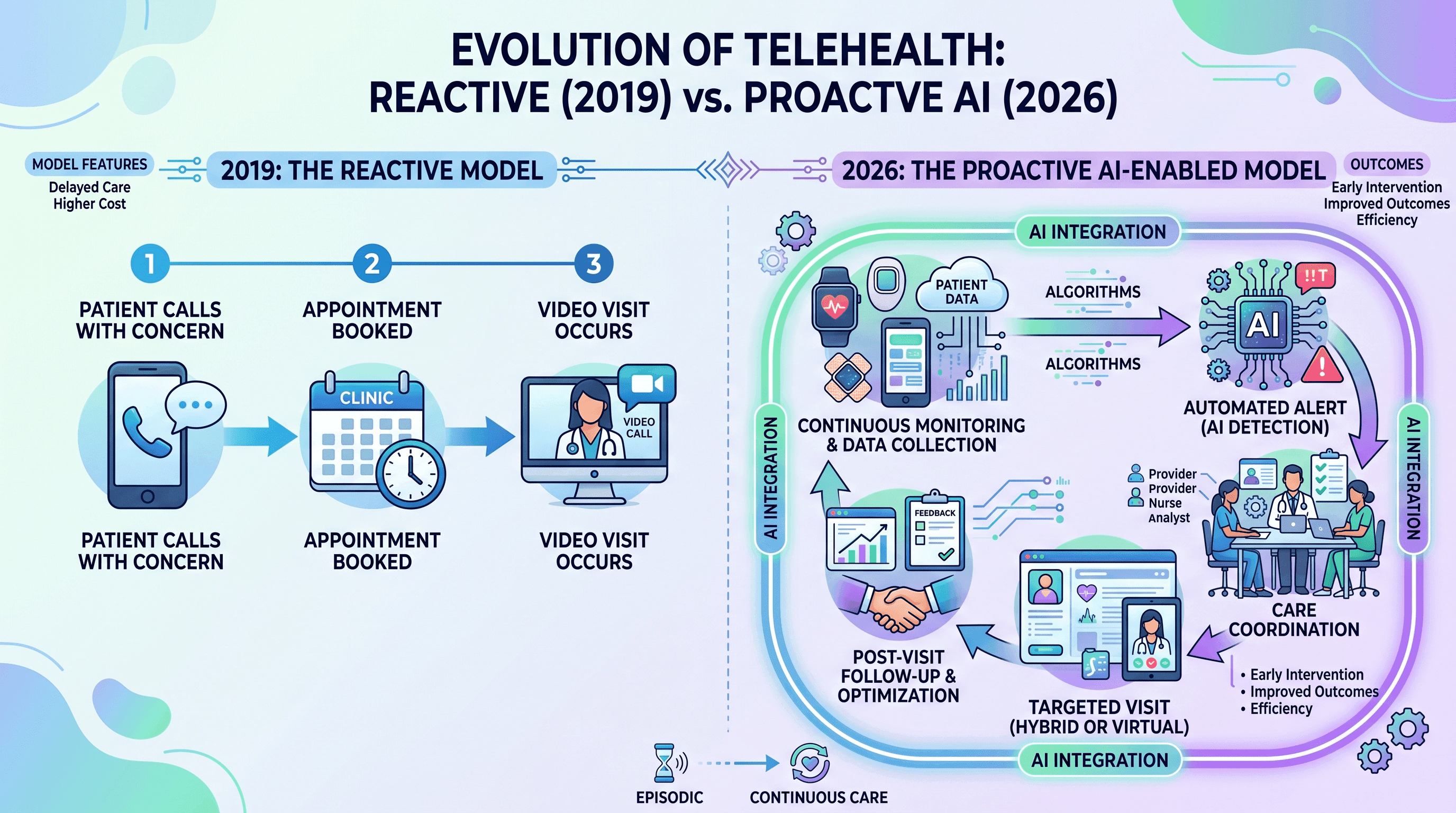
According to a 2025 analysis published in Nature Scientific Reports, AI-assisted telehealth systems demonstrated measurable improvements in early detection of high-risk deterioration compared to standard virtual care workflows. The shift from reactive to proactive care is not a future aspiration. It is a deployment decision available to health systems today.
Agentic AI and Virtual Nursing
The single most significant structural change in AI telemedicine heading into 2026 is the emergence of agentic AI — systems that do not merely answer questions but act on goals across multiple steps without human prompting at each stage.
In a clinical context, an AI agent might receive a patient's pre-visit intake form, retrieve the relevant sections of their EHR, cross-reference current medications against the reason for the visit, flag any contraindications, generate a structured clinical summary, and deliver it to the clinician two minutes before the telehealth session begins. None of those steps require a human hand-off between them.
This capacity directly addresses one of telehealth's most persistent problems: physician cognitive overload. According to the American Medical Association's 2025 Digital Health Survey, 66% of U.S. physicians now report using AI tools in their practice, up from 38% in 2023. Yet adoption has not uniformly reduced burnout, because many early AI tools added data-entry tasks rather than eliminating them.
Agentic AI systems integrated into virtual nursing workflows solve this differently. Rather than presenting a clinician with more information, they present the right information in the right sequence at the right moment. Virtual nursing agents handle medication reconciliation reminders, post-discharge follow-up calls, care gap identification, and appointment scheduling. Studies reviewed in Frontiers in Digital Health research on AI in telehealth* describe multi-agent systems capable of coordinating discharge planning, medication adherence monitoring, and specialist referral management within a single asynchronous workflow.
For a health system running 500 virtual visits per day, this means clinicians spend the hour with the patient — not the 20 minutes before it preparing and the 15 minutes after it documenting.
Decision-maker scenario: A regional health network with three virtual care coordinators managing 2,400 monthly telehealth encounters introduces an agentic pre-visit AI. Within 90 days, average preparation time per encounter drops from 18 minutes to 4 minutes. The same coordination team now manages 4,100 monthly encounters without adding headcount.
Remote Monitoring and Wearable Integration
Call it the Continuous Clinic. Remote patient monitoring (RPM) powered by AI does not just record biometric data from wearables. It interprets that data against population-level baselines and individual historical trends to surface what epidemiologists call "latent signals" — physiological changes that precede a clinical event by hours or days.
The clearest example is cardiovascular. An AI-connected wearable analyzing heart rate variability, blood pressure patterns, and activity data can detect early indicators of atrial fibrillation or heart failure decompensation before the patient feels symptoms. Research from the Mayo Clinic has documented AI-driven RPM models that identify high-risk cardiac patients days before deterioration, enabling telehealth intervention that reduces 30-day readmission rates measurably.
RPM is the fastest-growing segment of AI telemedicine. The global remote patient monitoring market is projected to grow at a compound annual growth rate of approximately 38.4% through 2030, according to MarketsandMarkets analysis of the AI telehealth sector.
For chronic disease populations — diabetes, hypertension, COPD, heart failure — the value proposition is unusually direct. An AI RPM system monitoring a patient with uncontrolled hypertension does not replace the clinician's judgment. It gives the clinician something they did not have before: a real-time, continuous view of how the patient's body is performing between appointments. That data, surfaced through a telehealth visit, allows treatment adjustments based on actual behavior rather than a single office measurement.
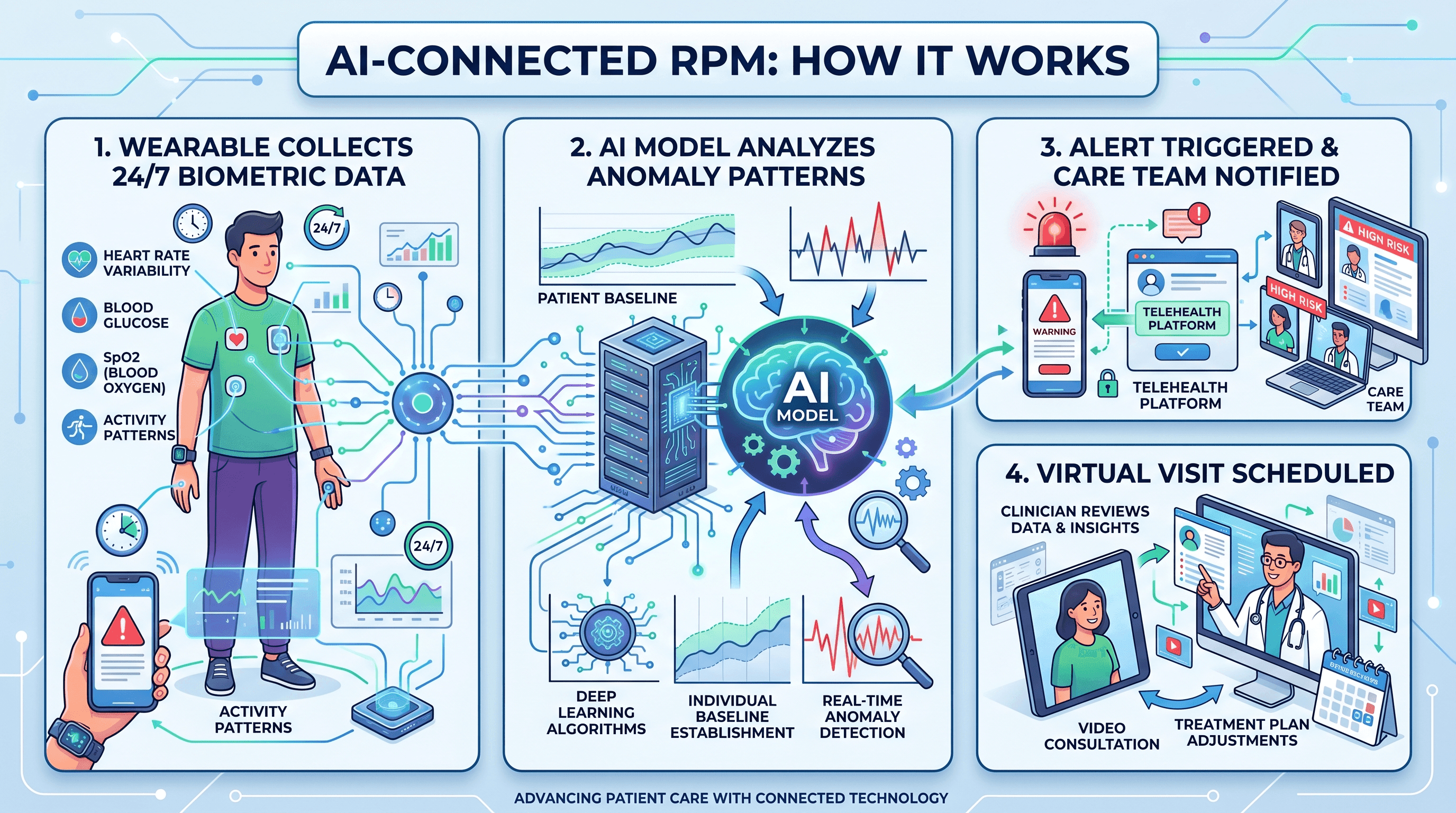
Hypertension is a particular area where RPM-plus-AI demonstrates strong real-world ROI. Uncontrolled hypertension remains a leading driver of stroke and cardiovascular events. For health systems managing high-risk patient populations, continuous AI monitoring closes the gap between episodic care visits and the daily physiological reality that actually determines outcomes. For a deeper look at how hypertension, heart disease, and stroke are clinically connected, this overview of the hypertension-heart disease-stroke relationship provides additional context on the conditions RPM is most effective at monitoring.
Ambient Documentation: The "Invisible" Assistant
Of all the AI telemedicine capabilities available today, ambient clinical documentation may have the most immediate and measurable impact on physician satisfaction and retention.
The problem it solves is structural. A clinician on a telehealth platform typically spends 30 to 40 percent of the visit looking at a screen, typing notes, clicking through EHR fields, and managing documentation. From the patient's perspective, the doctor is not fully present. From the clinician's perspective, the documentation burden compounds across 20 or 30 visits per day. A 2023 estimate from Harvard Health Publishing placed administrative burden as a primary contributor to the 80% of primary care physicians who reported increased workload since telehealth expansion.
Ambient documentation AI listens to the telehealth conversation — with appropriate consent mechanisms in place — and generates a structured clinical note in real time. The note populates the SOAP format (Subjective, Objective, Assessment, Plan) directly into the EHR. The clinician reviews, edits as needed, and signs off. The entire cycle typically adds less than two minutes to the encounter workflow.
Documented outcomes from early deployments report 4 to 6 hours of documentation time saved per clinician per week. At a 40-clinician virtual practice, that aggregates to 160 to 240 hours per week returned to direct patient care or clinician recovery time.
The governance requirement here is specific. Ambient listening in a clinical setting triggers HIPAA obligations regardless of whether the AI model is cloud-based or on-premise. Any deployment must include patient notification, consent documentation, a Business Associate Agreement (BAA) with the AI vendor, and audit logging of all ambient capture sessions. Health systems that have attempted to deploy ambient AI without fulfilling these requirements have faced both compliance exposure and patient trust erosion. Build the governance layer first.
AI-Assisted Remote Diagnostics
The physical exam has been telehealth's most persistent limitation. A clinician can hear a patient's symptoms, review lab values, and assess facial affect on camera. Assessing a skin lesion, evaluating eye vasculature for diabetic retinopathy, or grading wound healing remotely was, until recently, outside the platform's capability.
AI-assisted remote diagnostics changes this by turning the patient's smartphone camera into a point-of-care diagnostic instrument.
In dermatology, FDA-cleared computer vision models analyze smartphone images of skin lesions for malignancy indicators with sensitivity and specificity benchmarks that compete with board-certified dermatologist performance. In ophthalmology, AI imaging tools for diabetic retinopathy screening have received FDA De Novo authorization and are now deployed at primary care sites nationwide — including those operating as telehealth-only practices.
A 2024 peer-reviewed study in MDPI Healthcare examined AI-assisted diagnostic accuracy in remote consultation settings and found that AI-augmented image review reduced missed findings in asynchronous teledermatology workflows compared to standard asynchronous review without AI support.
The implications for specialist access are substantial. Diabetic retinopathy is the leading cause of preventable blindness in working-age adults in the United States, according to the CDC National Diabetes Statistics Report. A patient in a rural county with no local ophthalmologist can have a retinal image captured via smartphone, analyzed by AI within seconds, and flagged for telehealth specialist review within the same clinical encounter. Without AI, that screening pathway might require a 90-mile drive and a 6-week wait.
For health system leaders, AI-assisted diagnostics requires two parallel evaluations: the clinical evidence base for the specific AI tool in the specific use case, and the regulatory status. An AI diagnostic tool operating as Software as a Medical Device (SaMD) requires either FDA clearance (510(k)), De Novo authorization, or PMA approval depending on risk classification. An AI tool offering decision support without diagnostic conclusions may fall outside FDA's oversight scope under the January 2026 guidance update. Know the difference before procurement.
Mental Health and Sentiment Analysis
Mental health telemedicine adoption accelerated sharply after 2020 and has not receded. Platforms providing AI-augmented therapy support, crisis detection, and symptom monitoring now serve tens of millions of users. The clinical opportunity and the ethical complexity are both high.
The core AI capability in mental health telemedicine is sentiment and vocal analysis. AI models trained on large labeled datasets of speech patterns can detect shifts in vocal tone, cadence, word choice, and pause frequency that correlate with depression severity, anxiety escalation, and suicidal ideation risk. A clinician on a 45-minute telehealth session can miss a subtle emotional shift that an ambient AI model flags with precision.
A study from Mount Sinai published in JAMA Network Open found that NLP-powered vocal analysis during telehealth sessions identified early depression indicators that conventional screening instruments missed in a subset of patients. The researchers emphasized that AI-flagged findings require clinical follow-up. No AI system in this domain makes a diagnosis.
The ethical guardrails here are not optional. Mental health AI telemedicine operates in a space where patient vulnerability is high and the consequences of a false negative can be severe. Organizations deploying sentiment analysis tools must address: patient disclosure and consent for vocal data capture, data retention policies for sensitive mental health audio, HIPAA compliance for AI processing of protected health information, and clear escalation protocols when AI flags crisis indicators.
The human-in-the-loop requirement is strongest in this domain. AI sentiment analysis can be a powerful safety net. It must not become a replacement for trained clinical judgment.
If your organization serves populations with high rates of anxiety, depression, or trauma history, and the telehealth platform does not currently have AI-assisted mental health flagging, that is a gap worth examining in 2026. The tools exist. The evidence base is growing. The governance requirements are manageable with proper architecture.
Bridging the Rural Access Gap: Equity and Inclusion
Healthcare deserts exist across rural America, underserved urban neighborhoods, and indigenous communities worldwide. Telehealth reduced geographic barriers. AI telemedicine reduces linguistic, cognitive, and navigational barriers that geographic access alone does not solve.
Three AI capabilities are most directly relevant to healthcare equity in telemedicine.
AI-driven triage and symptom intake systems can guide patients through structured pre-visit assessments in plain language, reducing the literacy demands typically imposed by medical intake forms. A patient who struggles with the question "Are you experiencing dyspnea?" can navigate a conversation-style intake that asks "Are you having trouble breathing?" The clinical output is identical. The access barrier is not.
Real-time language translation powered by large language models (LLMs) now supports over 100 languages with medically validated terminology accuracy that was not available at scale three years ago. A Spanish-speaking patient in rural Texas, a Somali refugee in Minneapolis, and a Navajo elder in New Mexico can each complete a telehealth visit without relying on an interpreter line with a 20-minute wait. According to research published in Frontiers in Digital Health focusing on AI telemedicine in African health systems, multilingual AI support was identified as a primary enabler of equitable specialist access in low-resource settings.
Digital literacy support is the third capability. AI-powered care navigation tools can guide patients step-by-step through connecting to a telehealth visit, uploading images for remote diagnostic review, or responding to RPM device alerts — without requiring the patient to interpret technical instructions independently.
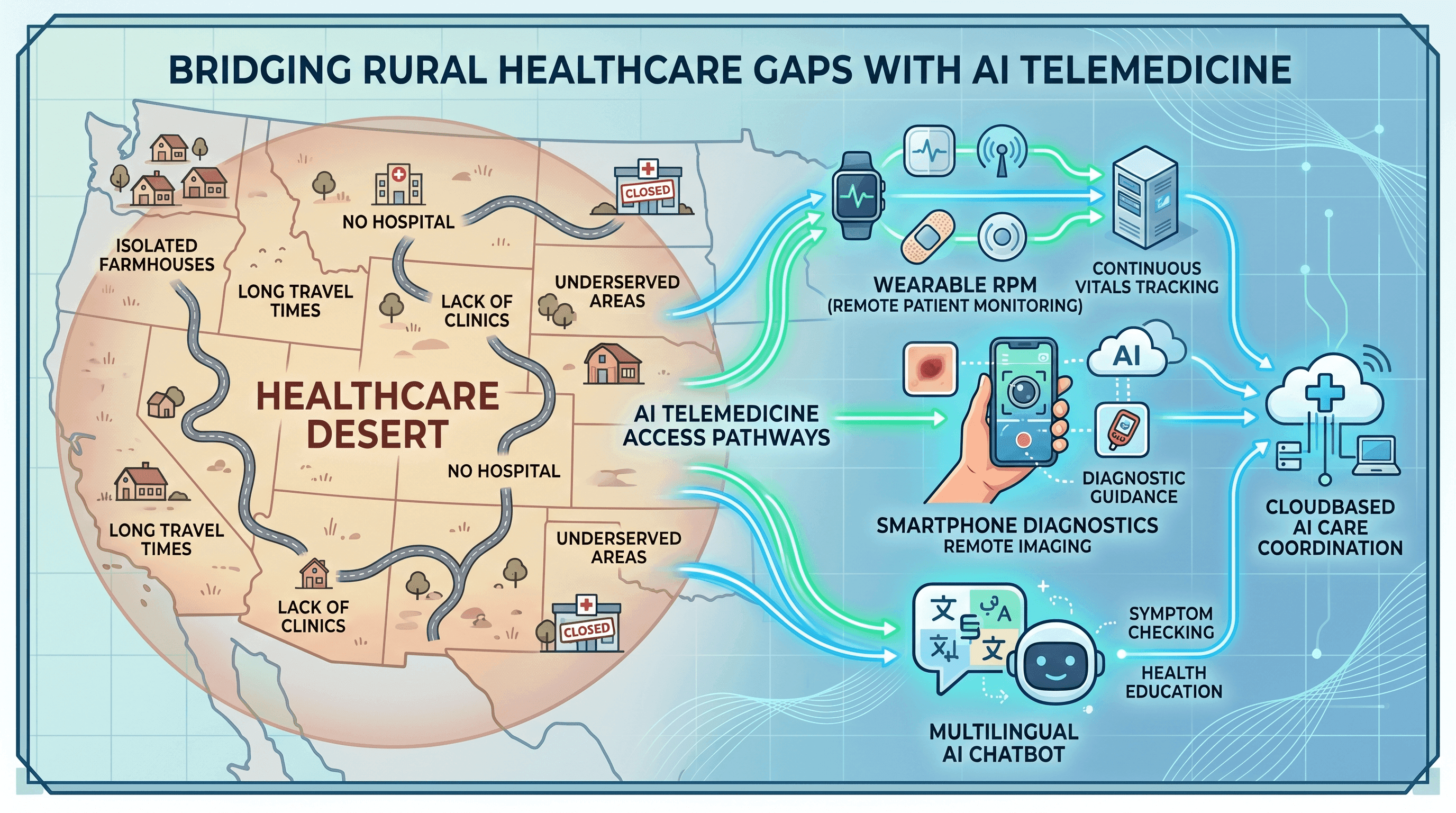
Health equity in AI telemedicine is also a risk management concern. AI models trained on non-representative datasets can produce systematically biased outputs for minority, elderly, and rural patient populations. A triage model trained primarily on data from urban academic medical centers may underperform for rural patients with different symptom-presentation patterns or comorbidity profiles. Organizations procuring AI telemedicine tools must require bias auditing and fairness reporting as non-negotiable vendor deliverables.
If your organization is considering AI telemedicine to expand reach into underserved populations, connecting with a virtual primary care provider who understands the specific equity gaps in your patient community is a strong starting point before platform selection.
Governance and the "Golden Record": Where the Human Stays in the Loop
The most persistent misconception about AI telemedicine is that its value scales with autonomy, and that the goal is to eventually remove the human from the clinical decision chain. That is not how leading health systems are deploying these tools, and it is not what the evidence supports.
The principle that governs best-practice AI telemedicine in 2026 is "human-in-the-loop" (HITL): AI handles data aggregation, pattern recognition, documentation, and administrative coordination. The clinician retains final authority over diagnosis, treatment decisions, and the patient relationship. These roles are complementary, not competitive.
FDA Regulatory Framework (2026 Update)
In January 2026, the FDA issued updated guidance streamlining oversight for low-risk AI health software. Under the revised risk-based classification framework, AI tools functioning as administrative or decision-support aids without making independent diagnostic claims fall outside FDA's enforcement discretion. AI tools operating as Software as a Medical Device with independent diagnostic output remain subject to full regulatory oversight including 510(k), De Novo, or PMA pathways depending on risk level.
The Technology-Enabled Meaningful Patient Outcomes (TEMPO) Pilot, operated jointly by FDA and CMS, is evaluating AI telemedicine tools in live clinical settings with the goal of developing a regulatory pathway that keeps pace with deployment speed. Organizations considering AI telemedicine tools that may function as SaMD should track TEMPO developments closely through 2026 to 2027.
HIPAA Compliance for AI Telehealth Tools
HIPAA compliance does not transfer automatically from a telehealth platform to an integrated AI tool. Each AI component that processes, stores, or transmits protected health information (PHI) requires its own compliance architecture.
Foley & Lardner's 2025 healthcare privacy analysis identifies the following requirements for AI telehealth deployments: end-to-end encryption for data transmission, role-based access controls limiting PHI exposure to authorized users, audit logging with timestamp integrity for all AI model inputs and outputs, and a signed Business Associate Agreement (BAA) with every AI vendor whose system touches PHI.
Ambient documentation tools present specific HIPAA considerations because they capture the full audio content of clinical encounters. A BAA is required. Patient notification and consent must be documented before each session. Retention policies for audio data must comply with both HIPAA's minimum necessary standard and applicable state privacy regulations, which in several states are more restrictive than federal requirements.
AI chatbots deployed for patient engagement outside of a scheduled clinical encounter occupy a gray zone. If the chatbot collects symptom data that is stored and associated with a patient record, it is processing PHI. If it provides general health information without retaining patient-identifiable data, it may not trigger HIPAA obligations. Clarify this distinction with legal counsel before deployment.
Can AI Replace Doctors in Telemedicine?
No. The clinical and regulatory frameworks are explicit on this point, and the practical evidence supports it. AI models in telemedicine are trained on population-level data and make probabilistic assessments. Clinical medicine requires contextual judgment that integrates patient history, values, social determinants of health, and nuance that population averages cannot fully encode.
What AI does is expand the clinician's effective capacity. An AI triage system does not replace the clinician who reviews the triage output. It ensures that clinician receives a structured, prioritized, complete patient summary rather than a disconnected set of form responses. An AI RPM alert does not replace the clinician who decides whether to escalate, wait, or adjust a medication. It ensures the clinician has a signal they would otherwise have missed.
Health systems that have attempted fully automated AI clinical decision pathways without human oversight have encountered both patient safety events and regulatory exposure. The "golden record" model — where AI contributes every available data point to a comprehensive longitudinal patient summary, and a clinician makes the final call — is both the safest and the most evidence-supported deployment architecture for 2026.
FAQ
What are the main types of AI used in telemedicine? The primary AI types active in telemedicine today include machine learning models (pattern recognition in RPM and diagnostic imaging), natural language processing (ambient documentation, chatbots, and sentiment analysis), computer vision (remote dermatology and ophthalmology diagnostics), and agentic AI systems (multi-step workflow automation for care coordination). Large language models underpin most of the conversational and documentation capabilities deployed since 2023.
What are the 4 types of AI? In the standard classification used in computer science and applied healthcare AI, the four types are reactive machines (AI that responds to current inputs without memory, like early symptom checkers), limited memory AI (systems that use recent data to improve decisions, which describes most current clinical AI tools), theory of mind AI (systems that model human intentions and beliefs, still largely in research), and self-aware AI (theoretical, not yet deployed in any clinical setting). Most telemedicine AI operates at the limited memory level.
Can you do telehealth for pneumonia? Telehealth can support early evaluation of respiratory symptoms including those consistent with pneumonia. A clinician can assess symptom severity, review imaging uploaded via secure patient portal, evaluate oxygen saturation data from RPM devices, and prescribe antibiotics when clinically appropriate and legally permitted in the clinician's jurisdiction. However, telehealth is not appropriate for cases where a patient presents with severe respiratory distress, SpO2 below 94%, altered mental status, or signs of sepsis. Those cases require in-person emergency evaluation. AI triage systems deployed on telehealth platforms are specifically designed to flag these severity indicators and route patients appropriately before the virtual visit begins.
Who are the major players in AI telemedicine? Several large integrated platforms including Teladoc Health, Amwell, and MDLive operate at scale with embedded AI components for triage, documentation, and engagement. Specialty AI vendors including Nuance (Microsoft), Abridge, and Nabla focus on ambient clinical documentation. K Health and Ada Health have built their core product around AI-driven symptom assessment and triage. RPM-specific AI is delivered through platforms like Biofourmis, Current Health (acquired by Best Buy Health), and Livongo (now Teladoc). The market is fragmented, with no single vendor dominating all eight capability areas described in this guide.
What are 7 types of AI in a clinical context? Beyond the four foundational types, applied healthcare AI is often categorized by function: supervised learning models (trained on labeled clinical outcomes), unsupervised learning (pattern detection in unlabeled patient data), reinforcement learning (systems that improve through feedback loops, used in care protocol optimization), generative AI (LLMs producing clinical notes or patient education), computer vision (medical imaging analysis), natural language processing (documentation and conversation), and agentic AI (multi-step autonomous task execution). Current AI telemedicine deployments draw on all seven, often in combination within a single platform encounter.
How does AI telemedicine handle patient privacy? AI telemedicine tools that process protected health information require a HIPAA-compliant infrastructure including encryption, access controls, audit logging, and a signed Business Associate Agreement with each vendor. Ambient documentation and chatbot tools present specific privacy considerations, and patient consent must be obtained before audio or symptom data is captured. State privacy laws in California, Colorado, Virginia, and several others impose additional requirements beyond HIPAA minimums.
References
- Nature Scientific Reports (2025) — AI-assisted telehealth early detection analysis cited in the proactive care section.
- MarketsandMarkets — AI in Telehealth and Telemedicine Market — Market growth projections and RPM CAGR data.
- PubMed Central / PMC12453293 — Multi-agent AI systems in virtual care coordination and discharge planning.
- Frontiers in Digital Health — AI Telemedicine in Africa — Multilingual AI support and health equity in low-resource settings.
- MDPI Healthcare (2025) — AI-assisted diagnostic accuracy in remote consultation settings.
- PubMed — 38436235 — AI in mental health telemedicine and NLP-based sentiment screening.
- PubMed — 40988810 — Clinical evidence on AI-driven RPM and chronic disease management.
- PubMed — 40866419 — Algorithmic bias and fairness reporting in AI health tools.
- CDC National Diabetes Statistics Report — Diabetic retinopathy prevalence and preventable blindness data.
- AMA 2025 Digital Health Survey — Physician AI adoption rates (66%, up from 38% in 2023).
- FDA — AI/ML-Enabled Medical Devices — FDA De Novo authorization for AI diagnostic tools and SaMD regulatory framework.
- Harvard Health Publishing — Physician Burnout — Administrative burden and PCP burnout data in telehealth context.
- JAMA Network Open — NLP in Mental Health — Vocal analysis AI for early depression indicator detection in telehealth.
- Momentary Lab — Hypertension, Heart Disease, and Stroke Connection — Clinical overview of conditions most directly managed through AI-powered RPM.


