


Modern medicine has always had a paperwork problem. Physicians spend nearly two hours on administrative tasks for every one hour of direct patient care, and that ratio has only worsened as documentation requirements have grown. An AI medical assistant changes that equation by acting as an intelligent layer between the patient, the data, and the clinician — absorbing friction without replacing the human judgment at the center of care.
This guide covers what AI medical assistants actually are, how the technology works across three distinct use categories, what peer-reviewed research shows about real-world outcomes, and where the genuine limits lie. If you are a physician, practice manager, or healthcare organization evaluating these tools, this is the honest decision guide the current conversation is missing.
At a Glance
| Topic | Key Facts |
|---|---|
| What it is | Software that automates clinical documentation, patient communication, triage support, and care coordination |
| Who uses it | Physicians, care teams, patients, and health systems |
| Core technologies | NLP, large language models, ambient audio capture, EHR integration |
| Key benefit (clinicians) | 2 to 4 hours per day reclaimed from documentation |
| Key benefit (patients) | 24/7 access to guidance, faster triage, better care continuity |
| Primary risk | Hallucination, automation bias, and HIPAA non-compliance if improperly deployed |
| Regulatory status | FDA oversight applies to clinical decision support tools meeting the definition of a medical device |
The Brain Behind the Visit
An AI medical assistant is a software system that uses artificial intelligence to perform clinical and administrative tasks that would otherwise consume physician or staff time. The term covers a wide range of tools, but two distinct categories define the space.
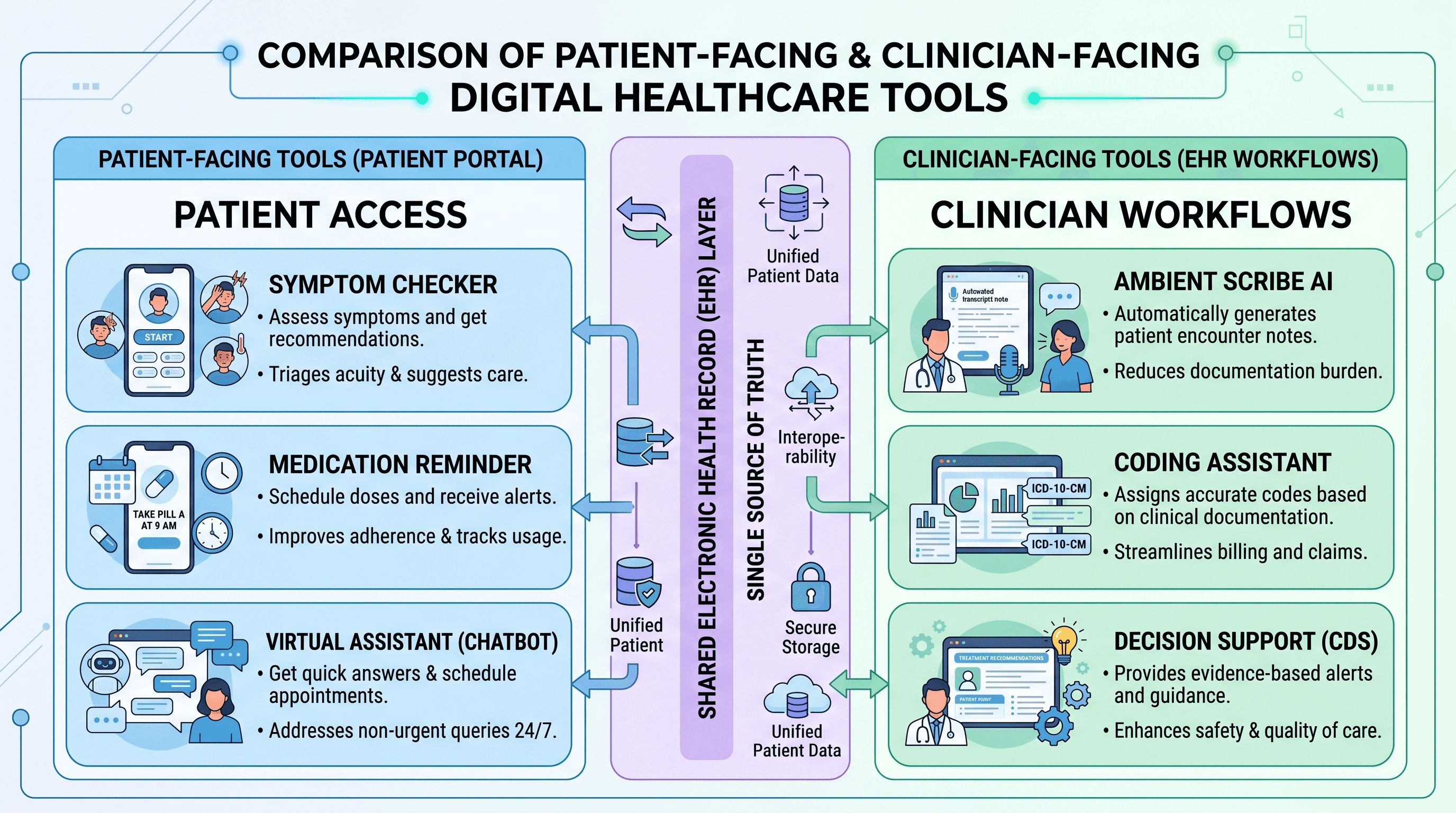
Patient-facing tools interact directly with people seeking care. These include symptom checkers that help patients understand what their symptoms might indicate, chatbots that answer insurance or appointment questions at any hour, and medication reminder systems that improve adherence between visits.
Clinician-facing tools work behind the scenes to support the people delivering care. These include ambient scribes that listen to a patient visit and generate a structured clinical note, clinical decision support systems that flag potential drug interactions or diagnostic inconsistencies, and revenue cycle tools that suggest accurate billing codes based on visit documentation.
AI medical assistant vs. AI medical scribe: what is the difference?
An AI medical scribe is a specific subcategory of clinician-facing AI assistant. Its sole function is to capture and transcribe a clinical encounter, then format that transcript into a structured note that maps to EHR fields, ICD-10 codes, and care plan elements. An AI medical assistant is a broader category: it may include scribe functionality but also handles patient communication, triage logic, prescription management, and care coordination. The scribe is one tool; the assistant is the full toolkit.
Patient-facing vs. clinician-facing tools: a clear taxonomy
Understanding this distinction matters when evaluating vendors. A patient-facing AI assistant that answers symptom questions carries different regulatory and liability considerations than an ambient scribe generating content that goes directly into a legal medical record. Both are valuable. Both require different validation standards. Conflating them is the most common mistake practices make when starting an AI evaluation process.
How AI Medical Assistants Work: The Technology Behind Them
The technical architecture of a modern AI medical assistant rests on three interdependent layers: natural language processing for understanding speech and text, large language models trained on medical data for generating meaningful output, and EHR integration for putting that output where clinicians can act on it.
Voice recognition and ambient capture
Ambient clinical intelligence begins with a microphone, either in a dedicated device or a standard smartphone. During a patient visit, the system captures the spoken conversation between physician and patient. Advanced voice recognition models separate speaker identities, filter background noise, and transcribe dialogue in real time. The transcription is not the end product — it is the raw input for the next layer.
Large language models trained on medical data
General-purpose language models like those underlying consumer chatbots are trained on broad internet data. Clinical AI models are fine-tuned on medical literature, clinical guidelines, anonymized EHR data, and terminology standards like SNOMED CT and ICD-10. This specialized training allows the model to understand that "chest pain radiating to the left arm" carries different significance than "chest pain after eating spicy food," and to structure a note accordingly. A 2024 study published in Nature Medicine found meaningful accuracy gaps between LLM performance on controlled benchmarks and real-world clinical environments, underscoring why domain-specific training matters more than benchmark scores alone.
EHR integration and structured output
The final layer converts the model's output into fields that live inside an electronic health record. This means the AI does not simply produce a text document — it maps assessment findings to the appropriate problem list, assigns billing codes, populates medication lists, and flags unsigned orders. Systems that integrate via HL7 FHIR APIs can achieve bidirectional data flow, meaning the AI also reads existing patient history to contextualize the current visit before generating a note.
Core Use Cases in Clinical Practice
Clinical documentation and ambient note-taking
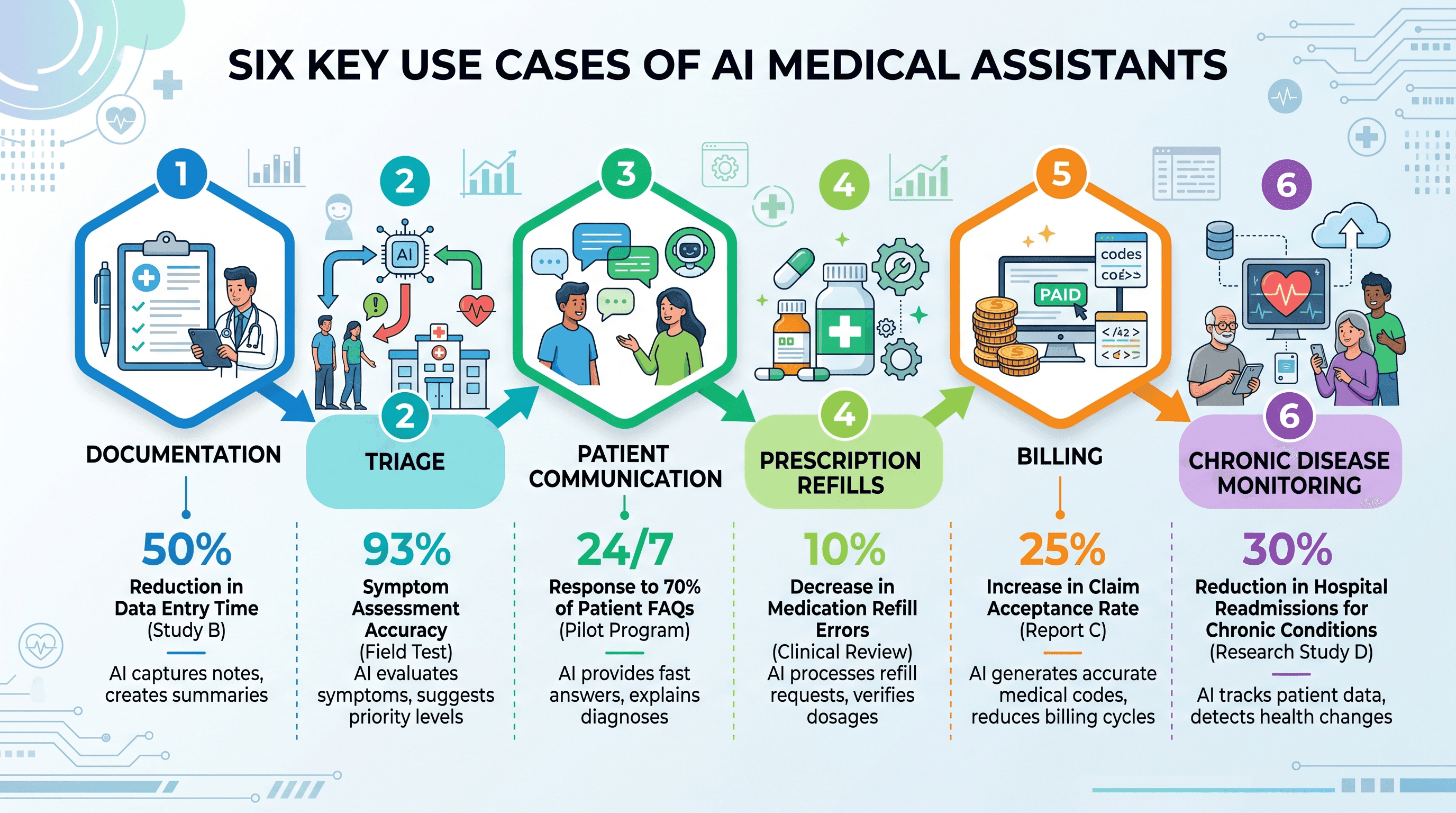
Documentation is where AI delivers the clearest, most immediate return. Ambient scribes generate a structured SOAP note, problem list update, and assessment-and-plan section from the conversation of a standard visit. A 2023 study from Stanford and Phyx measured a 41% reduction in note completion time when ambient AI was used, recovering roughly two hours per physician per day. Physicians report spending less time on "pajama time" — the evening hours previously spent catching up on documentation after clinic ends.
Real-time triage support
AI triage tools evaluate patient-reported symptoms through structured intake questionnaires, then categorize urgency and route the patient to the appropriate level of care. High-acuity presentations are flagged for immediate physician review; low-acuity concerns may be routed to asynchronous messaging or telehealth. This reduces unnecessary emergency department visits while ensuring urgent cases are not delayed in general scheduling queues.
Patient communication and 24/7 support
Patients now expect the same on-demand responsiveness from their health providers that they get from retail or banking apps. AI patient assistants field after-hours questions about symptoms, test results, medication instructions, and appointment availability without requiring a physician callback. Research published in PMC highlights that AI-driven patient communication tools significantly improve responsiveness and patient satisfaction scores, particularly for chronic disease populations requiring frequent touchpoints.
Automated prescription refill management
Refill requests account for a significant volume of in-basket messages in most primary care practices. AI assistants can evaluate a refill request against the patient's chart — checking for recent lab values, adherence patterns, and formulary status — and route straightforward refills to the prescribing clinician with a pre-populated order, requiring only a single confirmation click. Complex requests or those requiring updated assessments are flagged for full review.
Medical billing and coding assistance
Coding errors are one of the leading causes of claim denial and revenue leakage in outpatient practices. AI coding tools analyze the completed clinical note, cross-reference documented findings against CPT and ICD-10 criteria, and suggest the appropriate code set with supporting documentation pointers. This reduces undercoding (which costs revenue) and overcoding (which creates compliance risk) simultaneously.
Chronic disease monitoring
For patients managing conditions like type 2 diabetes, heart failure, or hypertension, AI assistants integrated with remote monitoring devices can track biometric data between visits and surface clinically relevant trends. If a patient's blood pressure readings show a sustained upward pattern over several days, the system can generate an alert for the care team without waiting for a scheduled visit. This proactive monitoring is especially valuable in high-risk populations where early intervention prevents acute events.
What the Clinical Evidence Actually Shows
The promise of AI in healthcare has historically outpaced the evidence. That gap is closing, but the evidence base still requires careful reading. Positive trial results and real-world performance are not always the same thing.
Burnout reduction: what the RCTs show
Physician burnout has been one of the most persistent crises in US healthcare. A 2023 American Medical Association survey found 41.9% of physicians reported burnout, down from a peak of 48.2% in 2023, a decline that coincides with growing adoption of administrative AI tools. An August 2025 randomized controlled trial published in JAMA Network Open found a 31% reduction in burnout scores among physicians using ambient AI documentation compared to controls. That is a meaningful finding, but it was measured over a defined trial period with selected practices — generalizing it requires caution.
Documentation time savings: measured outcomes
Time savings data is the strongest pillar of the current evidence base. Multiple independent studies converge on a figure of two to four hours per physician per day recovered from documentation, consistent with the Stanford and Phyx findings on note completion time. A systematic review published in MDPI Electronics found that AI-assisted documentation tools consistently outperformed manual methods on speed and note completeness across multiple healthcare settings.
Accuracy gaps: when LLMs underperform in the real world
The clearest caution flag in the literature comes from accuracy research. LLMs evaluated on standardized medical board-style questions often perform at or above physician-level accuracy. In real-world clinical environments, however, performance degrades. The Nature Medicine study referenced earlier documented meaningful gaps between benchmark accuracy and accuracy on real patient cases, attributable to distribution shift — the model encounters presentation patterns, social determinants, and comorbidity combinations that look different from its training data. Research from Researchgate identifies inconsistent performance across demographic subgroups as a specific concern requiring ongoing attention in deployment contexts.
"AI systems trained on biased data can propagate or even amplify existing health disparities." — NIH National Library of Medicine, PMC
Benefits for Physicians and Patients
For physicians: time, wellbeing, and revenue impact
Two to four hours of recovered documentation time per day is the headline benefit for clinicians, but the downstream effects are significant. Physicians who spend less time on administrative tasks report higher engagement during patient encounters, better maintenance of eye contact and conversational presence, and lower rates of end-of-day exhaustion. From a practice economics standpoint, recovered time translates to capacity for additional patients or services without extending hours.
For patients: access, continuity, and engagement
For patients, the primary benefit is reduced friction in accessing care. AI assistants that operate around the clock mean a 10 p.m. question about a medication side effect gets a meaningful response without requiring an emergency call. Triage tools that route patients accurately mean fewer unnecessary visits and faster paths to the right level of care. For patients managing chronic conditions, remote monitoring AI closes the gap between scheduled visits and creates a more continuous care relationship.
Risks and Limitations You Need to Know Before Adopting AI
No evaluation guide that omits this section deserves to be taken seriously. The risks of AI medical assistants are real, specific, and manageable — but only if they are acknowledged before deployment, not discovered afterward.
Hallucination and clinical accuracy risk
AI language models can generate confident, fluent, and entirely incorrect clinical content. This phenomenon, called hallucination, is not a bug that will be fully eliminated — it is an inherent characteristic of current generative models. In a clinical documentation context, a hallucinated drug dosage, an invented lab result, or an incorrect diagnosis in an AI-generated note that a physician signs without review becomes a legal and clinical liability. Every deployment of ambient AI must include a physician review step as a non-negotiable workflow requirement.
Automation bias: when clinicians defer too readily
Automation bias occurs when a human operator accepts machine output without appropriate scrutiny because the output looks authoritative. Research published in PMC documents this as a significant risk in clinical AI contexts, particularly when workload is high and cognitive fatigue reduces critical review. Training staff to maintain an active review posture, rather than a passive approval reflex, is as important as the technology itself.
Algorithmic bias and health equity concerns
AI models reflect the data they were trained on. If training data underrepresents certain populations — by race, socioeconomic status, geographic region, or language — the model's outputs may systematically underperform for those groups. Research from NIH PMC identifies this as a structural concern that requires practices to evaluate AI vendor claims about training data composition, not just aggregate accuracy metrics.
Liability: who is responsible when AI notes are wrong?
Current US legal and regulatory frameworks are clear on one point: the physician who signs the note bears responsibility for its content, regardless of how that content was generated. An AI-generated note that is signed without review is legally no different from a note the physician wrote themselves. Practices should work with legal counsel to establish documentation policies that explicitly address AI-assisted content, and should ensure their malpractice carriers are aware of AI tool adoption.
HIPAA Compliance: What Every Practice Must Verify
Healthcare data breaches affected an estimated 259 million individuals in 2024, and AI tools that process patient information are an expanding part of the attack surface. HIPAA compliance is not a checkbox — it is a continuous operational requirement, and the rules apply fully to AI vendors.
PHI, BAAs, and why general AI tools fail HIPAA
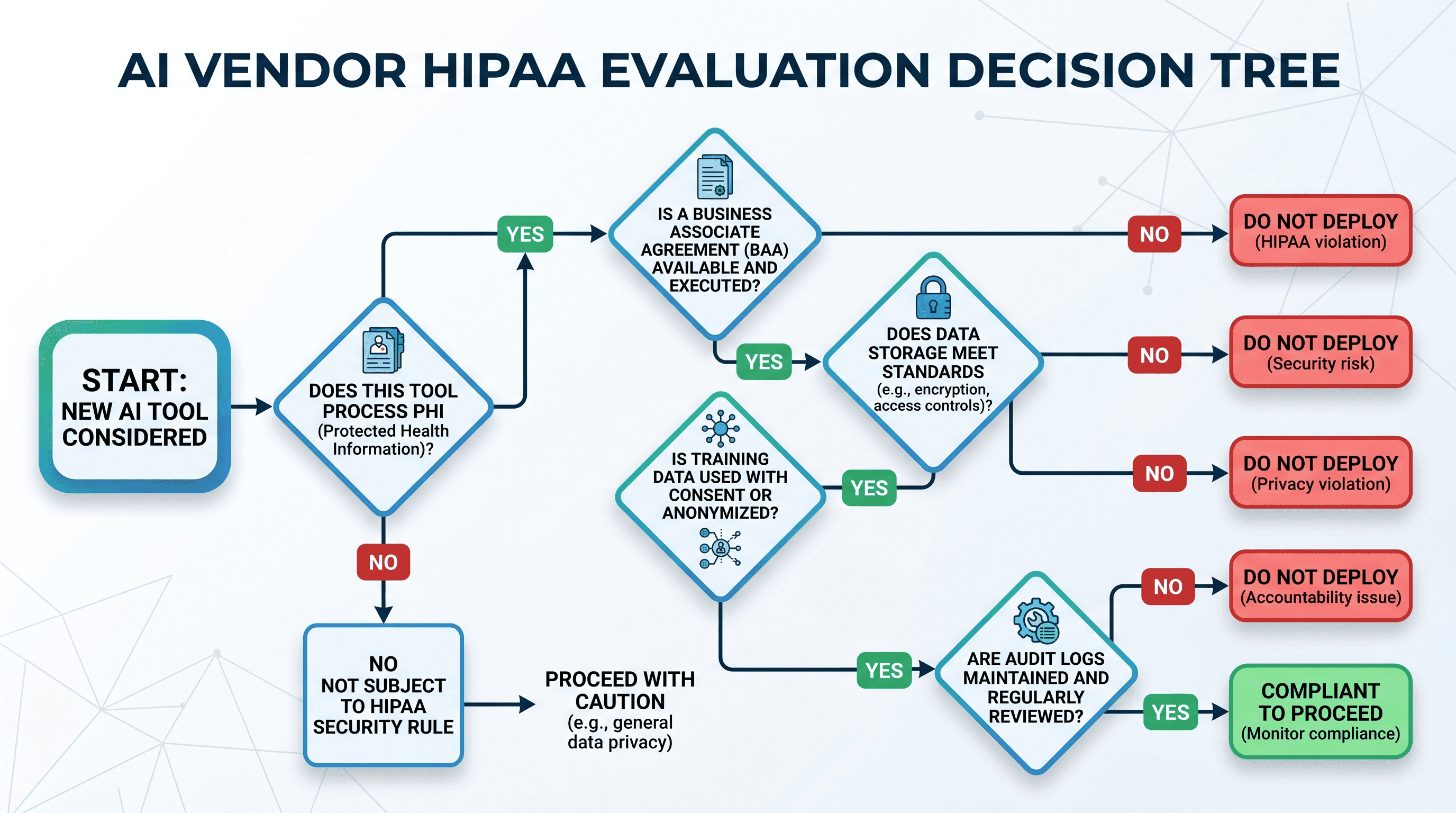
Protected Health Information (PHI) is any individually identifiable health information held or transmitted by a covered entity. When a physician uses a general-purpose AI tool — such as an unmodified consumer chatbot — to process patient notes, they are sharing PHI with a third-party vendor. Under HIPAA's Privacy Rule, this requires a signed Business Associate Agreement (BAA) with that vendor. Most general-purpose AI tools do not offer BAAs, which means their use with any patient data is a HIPAA violation, regardless of how the tool is marketed.
Technical safeguards to look for in a compliant tool
A HIPAA-compliant AI medical assistant must implement the technical safeguards required under 45 CFR Part 164. These include end-to-end encryption of data in transit and at rest, role-based access controls that limit who can view patient data, comprehensive audit logging of all data access events, and data de-identification protocols for any model training or improvement activities. Tools that use patient data to improve their models without explicit written authorization are violating HIPAA even if the data is anonymized after the fact.
Questions to ask any AI vendor before signing
Before deploying any AI tool that touches patient data, require written answers to the following questions from every vendor:
Will the vendor sign a Business Associate Agreement, and what terms does it contain? Where is patient data stored, and in which jurisdictions? Is PHI used to train or fine-tune models, and under what authorization? What is the vendor's breach notification protocol and historical breach record? Has the system undergone an independent HIPAA security risk assessment?
How to Choose an AI Medical Assistant: A Practical Evaluation Framework
Six criteria for clinical AI evaluation
Clinical accuracy and specialty fit comes first. Generic AI accuracy claims are less useful than accuracy data for the specific use case and patient population relevant to the practice. A family medicine ambient scribe trained primarily on oncology notes will underperform. Request specialty-specific validation data.
EHR compatibility determines whether implementation is a plug-in or a project. Native integrations with Epic, Cerner, or athenahealth are meaningfully easier to deploy than middleware solutions. Confirm whether the integration supports bidirectional data flow.
HIPAA compliance posture requires the full vendor assessment described in the previous section. A BAA is the minimum, not the standard.
Ease of adoption affects whether the tool is actually used after purchase. Physician adoption rates for AI tools drop sharply when workflows require more than three to five clicks to generate a note. Request physician time-to-productivity data from current customers.
Support quality matters more for AI tools than for most software categories because clinical environments cannot tolerate system outages or silent accuracy degradation. Ask about uptime SLAs and how the vendor monitors for model drift.
Total cost of ownership includes licensing fees, implementation costs, EHR integration fees, and ongoing training time. ROI calculations should be based on documented time savings in practices comparable to the one being evaluated.
Red flags to watch for in vendor claims
Vendors claiming "98% accuracy" without specifying the benchmark, the dataset, or the comparison baseline are offering marketing data, not clinical evidence. Vendors who cannot provide references from current customers in similar practice settings warrant skepticism. Any vendor who cannot clearly answer the HIPAA compliance questions above should not receive access to patient data.
Piloting AI in the practice: a quick-start approach
A structured 60-day pilot with a defined physician cohort, clear pre-and-post documentation time tracking, and a designated champion for troubleshooting generates decision-quality data. Pilots without measurement produce impressions, not evidence.
Will AI Replace Human Medical Assistants?
This question drives significant anxiety in the healthcare workforce, and the data offers a straightforward answer: no, at least not in the near term.
The US Bureau of Labor Statistics projects 12% job growth for medical assistants through 2034, generating approximately 112,300 annual job openings — a rate faster than the average for all occupations. AI is changing the work, not eliminating it. Human medical assistants are increasingly focused on tasks that require interpersonal judgment, physical proximity, and contextual flexibility — exactly the areas where current AI performs least reliably.
What is accurate is that medical assistants who can use AI tools effectively will be preferred over those who cannot. The role is evolving toward a model where the MA supervises and quality-checks AI outputs rather than performing every task manually. That is augmentation, not replacement.
If concerns about a diagnosis or health status are on a patient's mind between visits, connecting with a primary care provider through a virtual visit at Momentary is a straightforward way to get timely guidance without waiting for an in-person appointment.
The Limits: Where Human Expertise Is Mandatory
AI medical assistants are genuinely useful, and they are genuinely limited. Being clear about both is what makes them safe to deploy.
Physical examination is beyond the reach of any current AI tool. Palpating an abdomen, listening to breath sounds, or observing gait and affect during a conversation requires physical presence and trained clinical perception that cannot be replicated by software. No AI assistant, however sophisticated, substitutes for the hands-on component of a clinical encounter.
Emotional presence in difficult conversations is similarly irreplaceable. Delivering a serious diagnosis, discussing end-of-life preferences, or supporting a patient through a mental health crisis requires human empathy that AI can approximate in language but cannot genuinely provide. Patients in these moments are not seeking information — they are seeking connection.
Ethical and legal responsibility for a treatment plan rests with the clinician, not the tool. AI can synthesize data and surface options, but the physician makes the decision and bears the consequences. That accountability cannot be delegated to software, and regulatory frameworks across the US are clear on this point.
Finally, research from Harvard Medical School emphasizes that AI tools in clinical research and care require rigorous ongoing evaluation — what works in a controlled study may behave differently at scale, across populations, and over time.
Frequently Asked Questions
Is there a medical AI assistant available right now?
Yes. Numerous FDA-cleared and HIPAA-compliant AI medical assistants are commercially available as of 2026. These include ambient scribe tools, patient-facing symptom checkers, clinical decision support systems, and care coordination platforms. The market has matured significantly since 2022, and most major EHR vendors now offer integrated AI documentation features or certified third-party integrations.
Is an AI medical assistant regulated by the FDA?
It depends on the tool's function. The FDA regulates software as a medical device (SaMD) when it is intended to diagnose, treat, mitigate, or prevent disease. Ambient scribes and administrative tools typically fall outside this definition. Clinical decision support tools that directly influence clinical decisions may meet the threshold for FDA oversight. Practices should request a clear regulatory classification from any vendor and verify it independently.
Can AI replace a medical assistant?
Current AI tools can automate specific tasks that medical assistants perform, particularly documentation, scheduling, and routine patient communication. They cannot replace the full scope of an MA's role, which includes physical tasks, complex interpersonal situations, and real-time judgment calls that require on-the-ground context. BLS projects continued job growth in the MA category through 2034, alongside expanding AI adoption.
Can AI replace an MBBS physician or MD?
No. AI tools augment physician capacity and reduce administrative burden, but the clinical judgment, ethical responsibility, and physical examination skills that define physician practice are not replicated by current technology. The physician remains the decision-maker, the legal responsible party, and the human presence that patients seek in moments of serious health concern.
How quickly do physicians typically see time savings after adopting ambient AI?
Most published reports suggest physicians see meaningful documentation time reductions within the first two to four weeks of use, as they adjust to reviewing rather than writing notes. Full adoption and maximum time savings typically occur within 60 to 90 days. Initial productivity may dip slightly in the first week as the workflow changes.
What specialties benefit most from AI medical assistants?
Primary care, internal medicine, and psychiatry consistently show the highest time savings from ambient AI because of their high visit volumes and documentation-heavy encounter structures. Specialties with shorter, more procedurally defined encounters may see less dramatic documentation gains but can still benefit from AI-assisted billing, triage, and chronic disease monitoring tools.
To explore symptoms, understand a health concern, or decide on the right next step before a clinical visit, use Momentary's AI health navigator to get personalized guidance based on the specifics of a situation.
References
- PMC — Artificial Intelligence in Healthcare — Cited for AI-driven patient communication tools and chronic disease management outcomes.
- ResearchGate — AI-Driven Medical Assistant and Intelligent Chatbots in Modern Healthcare — Cited for real-world performance variation and demographic subgroup accuracy concerns.
- MDPI Electronics — AI in Clinical Documentation — Cited for systematic review of documentation time savings across healthcare settings.
- Harvard Medical School — AI in Clinical Research: Opportunities, Limitations, and What Comes Next — Cited for ongoing evaluation requirements and real-world deployment considerations.
- PubMed — Nature Medicine, LLM Real-World Accuracy — Cited for accuracy gaps between benchmark and real-world clinical performance.
- PMC — Algorithmic Bias and Health Equity in AI — Cited for automation bias research and health equity concerns in AI training data.
- PubMed — AI Documentation Time Savings — Cited for documentation time reduction studies.
- BLS — Medical Assistants Occupational Outlook — Cited for 12% job growth projection through 2034.


