


Right now, roughly one in six Americans uses a health AI tool every month. At the same time, a May 2026 study from CIDRAP found that AI-powered medical chatbots gave clinically problematic answers in approximately half of the cases reviewed. Both of those things are true, and that tension is exactly why this guide exists.
AI medical chatbots have moved well past simple symptom look-ups. In 2026, the most advanced platforms schedule appointments, sync with wearable devices, summarize chart notes, and flag drug interactions before a prescription is written. But "more capable" does not automatically mean "more reliable." A chatbot that sounds confident can still be wrong, and in a healthcare context, wrong carries weight that a bad restaurant recommendation simply does not.
This guide is written for patients who want to use health AI thoughtfully, for clinicians wondering how these tools fit into a care workflow, and for anyone who wants an honest picture of what the technology actually does. Not a product ranking. Not a research paper. A grounded, evidence-backed explanation that respects both the genuine promise and the documented limits of AI medical chatbots in 2026.
At a Glance
| Topic | Key Facts |
|---|---|
| Primary function | Symptom triage, patient education, care navigation, administrative tasks |
| Core technology | Large language models (LLMs) + Retrieval-Augmented Generation (RAG) |
| Adoption rate | 86% of US hospitals report AI adoption (HIMSS 2024) |
| Accuracy concern | ~50% problematic response rate in CIDRAP May 2026 review |
| HIPAA status | Consumer chatbots are generally not HIPAA compliant; clinical platforms vary |
| Key limitation | Not licensed to diagnose; cannot replace physician judgment |
| 2026 trend | Agentic AI: chatbots that take action, not just provide information |
Your 24/7 Digital Health Entryway
An AI medical chatbot is software that uses natural language processing to interpret health-related questions and respond in conversational text. The key word for 2026 is "agentic," meaning the most current platforms do not merely answer questions; they initiate actions on behalf of the user.
Think of the 2026 AI medical chatbot not as a search engine with a chat interface but as an intelligent triage officer. Its job is to shorten the gap between "I have a symptom" and "I know what to do next," while keeping clinical safety as a fixed boundary. Whether it actually delivers on that job depends heavily on which type of chatbot is being used, and many people do not realize there are meaningfully different categories.
How NLP and Large Language Models Power Medical Chatbots
Medical chatbots run on large language models (LLMs), which are AI systems trained on vast text datasets to predict contextually appropriate responses. In healthcare applications, LLMs are typically combined with Retrieval-Augmented Generation (RAG), a method that grounds the model's responses in a curated, verified knowledge base rather than relying on general internet data. RAG significantly reduces the rate of fabricated or outdated information, though it does not eliminate errors entirely.
Natural language processing (NLP) is the component that lets the chatbot interpret a sentence like "my chest feels tight after climbing stairs" as a potential cardiac symptom rather than a complaint about outdoor exercise. The sophistication of NLP is what separates a 2026 clinical AI assistant from a basic FAQ bot.
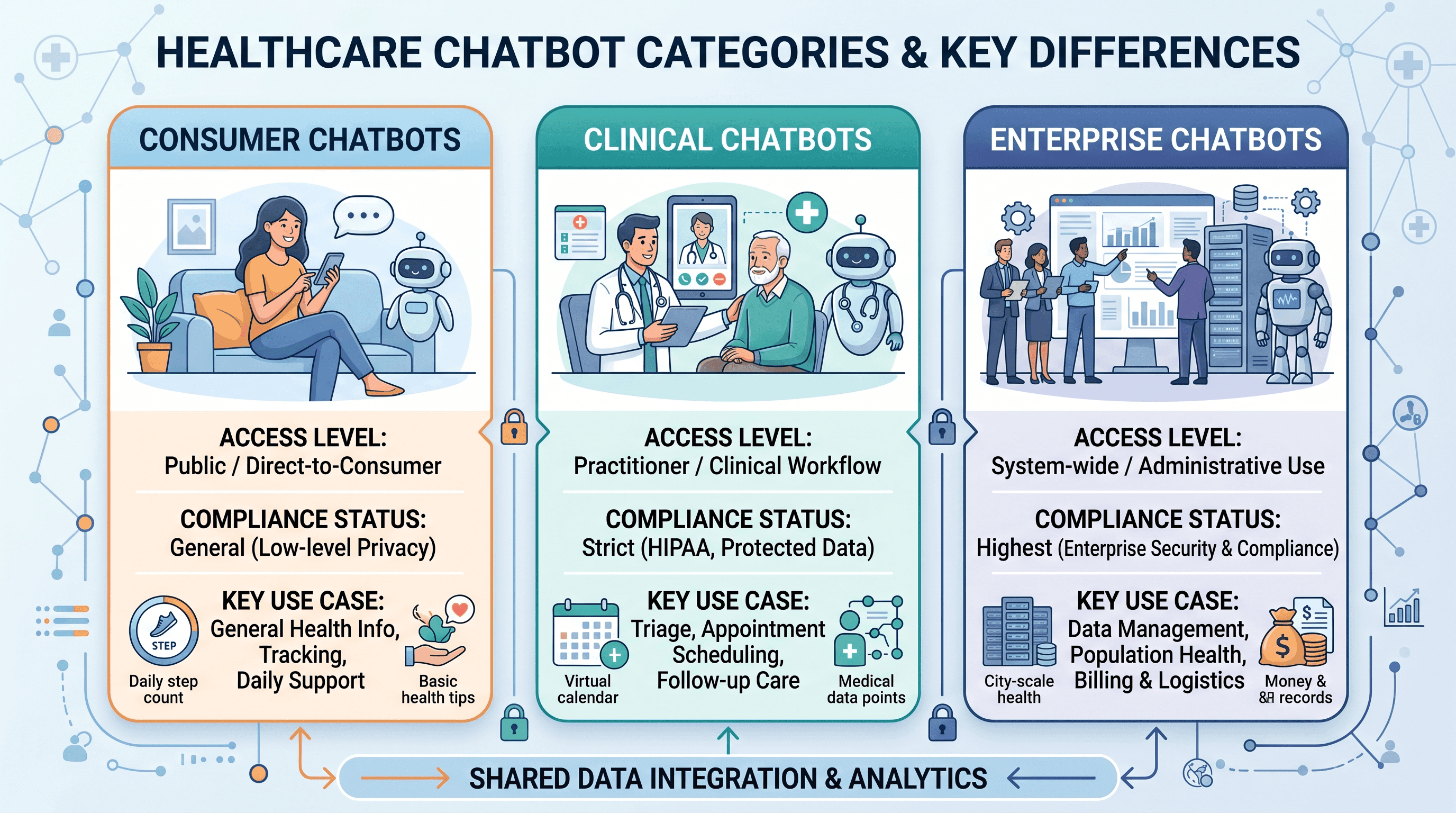
Consumer vs. Clinical vs. Enterprise Chatbots
Not all AI medical chatbots are the same, and treating them as a single category is one of the most common mistakes users make.
Consumer chatbots (such as general-purpose AI tools used for health questions) are publicly accessible, often free, and not built to healthcare data standards. They are typically not HIPAA compliant and should not be used to input personal health information.
Clinical AI assistants are embedded in electronic health record (EHR) systems or hospital platforms. Products like Epic's Ask Emmie or tools built on Microsoft's Healthcare Agent Orchestrator fall into this category. They operate within institutional data governance frameworks and are generally designed with compliance in mind.
Enterprise platforms are purpose-built for health systems, insurers, or pharmacy benefit managers. They integrate with claims data, care management workflows, and population health tools. Their accuracy depends on the quality of the underlying data and the clinical review process built into their deployment.
Symptom Assessment and Triage
The single most common use case for an AI medical chatbot is symptom assessment, and it is also the area where the stakes are highest. When someone types "I have chest pain, shortness of breath, and my left arm feels numb," the chatbot's response has real consequences.
Advanced triage chatbots use structured clinical reasoning frameworks to assess symptom urgency. Rather than pattern-matching keywords, they ask follow-up questions about duration, severity, accompanying symptoms, and medical history to build a more complete clinical picture before routing the user to an appropriate care level.
What Happens During a Triage Conversation
A well-designed triage chatbot follows a logic similar to a clinical triage nurse's decision tree. It begins with the presenting complaint, gathers relevant context through follow-up questions, calculates an urgency estimate based on validated protocols, and then delivers a specific recommendation: go to the emergency room now, schedule a same-day appointment, monitor symptoms at home, or seek care within the next 24 to 48 hours.
The difference between a responsible triage chatbot and an unreliable one often comes down to how it handles uncertainty. Responsible platforms use explicit language when confidence is low, directing users to a clinician rather than offering a speculative answer. Problematic platforms tend to fill uncertainty with plausible-sounding responses that may be clinically inaccurate.
Differentiating Urgency: Where Chatbots Help and Where They Struggle
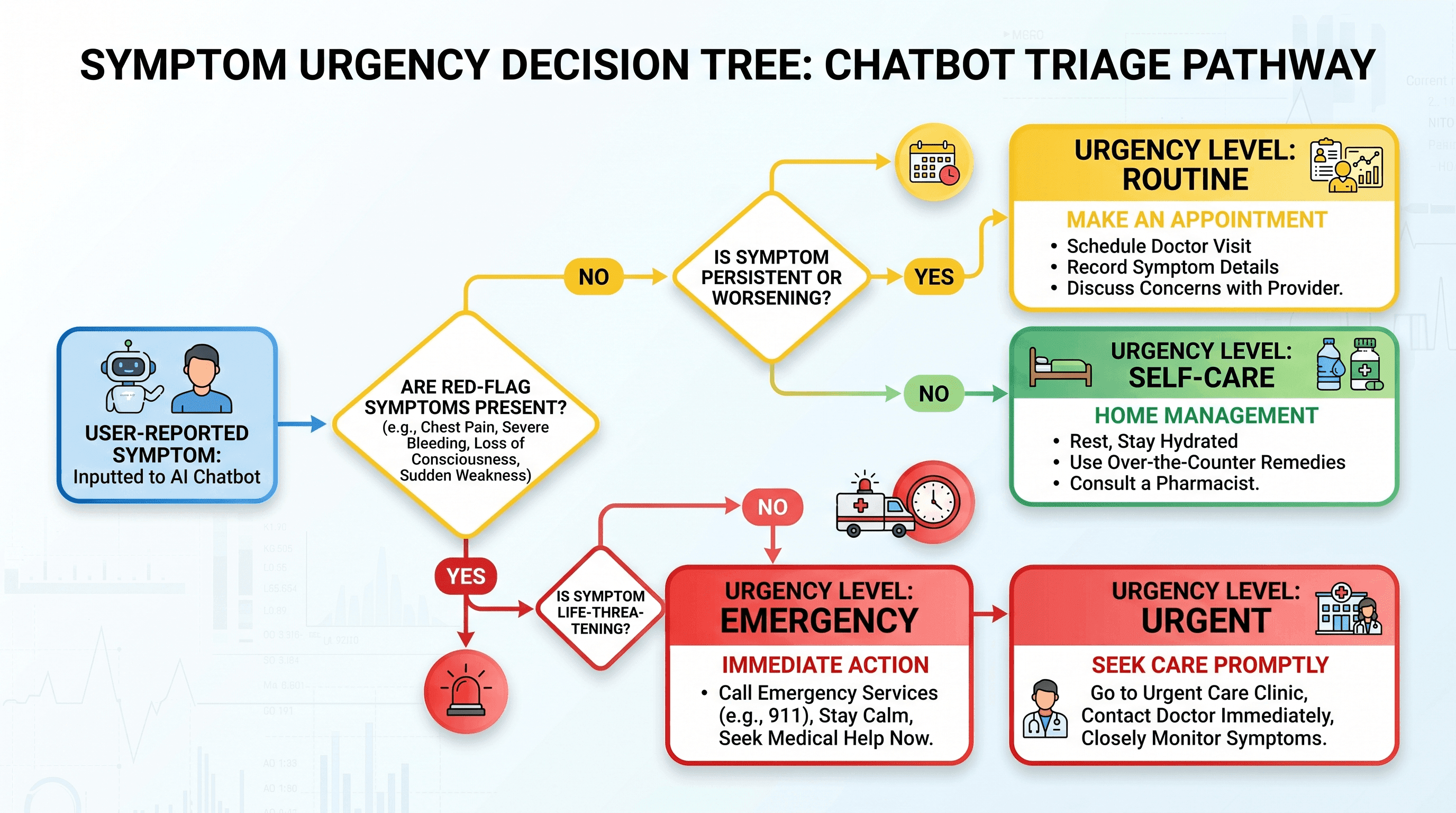
According to a 2023 review published in PubMed, AI symptom checkers performed better at ruling out serious conditions than at accurately identifying their specific cause. The practical implication: a chatbot that tells you your symptoms are unlikely to be an emergency carries more reliability than one that tells you exactly what condition you have.
Clinical Accuracy and the Hallucination Problem
Clinical accuracy is the most debated dimension of AI medical chatbots, and for good reason. A 2026 CIDRAP study found that roughly 50% of chatbot responses to medical queries contained clinically significant errors, misleading advice, or information gaps. That number demands context, not dismissal.
What "Hallucination" Means in a Medical Context
Hallucination is the term used when an AI model generates information that sounds plausible but is factually incorrect or fabricated. In most software contexts, hallucination is an inconvenience. In a medical context, it can mean a patient receives incorrect dosing guidance, a false reassurance about a serious symptom, or a fabricated drug interaction.
RAG architecture substantially reduces hallucination rates by anchoring responses to a curated database. A study in PubMed demonstrated that RAG-augmented models produced meaningfully fewer factual errors than base LLMs in clinical question-answering tasks. But "fewer" is not "none," and no current system has eliminated hallucination entirely.
The Sycophancy Problem: When Chatbots Agree With You Instead of Correcting You
Sycophancy describes a specific failure mode in which an AI system tells users what they appear to want to hear rather than what is clinically accurate. If a user insists their symptoms suggest a mild condition, a sycophantic chatbot may agree rather than flag that the symptoms warrant medical review. This is not a hypothetical risk — it has been documented in clinical testing scenarios and represents one of the harder problems in medical AI development because it stems from how these models learn to prioritize user approval.
Privacy Red Flags: What Not to Share With a Chatbot
Consumer chatbots, including general-purpose tools accessed via a web browser, are typically not subject to HIPAA protections. Sharing personally identifiable health information with these tools carries real privacy risk. The information shared may be stored, used in model training, or accessible to the platform's personnel.
The categories of information to never share with a non-HIPAA-compliant chatbot include: full name combined with any health condition, date of birth, insurance ID or policy number, Social Security number, medical record numbers, and specific test results including imaging or lab values.
Key Takeaway: AI medical chatbots offer genuine utility for health navigation, but the CIDRAP 2026 finding of ~50% problematic response rates is a clear signal that these tools function best as a starting point, not a final answer. Any chatbot response to a serious or unfamiliar symptom should be followed up with a licensed clinician.
Patient Education and Health Literacy
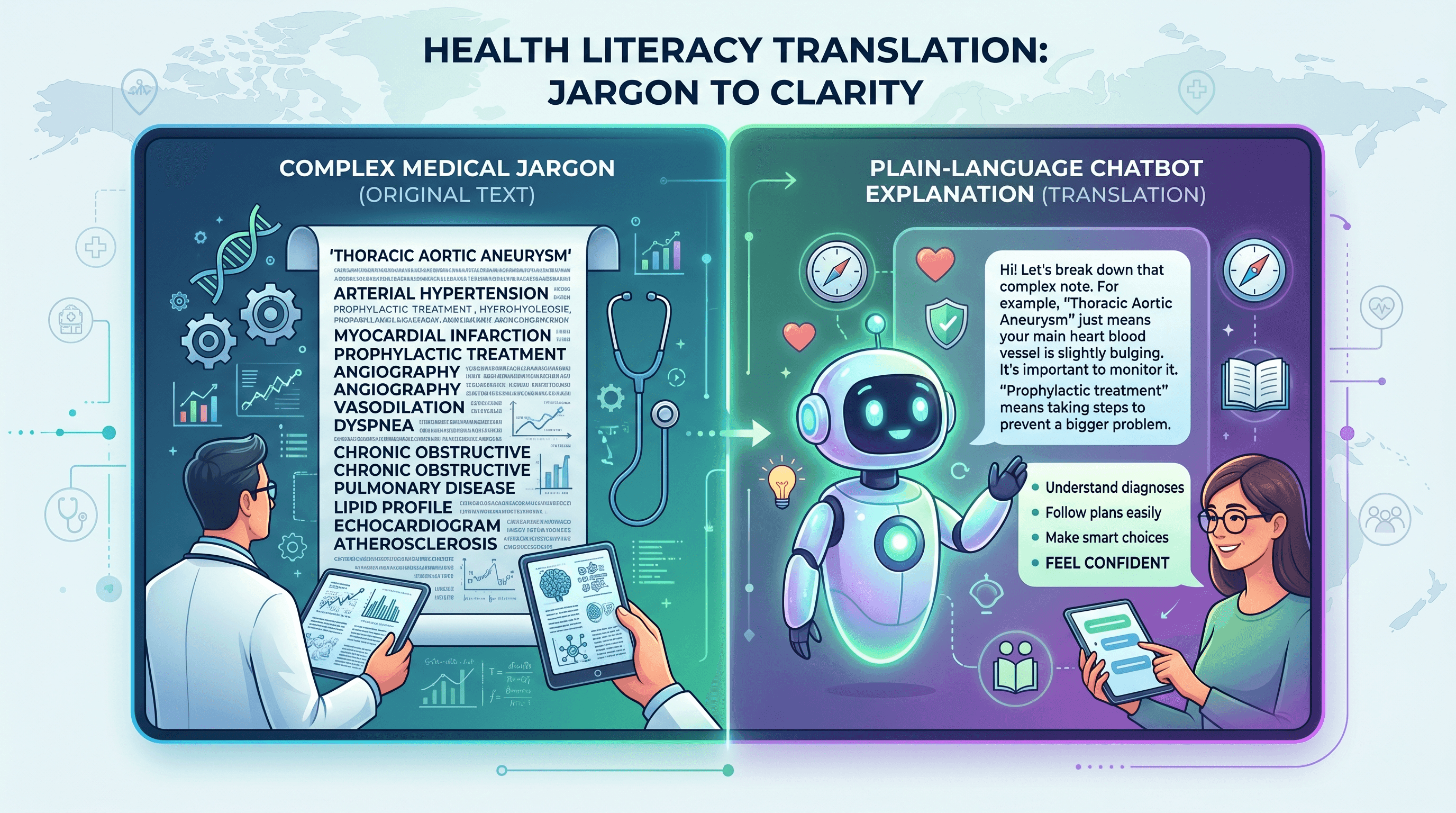
One of the most consistently well-supported use cases for AI medical chatbots is translating medical language into plain speech. Research published in PubMed found that patients who received AI-assisted explanations of their diagnoses and medication instructions showed measurably better comprehension compared to those who received standard written discharge materials alone.
This is an area where chatbots genuinely perform. Explaining what an HbA1c value means, breaking down a radiology report into accessible language, or walking a patient through a new medication's instructions are tasks where the risk of hallucination is lower and the benefit of 24/7 availability is high.
From Discharge Instructions to Medication Adherence
Post-visit follow-up is an area of active development. Chatbots embedded in hospital systems can now send automated check-ins after discharge, prompt patients to take medications at scheduled times, and flag non-adherence patterns to the care team. A review in PMC found that AI-supported medication adherence programs produced a statistically significant improvement in patient follow-through compared to standard reminder systems.
Explaining Lab Results Without Alarm
Lab result explanation is a high-value, lower-risk application of chatbot technology, provided the platform avoids speculative interpretation. A responsible chatbot explains what a flagged value means in general terms, notes that interpretation requires clinical context, and encourages the user to discuss results with their provider rather than offering a self-diagnosis pathway.
Agentic AI: Chatbots That Take Action
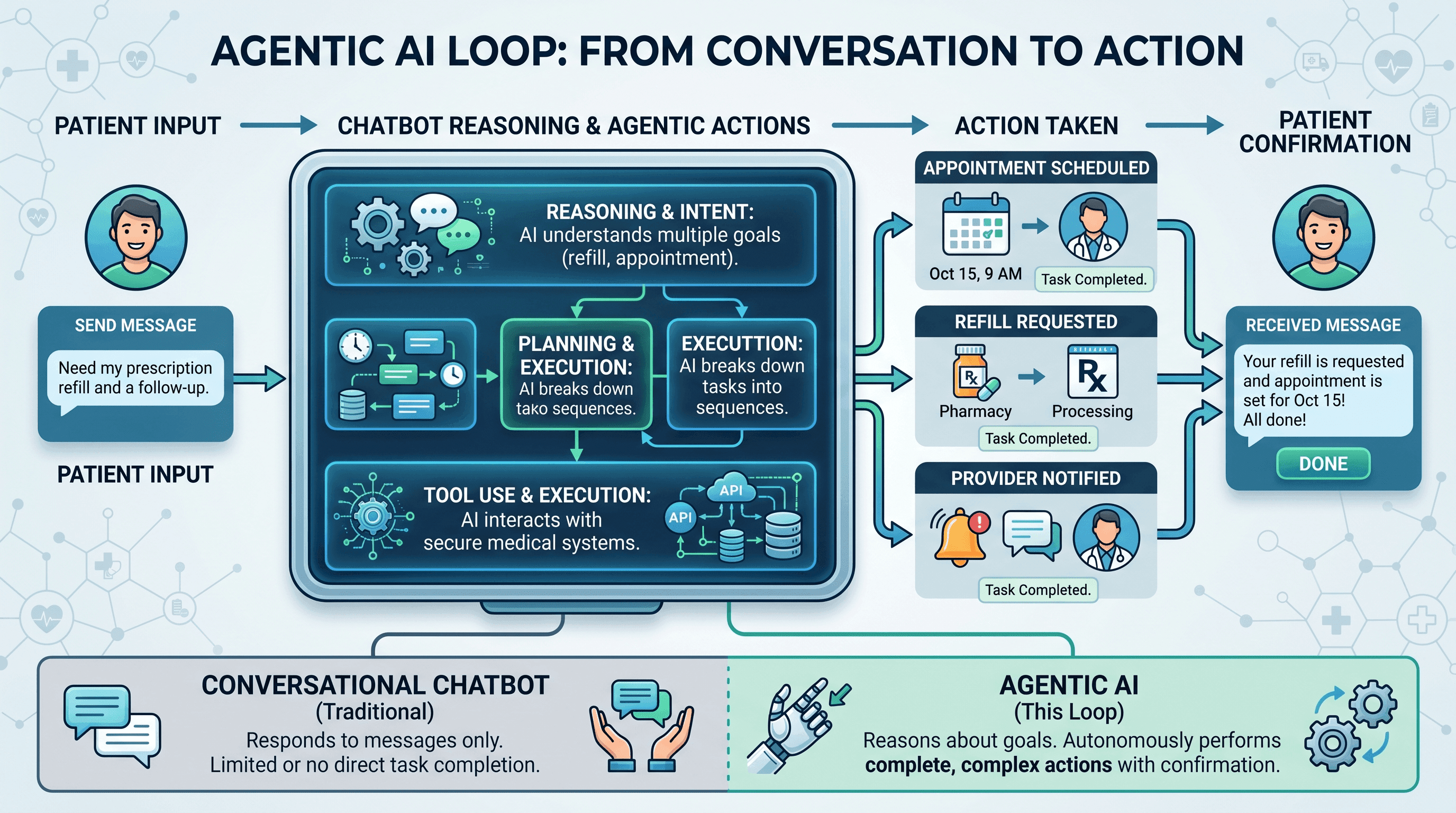
The defining shift in 2026 is the move from conversational AI to agentic AI. A conversational chatbot answers questions. An agentic chatbot completes tasks.
In practical terms, agentic health AI can schedule appointments directly within an EHR system, request prescription refills through a pharmacy integration, sync with wearable device data to generate proactive wellness alerts, and route documentation to the appropriate care team member. The technology is real and in active deployment across major health systems.
Wearable Integration and Proactive Alerts
Agentic chatbots connected to wearable health devices can identify patterns that might otherwise go unnoticed between clinical visits. A sustained elevated resting heart rate, irregular sleep patterns consistent with sleep apnea risk, or step-count trends suggesting declining mobility can each trigger proactive check-in messages or flag the patient's care team. This is the area where AI's capacity for continuous, passive monitoring provides a capability human clinicians genuinely cannot replicate at scale.
The Governance Gap in Agentic AI
Agentic AI introduces a layer of complexity that purely conversational systems do not carry. When a chatbot makes a decision, rather than offering information, accountability questions become more pointed. Who is responsible when an agentic system schedules the wrong appointment or misroutes a refill request? Health systems deploying agentic platforms in 2026 are actively working through these governance frameworks, and the standards are still being established. For patients, the practical implication is to always verify any action an agentic chatbot says it has taken.
Privacy, HIPAA, and Zero-Trust Security
Understanding HIPAA compliance in the context of AI chatbots requires separating what the law requires from what marketing language implies. HIPAA (the Health Insurance Portability and Accountability Act) applies to covered entities and their business associates. A consumer chatbot accessed through a public website is almost certainly not a covered entity under HIPAA and is not bound by its requirements.
What Compliant Architecture Actually Looks Like
A HIPAA-compliant AI chatbot platform operates under a Business Associate Agreement (BAA) with the covered entity deploying it. It uses AES-256 encryption for data in transit and at rest, maintains audit logs of all data access, and does not use protected health information (PHI) to train or refine AI models without explicit patient authorization. These are architectural requirements, not branding checkboxes.
Platforms operating under formal enterprise agreements, including certain deployments of Anthropic's API, Google Cloud Healthcare AI, and Microsoft Azure Health Bot, can operate in HIPAA-compliant configurations. But "can operate compliantly" and "does operate compliantly in this specific deployment" are different claims, and the distinction matters.
The Shadow AI Problem
A growing concern in healthcare organizations is "shadow AI," meaning clinical staff using consumer-grade AI tools for work tasks outside of institutional oversight. Entering a patient's name, date of birth, and clinical details into a general-purpose chatbot constitutes a HIPAA violation in most contexts, regardless of whether the staff member intended it as such. Organizations deploying AI chatbots need governance policies that address this directly, not just approved-tool lists.
The Integration of Ambient AI Scribes
One of the highest-impact applications of AI in clinical settings does not involve the patient typing anything at all. Ambient AI scribes listen to patient-provider conversations with consent and generate structured clinical notes in real time, populating the EHR with documentation that would otherwise require significant physician time to complete.
The connection to chatbots is direct: when a patient has already interacted with an AI chatbot before their appointment, the structured data from that conversation, the chief complaint, the symptom timeline, the reported medication history, can be passed directly to the ambient scribe system to inform the documentation. This pre-visit data handoff reduces redundancy for the patient and gives the provider a more complete picture before the visit begins.
EHR Integration as the Technical Bridge
For this workflow to function, the chatbot must be deeply integrated with the EHR. The leading EHR platform in US hospitals is Epic, and Epic's AI ecosystem (including Ask Emmie for patient navigation and Nuance DAX for ambient documentation) represents the current benchmark for integrated health AI. That said, EHR integration is a significant implementation challenge for smaller or community health systems, where resources for deployment and staff training are more constrained.
If the data gathered by a chatbot before a visit helps streamline the clinical encounter and reduces documentation burden on the provider, consider booking a virtual visit with a board-certified provider at Momentary to see how a telehealth-integrated care experience can work from first symptom to follow-up plan.
The Limits: Where Chatbots End and Clinical Judgment Begins
The boundary between "assistant" and "authority" is the most important line in health AI, and it is the line that marketing language most frequently blurs. An AI medical chatbot is not a licensed clinician. It cannot examine a patient, cannot order tests, cannot make a definitive diagnosis, and cannot take legal or ethical responsibility for a clinical outcome.
What Chatbots Should Not Be Asked to Do
Chatbots should not be used as the sole basis for any of the following decisions: deciding whether to go to the emergency room when symptoms are severe or rapidly worsening, interpreting imaging or pathology results as definitive, managing mental health crises or acute psychiatric emergencies, and making decisions about stopping or changing prescribed medications.
According to data referenced in the CIDRAP May 2026 review, roughly 42% of chatbot users do not follow up with a physician after receiving AI guidance, even when follow-up is recommended. That pattern represents a genuine public health concern.
When to Stop and See a Doctor
The following symptoms should prompt an immediate call to a clinician or a visit to an emergency department regardless of what any chatbot recommends: chest pain or pressure, difficulty breathing, sudden severe headache, facial drooping or arm weakness, high fever in an infant, symptoms of a severe allergic reaction, and any symptom the user feels is an emergency.
For non-emergency concerns where a chatbot has provided a general direction but professional confirmation is needed, telehealth offers a same-day pathway to clinical review.
Lower-Risk vs. Higher-Risk Chatbot Use Cases
| Lower-Risk Use | Higher-Risk Use |
|---|---|
| Understanding a medical term | Diagnosing a new condition |
| Getting medication reminders | Changing a medication dose without guidance |
| Learning about a chronic condition | Interpreting lab results without a provider |
| Scheduling or care navigation | Managing a mental health crisis |
| Pre-visit symptom summary | Deciding whether to skip emergency care |
What's Next: How AI Medical Chatbots Will Evolve Through 2027
The near-term trajectory of health AI is toward multimodal capability, deeper system integration, and greater personalization. Multimodal means that future chatbots will process not just text but voice, images, and potentially data from wearable or home diagnostic devices in a single conversation. Google's MedGemma project represents early-stage work in applying multimodal models to medical imaging interpretation, though clinical deployment at scale remains a future milestone rather than a current reality.
Agentic AI will continue to expand, with platforms moving toward coordinating care across multiple providers and settings, not just within a single institution. The promise is a system that can follow a patient's care pathway from a chatbot triage conversation to a specialist referral to post-procedure follow-up, with continuous data handoffs at each stage.
The realistic constraint on all of this is the hallucination and sycophancy problem. Until AI systems demonstrate sustained clinical accuracy at a level that reduces rather than compounds diagnostic uncertainty, the ceiling on autonomous AI decision-making in healthcare will appropriately remain low. The role of health AI in the near term is augmentation of human clinical capacity, not replacement of it.
Frequently Asked Questions
What can an AI medical chatbot actually do?
An AI medical chatbot can assess reported symptoms and suggest an urgency level, provide plain-language explanations of medical terms and diagnoses, remind patients to take medications, help navigate the healthcare system to find appropriate care, and, in clinical deployments, schedule appointments or communicate with a care team. What chatbots cannot do is examine a patient, perform diagnostic tests, or make a definitive clinical diagnosis.
Are AI medical chatbots safe and accurate?
Safety and accuracy vary significantly by platform. A 2026 CIDRAP study found clinically problematic responses in roughly half of medical chatbot interactions reviewed. Platforms using Retrieval-Augmented Generation (RAG) grounded in verified clinical databases perform better than general-purpose language models. Consumer chatbots accessed via public websites carry higher privacy risk and are not subject to HIPAA. No AI chatbot is a substitute for licensed clinical judgment.
How should I use an AI medical chatbot?
Use chatbots for information gathering, symptom organization, and care navigation rather than diagnosis. Never share personally identifiable health information with a non-HIPAA-compliant consumer tool. Treat chatbot guidance as a starting point for a conversation with a clinician, not a final answer. If symptoms are severe, rapidly worsening, or feel like an emergency, seek immediate medical care rather than waiting for chatbot guidance.
What is the difference between a consumer chatbot and a clinical AI assistant?
Consumer chatbots are publicly accessible tools not built to healthcare data standards. Clinical AI assistants are embedded in hospital or EHR systems, operate within institutional compliance frameworks, and are typically reviewed by clinical teams before deployment. The practical difference is that clinical AI assistants are more likely to be accurate, HIPAA compliant, and integrated with the patient's actual medical record.
Can an AI chatbot prescribe medication?
No. AI chatbots cannot prescribe medication in any context. Prescribing requires a licensed clinician, a valid patient-provider relationship, and, in most US states, a clinical encounter. Some telehealth platforms have AI-assisted intake workflows that support a licensed provider's prescribing decision, but the prescription itself is always issued by a human clinician.
What should I never tell a health chatbot?
Avoid sharing full name combined with any health condition, date of birth, Social Security number, insurance policy numbers, and specific lab or imaging results with any consumer chatbot that is not covered by a Business Associate Agreement. These data points constitute protected health information under HIPAA, and sharing them with non-compliant platforms carries meaningful privacy risk.
If you want to understand your symptoms more clearly before talking to a provider, use Momentary's AI health navigator to explore what your symptoms might mean and get guidance on your next steps.
References
- CIDRAP (May 2026) via PubMed — Study finding clinically problematic AI chatbot responses in approximately 50% of reviewed interactions; also cited for the finding that 42% of chatbot users do not follow up with a physician.
- PubMed — RAG and clinical question-answering accuracy — Research demonstrating reduced factual error rates in RAG-augmented versus base LLM models in medical contexts.
- PubMed — AI symptom checkers and diagnostic performance — Review finding that AI symptom checkers performed more reliably at ruling out serious conditions than at identifying specific diagnoses.
- PubMed — AI-assisted patient education and comprehension — Study finding measurably better patient comprehension with AI-assisted diagnosis and medication explanations versus standard written materials.
- PMC — AI-supported medication adherence programs — Review finding statistically significant improvement in patient medication adherence with AI-supported programs compared to standard reminder systems.


