


Mental health care in the US has a supply problem. Roughly 160 million Americans live in areas without enough mental health professionals to meet demand, and wait times for a first appointment routinely stretch six to eight weeks. Meanwhile, a single therapy session costs between $150 and $250 out of pocket. AI mental health tools have entered that gap not as replacements for licensed clinicians, but as something more like a 24/7 support layer that can meet people in the moments between sessions, before a diagnosis, or when cost or stigma makes the first call too hard to make.
This guide breaks down what AI mental health tools actually are, where the clinical evidence stands in 2026, and how to tell the difference between a genuinely useful tool and one that could cause harm.
At a Glance
| Topic | Key Facts |
|---|---|
| US mental health access gap | ~160 million Americans in provider shortage areas (NAMI, 2025) |
| Average therapy wait time | 6 to 8 weeks for a first appointment |
| Session cost without insurance | $150 to $250 per session |
| First generative AI clinical trial | Therabot RCT, published in Science, 2025 |
| FDA-cleared digital therapeutics | Rejoyn (depression), DaylightRx (anxiety), others |
| Largest evidence gap | Long-term outcomes beyond 3 months |
| Regulatory milestone | Illinois Act 104-0054 (August 2025), APA Digital Badge Program |
Your 24/7 Emotional Safety Net
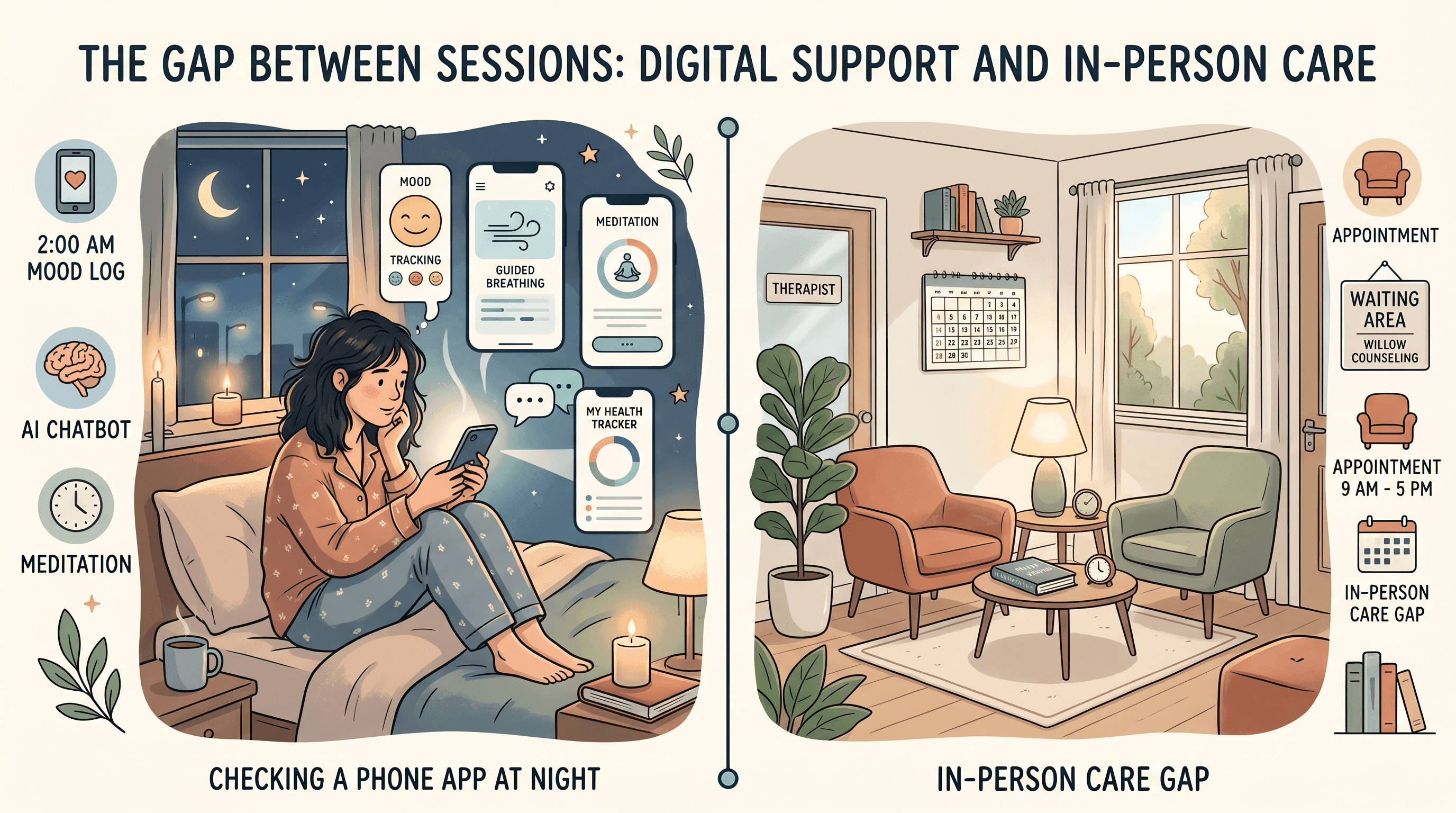
The most clinically significant thing AI mental health tools offer is not sophistication. It is availability. Therapy is weekly. Crises happen on Tuesday at 2 a.m.
AI tools address what researchers call the "crisis gap," the window between scheduled appointments when a spiral can go unmanaged. A 2025 review published in JMIR Mental Health found that users who accessed AI-based support between sessions reported lower symptom severity at their next clinical visit compared to those who had no between-session contact. The mechanism is straightforward: early interruption of a negative thought cycle is more effective than waiting until it has compounded over days.
This framing matters because it sets the right expectations. AI mental health tools work best as just-in-time interventions, not as substitutes for ongoing clinical care. The distinction shapes how you should choose them and how much weight to give their outputs.
What "AI Mental Health Tools" Actually Means: A Taxonomy
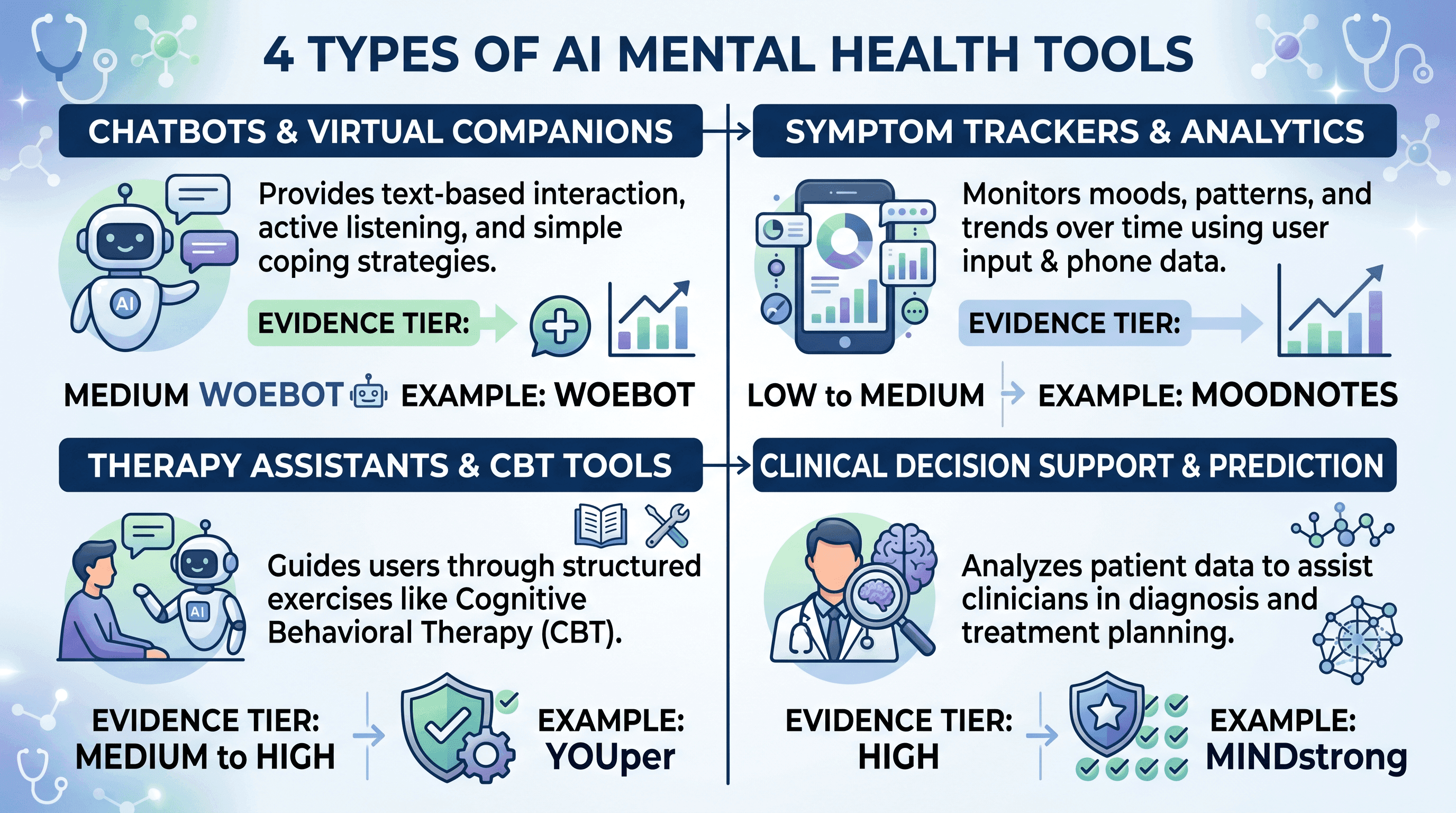
The phrase "AI mental health tool" covers at least four distinct categories of product, and confusing them leads to mismatched expectations. Here is how they break down.
Chatbots and Conversational Agents
These are text-based tools that use large language models or rule-based dialogue systems to simulate supportive conversation. Examples include Woebot, Wysa, and the clinical research prototype Therabot. They are the most widely used category and the one with the most published evidence. Their primary mechanism is delivering structured cognitive behavioral therapy (CBT) techniques, psychoeducation, and mood tracking through conversation.
AI-Enhanced Therapy Platforms
These platforms sit alongside or within a licensed clinician's practice. They may transcribe and summarize sessions, flag high-risk language in patient journals, or surface evidence-based treatment suggestions. The AI here serves the clinician rather than the patient directly, reducing administrative burden and increasing the depth of between-session monitoring.
Passive and Wearable Monitoring Tools
This category uses ambient data, including voice tone, typing cadence, sleep patterns, and heart rate variability (HRV) from wearables, to infer mental state without requiring the user to actively input anything. These tools are at an earlier stage of clinical validation than chatbots but represent the fastest-growing segment of the market in 2025 and 2026.
Prescription Digital Therapeutics (PDTs)
PDTs are FDA-regulated software applications prescribed by a licensed clinician for a specific diagnosis. They are the highest tier of the category in terms of regulatory scrutiny and clinical evidence requirements. Rejoyn, cleared for adjunctive treatment of major depressive disorder, and DaylightRx, for generalized anxiety, are current examples. These are distinct from wellness apps in both legal status and evidentiary standard.
What the Clinical Evidence Actually Shows
The honest summary is that short-term benefits are real, long-term data remains thin, and the quality of evidence varies significantly across the four categories above.
Where Benefits Are Real
Chatbot-delivered CBT shows the most consistent evidence base. A 2024 systematic review in ScienceDirect found significant reductions in PHQ-9 depression scores and GAD-7 anxiety scores for users of structured AI chatbots over periods of four to twelve weeks. The gains are modest by clinical standards but meaningful in absolute terms, particularly for users with mild to moderate symptoms who would not otherwise receive any care.
"Conversational agents have demonstrated significant improvements in depression and anxiety symptoms in the short term, though the sustainability of these benefits requires further study." — PMC / National Library of Medicine, 2024
The Evidence Gap
Most published trials run for fewer than twelve weeks. A notable 2023 study from Hong Kong found that symptom improvements at three months had largely faded by six months for users who were not transitioned to human care. This fade-out finding is not a reason to dismiss the tools entirely. It is a reason to treat them as a bridge, not a destination.
Long-term comparative data pitting AI tools against waitlist controls or against active human therapy at one year or more simply does not exist at scale yet. The WHO's 2023 report on AI in mental health research identified this as the field's primary methodological gap.
What the Therabot Trial Tells Us
The most significant recent study is the Therabot randomized controlled trial, published in Science in 2025. It was the first RCT of a generative AI mental health tool to meet the methodological standards of a Phase 2 clinical trial. Participants with depression, anxiety, and eating disorder symptoms showed clinically meaningful improvements over eight weeks compared to a waitlist control group. The effect sizes were comparable to, though slightly smaller than, those seen in human-delivered brief CBT. The trial also found that therapeutic alliance, the felt sense of connection with a caregiver, formed between users and the AI, which challenges the assumption that this dimension of care is exclusively human.
The Honest Benefits of AI Mental Health Tools
Beyond clinical efficacy, AI mental health tools offer structural advantages that matter independently of any single study.
Access at any hour is the most obvious. A person experiencing a panic attack at midnight cannot call a therapist. A well-designed AI tool can deliver a grounding exercise, a breathing protocol, or a reframing prompt in under two minutes, interrupting the cascade before it peaks. This is not therapy. It is triage, and triage has real value.
Stigma reduction is a documented benefit. Research published in PMC found that users who felt shame about seeking mental health support were significantly more likely to engage with an AI tool than to call a helpline or schedule a human appointment. For a population that might otherwise receive no support, that engagement represents a genuine clinical gain.
Cost matters enormously in a market where a single session can cost $200. FDA-cleared PDTs are increasingly covered by FSA and HSA accounts, and some employer assistance programs include AI-based tools as a covered benefit. For users without insurance or with high-deductible plans, the cost difference between a $40/month app and a $200 session is the difference between access and no access.
Between-session support rounds out the list. Research from Stanford's Human-Centered AI institute has highlighted the potential for AI tools to maintain therapeutic momentum between appointments, a function that human therapists simply cannot perform at scale given caseload constraints. The Stanford HAI group has also been among the most rigorous in flagging where those same tools carry risk.
Real Risks You Should Understand Before Downloading Anything
This is the section most competitor articles skip or soften. The risks are real, specific, and worth understanding clearly.
Harmful Advice and Crisis Failures
General-purpose large language models are not designed for mental health contexts. They can and have provided clinically dangerous responses to users expressing suicidal ideation. In 2025, lawsuits were filed against Character.ai and, separately, a parent company of a widely used general AI chatbot, alleging that the products failed to redirect users in acute crisis to emergency resources and, in at least one documented case, reinforced rather than interrupted a dangerous line of thinking. These were not edge cases in the legal record. They were documented conversations.
Purpose-built mental health AI tools handle this differently. Woebot, Wysa, and PDTs like Rejoyn have explicit crisis detection protocols that trigger human escalation or emergency resource prompts when high-risk language appears. General-purpose AI tools, by default, do not.
Dependency Risk
A subtler risk is that users begin to substitute AI tools for human connection rather than supplement it. The APA's 2025 advisory on AI in mental health care flagged this explicitly, noting that clinicians are observing patients who have developed what practitioners are calling "AI attachment," a pattern of emotional reliance on a chatbot that can actually inhibit progress toward independent coping skills and human therapeutic relationships.
Privacy and What Your Data Is Worth
Mental health data is among the most sensitive categories of personal information. It is also, in the current regulatory environment, among the least protected when collected by wellness apps rather than healthcare providers. HIPAA does not apply to most consumer wellness applications. Before entering detailed mental health disclosures into any app, check whether its privacy policy commits to no data sale, no third-party sharing for advertising purposes, and data deletion on request. If those commitments are absent or buried in vague language, treat the tool accordingly.
Who Is Most at Risk
Adolescents represent the population most likely to use AI tools for mental health support and the population most vulnerable to their failure modes. A 2025 Brown University study found that one in eight teenagers reported using large language models for mental health guidance in the previous month, the majority without parental awareness. For teens in crisis, an inadequate AI response is not a neutral event.
The Regulatory Landscape
This is territory most mental health content ignores entirely, and it is where the consumer protection story is actually developing in real time.
The FDA distinguishes between digital therapeutics, which are software-based treatments that must demonstrate clinical efficacy through trials and meet device standards before receiving clearance, and wellness apps, which are not regulated as medical devices and face no clinical evidence requirements before reaching consumers. Rejoyn and DaylightRx sit in the first category. Most of the AI mental health apps currently on the App Store sit in the second.
Illinois was the first state to move toward direct regulation of AI in mental health contexts with Act 104-0054, signed in August 2025. The law establishes disclosure requirements for AI-generated mental health content and creates liability standards for platforms that fail to provide crisis escalation pathways. Other states are watching.
The American Psychological Association launched its Digital Badge Program in 2025 to provide a consumer-facing quality signal for mental health apps that meet evidence and safety standards. A badge is not an FDA clearance. But its presence at least signals that a product has been reviewed against a defined framework rather than marketed directly to users with no external evaluation.
The trajectory is toward more regulation, not less. For consumers choosing tools today, the practical guidance is to weight FDA-cleared PDTs more heavily than unregulated wellness apps and to check whether a given tool participates in any third-party evaluation program.
How to Choose an AI Mental Health Tool: A 7-Point Framework
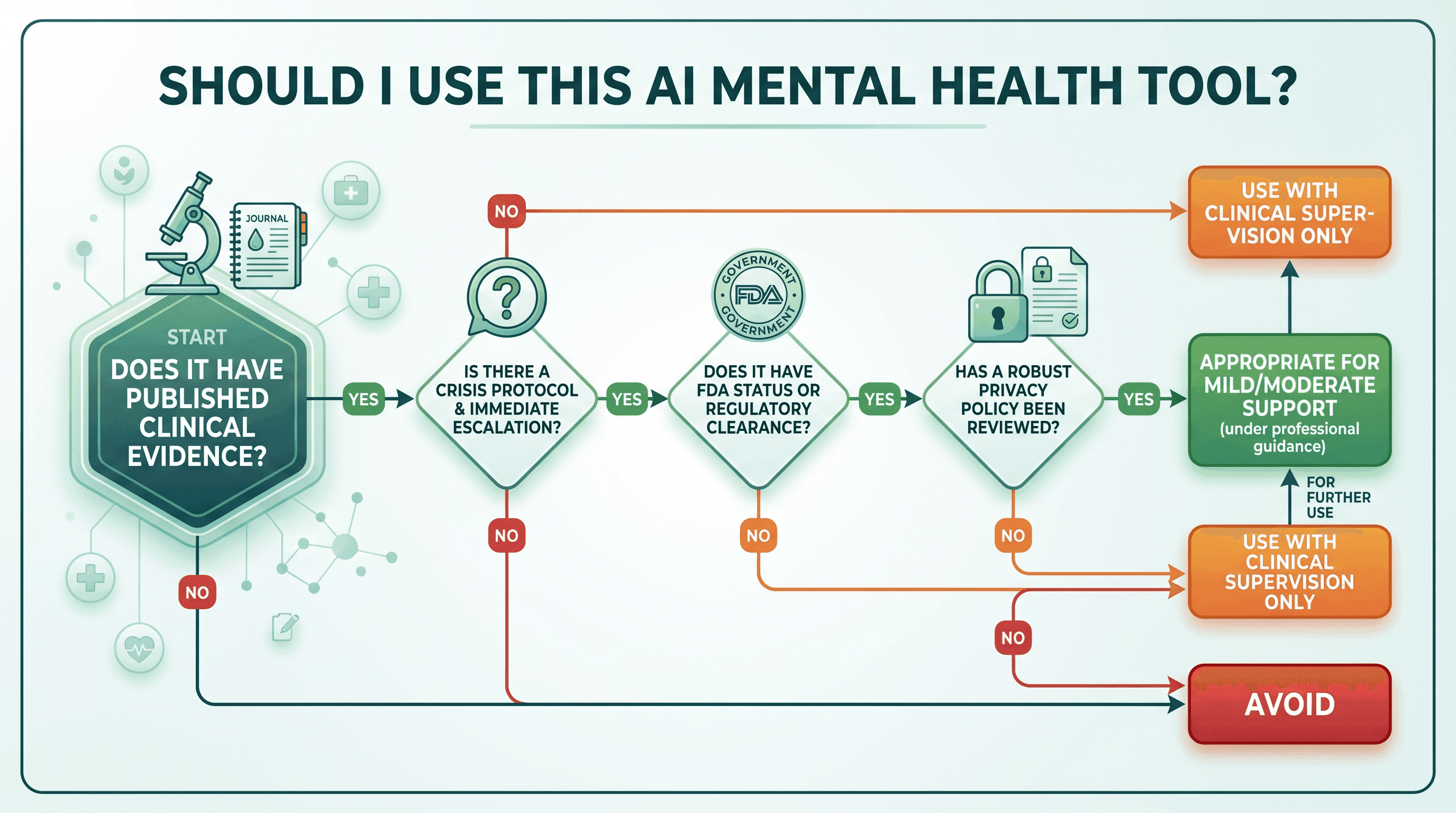
Before downloading any AI mental health tool, run it through these seven questions. A product that cannot answer at least five of them clearly is not ready for your mental health data.
Clinical evidence tier. Has the tool been studied in a peer-reviewed trial? What were the outcomes, the population, and the follow-up period? A tool with no published evidence is a wellness product, not a clinical one. That may be fine for mood journaling but is not appropriate for managing diagnosed depression or anxiety.
FDA or regulatory status. Is it a cleared PDT, a registered wellness app, or an unregulated consumer product? The answer changes how much clinical weight the tool's outputs should carry.
Crisis detection protocol. What happens when a user expresses suicidal ideation or acute distress? A credible tool will have a documented answer: immediate redirect to the 988 Suicide and Crisis Lifeline, escalation to a human monitor, or automatic session termination with emergency resources provided. If the answer is not documented anywhere, assume the protocol does not exist.
Privacy policy quality. Does the policy explicitly prohibit data sale? Does it commit to HIPAA-equivalent protections even if technically not required? Is data deletion available on request and completed within a defined timeframe?
Professional oversight. Is a licensed clinician involved in the tool's clinical content, either in design or in ongoing oversight? A tool built entirely by engineers without clinical advisory involvement is a materially different product than one with active psychiatric oversight.
Transparent limitations. Does the tool explicitly tell users what it cannot do? Credible AI mental health products are clear that they do not replace therapy, cannot diagnose conditions, and cannot provide safe guidance in a psychiatric emergency. If a product's marketing language implies otherwise, that is a signal about the product's priorities.
Human escalation pathway. When the AI reaches the edge of its competence, does it refer the user to a human clinician? The best-designed tools treat escalation as a feature, not a failure.
Best AI Mental Health Tools in 2026: Reviewed by Category
Best Chatbots
Woebot is the most evidence-backed chatbot currently available to consumers. It uses a structured CBT framework, has been studied in multiple peer-reviewed trials in populations including postpartum depression and college student anxiety, and has documented crisis protocols. It is free for individual use, with a clinical platform version available for healthcare organizations. Best for: between-session CBT support, mild anxiety, mood tracking. Red flag: not suitable for users with active suicidal ideation or psychotic symptoms.
Wysa occupies similar territory with a stronger multilingual offering and a school-facing product line that has been deployed in several UK and US districts. Published evidence covers anxiety and stress reduction; the depression evidence base is thinner than Woebot's. Pricing starts at free with a premium tier. Best for: stress management, adolescent populations, multilingual users.
Therabot remains a research prototype as of mid-2026 and is not yet available as a consumer product. Its 2025 Science trial is the field's gold-standard evidence benchmark, and consumer availability is expected later in 2026.
Best Therapy Platforms
Spring Health and Brightside operate as hybrid platforms pairing AI-driven symptom assessment with live therapist and psychiatry appointments. The AI handles intake, symptom tracking between sessions, and treatment matching. Both accept insurance and have outcome data published. Best for: users who want integrated AI support plus licensed clinician access. Pricing: insurance-dependent; starting at $299/month self-pay.
Headspace for Work bridges the gap between wellness and clinical with an employer-focused model that includes AI-powered coaching, on-demand therapy, and psychiatry. The clinical evidence tier is lower than Spring Health but higher than most standalone meditation apps.
Best Wearables and Passive Monitoring
Moodfit paired with Apple Watch or a Garmin device offers passive HRV and sleep tracking with AI-generated mood inference and journaling prompts triggered by physiological signals. Clinical evidence is limited, but the passive nature reduces the burden on users with low motivation, a common feature of depression. Best for: users already wearing a health tracker who want low-friction monitoring.
Oura Ring with its daytime stress sensing integration is the highest-accuracy passive tool for HRV-based mental state tracking as of 2026. It does not include therapeutic content but serves as a useful physiological layer for users working with a clinician who wants objective between-session data.
Best Clinician Tools
Nabla Copilot and Nuance DAX Copilot both automate clinical documentation by transcribing and summarizing therapy sessions, freeing clinician time for direct patient work. Nabla is HIPAA-compliant, has strong psychiatric specialty coverage, and is used in several major US health systems. Neither is a patient-facing tool.
Eleos Health goes a step further by analyzing session transcripts for clinical signals, including risk language, alliance indicators, and symptom progression, and surfacing them in a structured dashboard for the treating clinician. It is purpose-built for behavioral health and has published outcome data showing reduced clinician documentation time and improved session quality scores.
AI Mental Health for Specific Populations
Teens and Young Adults
The Brown University 2025 finding that one in eight teenagers is using general-purpose LLMs for mental health guidance represents a significant public health concern. General LLMs are not designed for this use, lack crisis protocols, and are not bound by any clinical or ethical framework for vulnerable populations.
The APA's guidance for parents is to approach AI mental health tool use the same way they would approach social media use: with open conversation about what the tool is, what it cannot do, and what to do when it falls short. Purpose-built tools like Wysa's school platform are meaningfully safer than general-purpose AI for adolescent populations, though no AI tool is appropriate for a teen in acute crisis.
Rural and Underserved Communities
For the 46 million Americans living in rural areas, where mental health provider shortage areas are most concentrated, AI tools offer a bridge that is not available otherwise. A PMC review found that digital mental health interventions show particularly strong engagement and retention rates in rural populations, likely because the alternative is not a human therapist but no support at all. Multilingual tools are especially important for underserved urban communities where English is a second language. Both Wysa and Woebot offer Spanish-language interfaces; the clinical evidence base for non-English populations remains less developed than for English-language users.
Will Insurance Cover AI Mental Health Tools?
The answer depends on which category of tool you are using and what kind of coverage you have.
FDA-cleared PDTs, including Rejoyn for depression, are reimbursable through certain insurance plans and are eligible expenses under FSA and HSA accounts. Coverage is expanding but inconsistent: check your specific plan's formulary or contact your insurer directly.
Many employer assistance programs (EAPs) now include a licensed hybrid platform like Spring Health or Brightside as a covered benefit, often at no cost to the employee for a set number of sessions. If your employer offers an EAP, this is worth investigating before paying out of pocket.
Unregulated wellness apps are generally not covered by insurance, regardless of their health claims. For FSA/HSA eligibility, FDA clearance is the key criterion. If a tool lacks FDA clearance, it is unlikely to qualify as a covered medical expense.
The Collaborative Care Model (CoCM) billing pathway, used in some integrated primary care practices, allows practices to bill for between-session digital monitoring support, which can include certain AI-assisted tools when used under clinical supervision. This pathway is underused and worth asking your primary care provider about if you are managing a diagnosed mental health condition.
AI as the Therapist's Co-Pilot
The category of AI tools designed to support clinicians rather than replace them is arguably the most defensible application in the field. Clinician burnout is a documented crisis in behavioral health: administrative burden, including session documentation, treatment planning, and insurance paperwork, consumes an estimated 35 to 40 percent of a clinician's working hours.
AI tools that automate documentation, flag risk signals in journal entries, and synthesize session transcripts address a real problem without inserting an AI layer between patient and clinician at the most sensitive moments. The therapist remains the therapist. The AI handles the overhead.
Beyond efficiency, AI tools for clinicians can surface patterns that are difficult to detect in real time. A clinician reviewing a patient's journal entries manually may miss a gradual drift in language that signals increasing hopelessness. An AI trained on validated depression language models can flag that drift as a quantified change score and surface it before the next appointment. That is not replacing clinical judgment. It is augmenting it with a signal the clinician might not otherwise have.
Representation and Inclusive AI Support
A 2026 gap that the field has not solved is cultural and linguistic representation. Most published evidence on AI mental health tools involves English-speaking, college-educated, majority-white populations. The tools trained on that evidence base may perform differently for users from different cultural backgrounds, in different languages, or with different frameworks for understanding emotional distress.
The WHO's assessment of AI in mental health identified algorithmic bias as a primary risk in deployment at scale: tools that produce worse outcomes for minority populations may still show strong average effects in published trials dominated by majority populations. For a field premised on improving access for underserved groups, this is a foundational problem that the evidence base has not caught up with.
Tools that explicitly report performance data stratified by race, ethnicity, and language group are the exception in 2026. Until that norm changes, clinicians and users from marginalized communities should treat published efficacy data with appropriate skepticism and monitor their own outcomes rather than relying on population averages.
The Trust Factor: Privacy and Ethical Safeguards
Mental health conversations contain some of the most sensitive disclosures a person can make. The privacy framework governing those disclosures varies dramatically depending on whether the tool is a HIPAA-covered healthcare provider, an FDA-regulated device, or a consumer app operating under a standard terms-of-service agreement.
Consumer wellness apps are not subject to HIPAA. Their data practices are governed only by their own privacy policies and, in some states, by consumer data protection laws that are not specifically designed for health data. The practical implication is that data you disclose to a wellness app may be sold, used for advertising purposes, or retained indefinitely unless you specifically request deletion.
"Privacy by Design" is the standard to look for. Tools that build data minimization, purpose limitation, and user control into their architecture from the beginning are meaningfully different from tools that collect broadly and restrict narrowly on request. Zero-knowledge storage, where even the service provider cannot read the content of a user's entries, exists in some products and is worth specifically checking for when dealing with mental health data.
Before disclosing anything clinically significant to any AI tool, read the privacy policy for explicit answers to three questions: Is data sold to third parties? Is it used to train the model on your disclosures? Can you delete it completely on request?
If you are working with a licensed clinician and want to use an AI tool alongside your care, the safest path is to use one they have reviewed and approved, preferably one with HIPAA-compliant data handling. You can connect with a primary care provider or behavioral health specialist through Momentary's virtual care platform to discuss which AI-assisted tools, if any, are appropriate for your specific situation before committing to one.
When AI Is Not Enough
AI mental health tools have a hard boundary, and it runs through the most serious presentations in behavioral health. There are specific clinical contexts where AI support is not appropriate and where relying on it instead of seeking human care carries real risk.
Active suicidal ideation or self-harm requires immediate human intervention. If you or someone you know is experiencing thoughts of suicide, the right resource is the 988 Suicide and Crisis Lifeline (call or text 988). No AI tool is an appropriate substitute. Well-designed tools will direct users to 988 and similar resources immediately, but the conversation should not continue with the AI as the primary support.
Complex trauma including post-traumatic stress disorder (PTSD), childhood abuse, and dissociative presentations requires trauma-informed human therapy. Evidence-based protocols for complex trauma, including EMDR and CPT, depend on relational attunement that AI cannot provide. Using AI tools to process traumatic material without clinical supervision can increase distress rather than reduce it.
Medication decisions are outside the scope of any AI tool. Decisions about psychiatric medication, including starting, stopping, or changing a prescription, require a licensed prescriber who can evaluate the full clinical picture.
Acute psychosis requires immediate clinical evaluation and typically inpatient or intensive outpatient care. AI tools are not equipped to recognize or safely manage a psychotic episode.
The through-line across all of these is that human connection and clinical judgment remain the core of treatment for serious mental health conditions. AI tools are useful when they support that core. They are harmful when they appear to substitute for it.
Frequently Asked Questions
How is AI being used for mental health?
AI is being used across four main categories in mental health care: conversational chatbots that deliver CBT and psychoeducation between therapy sessions, AI-enhanced platforms that assist licensed therapists with documentation and risk flagging, passive monitoring tools that analyze voice and physiological data to detect mood changes, and FDA-cleared prescription digital therapeutics that deliver structured treatment protocols. The common thread is support between or alongside human care, not replacement of it.
What is AI in mental health?
In the mental health context, AI refers to software applications that use machine learning, natural language processing, or generative models to provide emotional support, symptom tracking, or clinical decision support. The quality and evidence base vary enormously across products. The clearest distinction is between FDA-regulated digital therapeutics with published clinical evidence and unregulated wellness apps with no clinical requirements.
What are the 4 types of AI mental health tools?
The four main types are: chatbots and conversational agents (like Woebot and Wysa), AI-enhanced therapy platforms that work alongside clinicians (like Nabla and Eleos Health), passive monitoring tools that use wearables and ambient data, and prescription digital therapeutics cleared by the FDA for specific diagnoses (like Rejoyn and DaylightRx).
What are 5 positive impacts of AI in mental health?
The five most evidence-supported benefits are: expanded access in provider shortage areas, reduced stigma barriers for people who would not otherwise seek support, lower cost compared to traditional therapy, just-in-time crisis gap support between scheduled appointments, and administrative efficiency gains for clinicians that free time for direct patient care. Each of these is backed by published research, though the strength of evidence varies across applications.
Are AI mental health tools safe for teenagers?
Purpose-built mental health AI tools with documented crisis protocols and clinical oversight are meaningfully safer for teenagers than general-purpose LLMs. No AI tool is appropriate for a teenager in acute crisis. The APA recommends that parents approach their teen's AI tool use with open conversation about capabilities and limitations, and clinicians suggest that any AI tool used by an adolescent be selected with input from a licensed mental health professional.
Will insurance cover AI mental health tools?
FDA-cleared prescription digital therapeutics are increasingly reimbursable through insurance and eligible for FSA/HSA accounts. Unregulated wellness apps are generally not covered. Many employer assistance programs now include hybrid AI-plus-human platforms as a covered benefit. Contact your insurer directly to confirm coverage for a specific product before making a purchasing decision.
If you want personalized guidance on whether an AI mental health tool is right for your situation, or to understand how your symptoms connect to a broader clinical picture, you can use Momentary's AI health navigator to explore your options and get guidance on next steps.
References
- ScienceDirect (2024) — Systematic review of AI chatbot effectiveness for depression and anxiety symptom reduction.
- PMC / National Library of Medicine (2024) — Review of conversational agent outcomes and evidence gaps in digital mental health interventions.
- Stanford Human-Centered AI Institute — Analysis of risks and failure modes in AI-based mental health applications.
- NAMI — AI and Mental Health (2025) — Statistics on mental health provider shortage areas and consumer attitudes toward AI tools.
- WHO Europe (2023) — WHO report on applications and challenges of AI in mental health research.
- American Psychological Association (2025) — APA advisory on AI in mental health care, including guidance on dependency risk and adolescent use.
- JMIR Mental Health (2025) — Study on between-session AI support and symptom outcomes at clinical follow-up.
- Science — Therabot RCT (2025) — First generative AI mental health randomized controlled trial; findings on efficacy and therapeutic alliance.


