


Artificial intelligence has moved from the research lab into the exam room. Primary care, the branch of medicine most Americans depend on first for nearly every health concern, is now deploying AI tools that listen to conversations, flag at-risk patients before they show symptoms, and coordinate care between specialists without a phone call ever being made. The question is no longer whether AI belongs in primary care. The question is what it actually does, where it still falls short, and what both patients and practice leaders should realistically expect.
At a Glance
| Topic | Key Facts |
|---|---|
| Primary care AI adoption | 29% of US physicians now use AI scribes (Doximity, 2026) |
| Physician shortage | AAMC projects a shortfall of up to 87,000 PCPs by 2037 |
| Documentation burden | Physicians spend approximately 28 hours per week on administrative tasks |
| Patient acceptance | Most patients accept AI when a physician remains clearly in charge |
| AI scribe time savings | Approximately 16 minutes saved per 8-hour shift in recent multi-center trials |
| Key risk | Automation bias: over-reliance on AI outputs without clinical verification |
Your Medical "First Responder": What AI in Primary Care Actually Does
Primary care is the entry point for about 55% of all outpatient visits in the United States, according to the CDC. It handles chronic disease monitoring, preventive screenings, mental health check-ins, and the kind of ambiguous complaints that do not fit neatly into specialist categories. That breadth is exactly what makes it the highest-leverage environment for AI deployment, and also the most complex one.
The core promise of AI in primary care is a "prevention-first" model. Rather than waiting for disease to reach a threshold that triggers a referral, AI tools analyze patterns across large patient populations and individual biometric streams to surface risks earlier. At the same time, they absorb administrative and logistical work so the clinician can direct full attention to the person across the desk.
This is not a single technology. It is a layered set of tools covering documentation, care coordination, predictive screening, chronic disease management, and patient triage. Each layer has different evidence behind it, different implementation challenges, and different implications for how a GP appointment actually feels.
Ambient Scribes and the "Eye-Contact-First" Visit
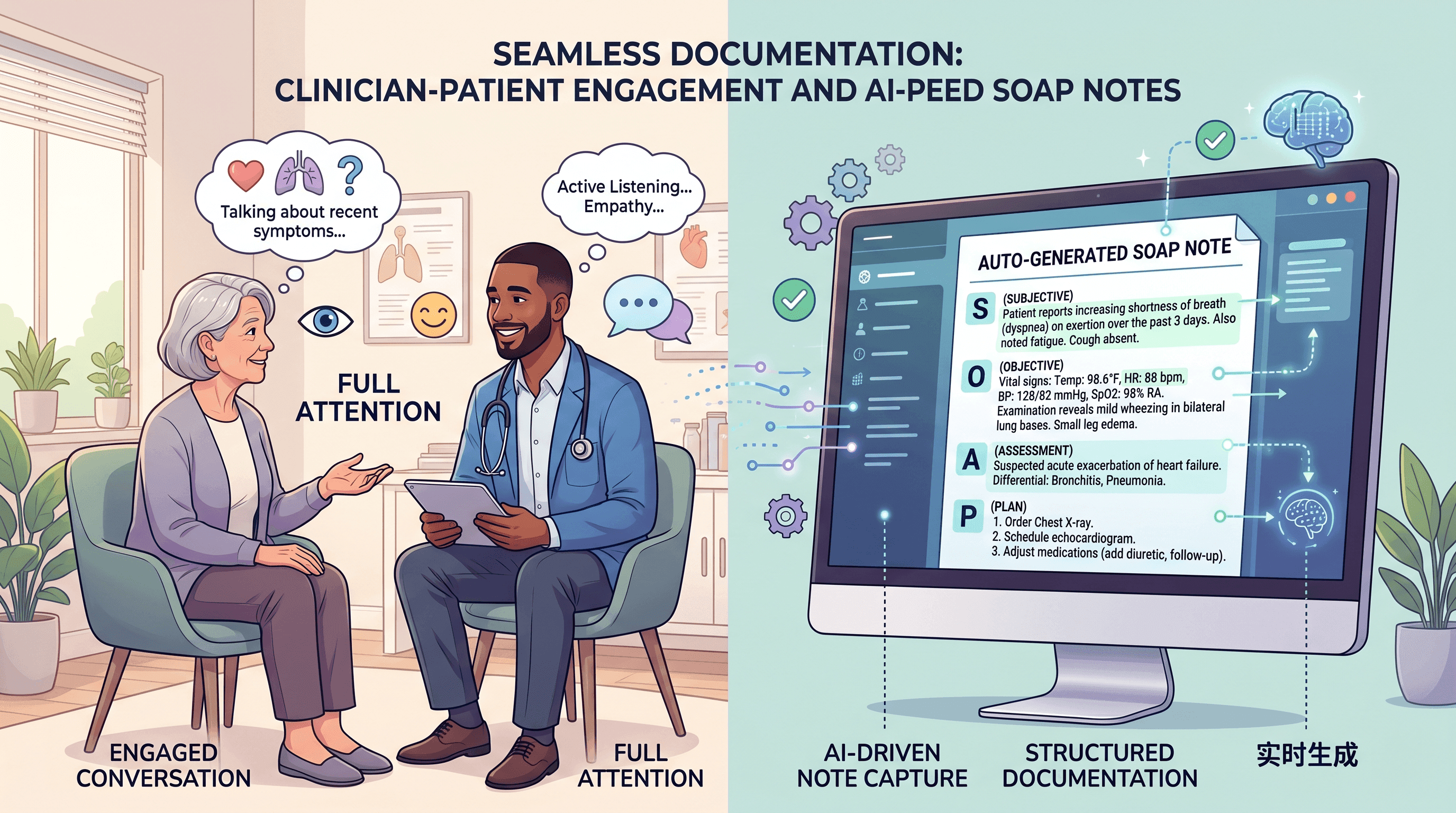
The most widely deployed AI application in primary care in 2026 is the ambient scribe. These are systems that listen to a clinical encounter in real time, process the conversation using large language models, and generate a structured clinical note, typically formatted as a SOAP note (Subjective, Objective, Assessment, Plan), before the appointment ends.
According to the Doximity 2026 State of AI in Medicine Report, 29% of US physicians now use AI scribes, up sharply from single-digit adoption just two years prior. The two platforms most cited by clinicians are DAX Copilot (Microsoft) and Nabla, both of which integrate directly with major EHR systems including Epic and Cerner.
The primary benefit is time. When clinicians are not typing or dictating during an appointment, they can maintain eye contact, ask follow-up questions, and be more physically present. Patients consistently report that visits feel longer and more thorough even when the clock time is unchanged. A 2025 study in JMIR found that ambient scribes contributed to measurable improvements in patient-reported satisfaction scores related to physician attentiveness.
The Ambient Scribe Reality Check
The honest version of this benefit is more modest than vendor marketing suggests. A multi-center randomized controlled trial published in April 2026 found that ambient scribes saved clinicians approximately 16 minutes per 8-hour shift. That is a real improvement, worth deploying, but it is not the transformational reduction in documentation burden that early projections implied.
The gap between expectation and reality tends to show up in revision time. Clinicians still need to review, correct, and sign off on AI-generated notes. When a scribe misinterprets a clinical term or omits a nuance, the correction takes longer than it would have taken to dictate the note manually. This does not eliminate the benefit. It does mean that practices should evaluate ambient scribes against realistic benchmarks rather than sales-deck projections.
Agentic AI and Care Coordination
Beyond documentation, a newer category of AI is beginning to reshape how primary care practices manage the space between visits. Agentic AI refers to systems that can take autonomous action within defined workflows rather than simply generating text for a human to review. In primary care, this means AI that does not wait for a staff member to initiate a task.
Concrete examples already in deployment include AI systems that automatically schedule follow-up appointments after a lab result triggers a predefined protocol, send outreach messages to patients who are overdue for annual screenings, route referral requests to the appropriate specialist based on insurance panel and diagnosis code, and reconcile incoming lab and imaging results against a patient's current care plan without requiring manual review by a nurse coordinator.
A December 2025 Viewpoint in The Lancet Primary Care framed agentic AI as the frontier that matters most for the access crisis, precisely because per-visit tools still require a physician to be present. Agentic tools extend the practice's reach between visits, which is where the majority of chronic disease deterioration actually happens.
Population Health and Proactive Panel Management
At a population level, AI tools can now monitor entire patient panels rather than responding to individual appointment requests. A practice serving 2,000 patients can deploy a system that flags every patient overdue for a colorectal cancer screening, segments them by risk tier based on age and family history, and triggers an automated outreach sequence, all without a staff member reviewing a spreadsheet.
Stanford Medicine's AI in Primary Care research has highlighted this population-level view as one of the most promising and underused capabilities. The leverage is significant: catching a patient before a condition becomes acute is almost always cheaper, less disruptive, and better for outcomes than treating the acute episode.
Predictive Screening and Early Detection
Primary care's foundational value proposition is catching problems before they become emergencies. AI is now extending this capability into timelines that were previously impossible for a clinician working from annual visit data alone.
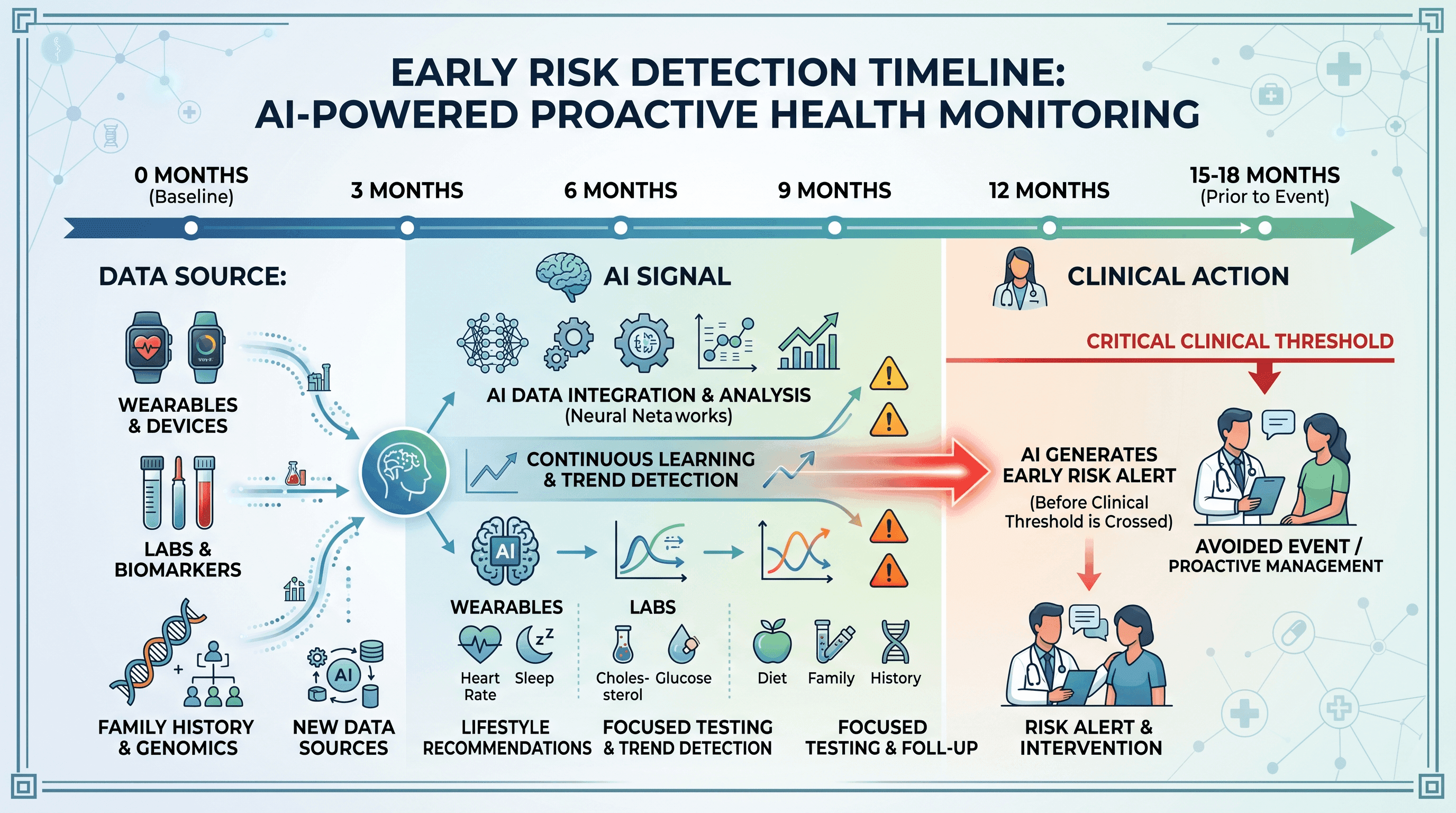
Predictive screening tools integrate wearable device data, genetic markers where available, structured EHR data, and social determinants of health to generate risk scores for conditions including Type 2 diabetes, chronic kidney disease, cardiovascular events, and early-stage dementia. A patient whose resting heart rate variability has declined steadily over 18 months, whose HbA1c is in the high-normal range, and whose family history flags for cardiovascular disease may receive an automated outreach from a risk stratification algorithm well before any single data point crosses a clinical threshold on its own.
Research published in PMC has shown that multimodal AI risk models, those integrating more than one data source, consistently outperform single-biomarker thresholds for early identification of chronic disease trajectories.
The concept of a digital health twin, a continuously updated computational model of an individual patient's physiology, remains largely in research settings as of 2026. But its building blocks are in clinical use. Wearable integration, passive biometric monitoring, and AI-driven interpretation of longitudinal trends are all live in primary care practices that have connected remote patient monitoring platforms to their EHR.
AI-Driven Chronic Disease Management
For the approximately 133 million Americans living with at least one chronic condition, according to the NIH, primary care is a lifelong relationship rather than a series of discrete visits. AI is reshaping what that relationship looks like between appointments.
For patients managing Type 2 diabetes, AI-connected platforms can monitor continuous glucose monitor (CGM) data, flag patterns that suggest insulin resistance is worsening, and send protocol-driven nudges to both the patient and the care team before a quarterly HbA1c test would have caught the drift. For patients with hypertension, remote blood pressure monitoring integrated with AI risk scoring means a clinician can intervene on a trend rather than a single out-of-range reading.
This continuous monitoring model reduces what researchers call "care gap" time, the period between visits when a patient's condition may be deteriorating without clinical awareness. A scoping review in PMC found that AI-assisted chronic disease management programs were associated with improved medication adherence and earlier detection of decompensation events compared to standard care intervals.
The tradeoff is patient engagement. AI chronic disease tools work best when patients actively use connected devices and respond to outreach. Populations with lower digital literacy or inconsistent smartphone access may derive less benefit, a point addressed in the equity section below.
The Digital Front Door and Smart Triage
Before a patient ever reaches a clinician, AI is now active in the intake process. AI-powered patient portals, sometimes called "digital front door" platforms, use symptom checkers and conversational interfaces to assess urgency, route patients to the appropriate level of care, and provide immediate interim guidance.
A patient who messages a portal at 11 PM reporting three days of escalating shortness of breath and mild chest pressure will receive a different automated response than one reporting a mild sore throat for two days. The first will be flagged for urgent review and likely redirected to emergency evaluation. The second may receive a telehealth triage appointment for the following morning.
This kind of AI-powered triage does not replace clinical judgment. It accelerates the routing decision so that the right patients reach the right level of care faster, and so that primary care capacity is not consumed by cases better handled at urgent care or the ED. For practices managing high no-show rates, AI triage systems that confirm appointment necessity and send adaptive reminders have shown measurable reductions in unnecessary visit volume.
What Patients Actually Think
The patient perspective on AI in primary care is more nuanced than either optimistic or skeptical framings suggest. A 2025 California Health Care Foundation (CHCF) patient research study found that most patients are willing to accept AI tools in their care, but with conditions that matter a great deal in practice.
The non-negotiables, as reported by patients, are that the physician remains visibly in charge of every decision, that patients are told when AI is influencing their care, and that they can ask questions and receive plain-language explanations of what the AI flagged and why. Consent is not a legal formality in this context. It is a trust mechanism.
Trust gaps are more pronounced among Black patients and other populations with documented histories of mistreatment in the health system. For these patients, an AI tool that appears to operate as a "black box" (a system that produces outputs without legible reasoning) is not simply a technical inconvenience. It is a reactivation of justified distrust. Practices that deploy AI in communities with fraught histories in medicine need explicit transparency protocols that go beyond a consent checkbox.
One counterintuitive finding from the CHCF research: AI tools that handle documentation and administrative tasks can paradoxically increase trust among non-English-speaking patients, because their clinician now has more uninterrupted time to speak with them through an interpreter, rather than dividing attention between the patient and a keyboard.
Consent, Transparency, and the "Black Box" Problem
A simple patient-facing disclosure does not need to be technically complex. Practices can embed a two-sentence statement into intake forms: "We use AI tools to help document your visit and to support your care team. Your physician reviews everything before it becomes part of your record, and you can ask about AI's role at any time." That baseline is both honest and reassuring for most patients.
Where practices fall short is in failing to train front-desk and nursing staff to answer follow-up questions about AI. Patients who ask and receive vague or deflected answers are more likely to disengage from care than those who never asked.
The Equity Risk: When AI Reinforces the Gaps It Promised to Close
Algorithmic bias in healthcare AI is a systemic problem, and primary care is not exempt from it. Most AI models currently deployed in clinical settings were trained primarily on data from well-resourced health systems, predominantly large academic medical centers and integrated delivery networks. These training populations are not representative of the patients most in need of primary care support.
When a risk stratification model is trained on a population that skewed toward patients with consistent access to care, reliable documentation, and a full medication history, its predictions will be less accurate for patients whose health records are fragmented, who moved between providers, or whose social determinants of health were never systematically captured.
A 2025 paper in The Lancet Oncology examining AI implementation in care settings noted the risk of "performance stratification," where AI tools perform well for populations similar to their training data and systematically underperform for others.
The infrastructure gap compounds this. Well-resourced private practices and health systems can afford the EHR integrations, staff training, and vendor contracts required for AI deployment. Federally qualified health centers and safety-net providers, which serve the highest proportions of uninsured and Medicaid patients, often cannot. If AI adoption follows the same pattern as prior healthcare technology investments, the result will be a widening of existing disparities rather than a narrowing.
This is not an argument against AI in primary care. It is an argument for deliberate policy attention to where AI investment flows, what training data is used, and how performance is audited across demographic subgroups.
The Automation Bias Problem No One Is Talking About
One risk that appears in the clinical literature but is largely absent from vendor conversations is automation bias, the tendency for clinicians to over-trust AI-generated outputs without applying independent judgment.
A discussion in PMC on AI in clinical settings raised concerns about training a generation of physicians whose diagnostic reasoning is shaped by constant AI scaffolding. When AI outputs are usually correct, the human tendency is to stop checking them. But the cases where AI is wrong are often the edge cases, the patients whose presentations do not fit standard patterns, the rare diagnoses, the ambiguous drug interactions. These are precisely the cases where a clinician's independent judgment matters most.
Ambient scribe errors that go unreviewed become part of the medical record. A CDSS flag that a physician dismisses without checking becomes a missed diagnosis. The risk is not that AI is unreliable. The risk is that AI's reliability, when it is high, trains the clinician to lower their guard in ways that create harm when reliability drops.
Active countermeasures are available. These include requiring clinician attestation for all AI-generated notes, building regular audits of AI-suggested diagnoses into QA workflows, and explicitly training clinical staff that AI outputs are starting points rather than conclusions.
If your practice is considering deploying AI tools and would like to discuss how these concerns apply to your specific clinical environment, connecting with a primary care provider via Momentary's virtual platform is one way to get a clinician's perspective on what implementation looks like in practice.
Is Your Practice Ready? A Practical AI Implementation Framework
Most AI implementation failures in primary care are not technology failures. They are planning failures: a tool deployed without a clear use case, a vendor selected from a sales demonstration rather than a clinical trial, or a consent process that was an afterthought.
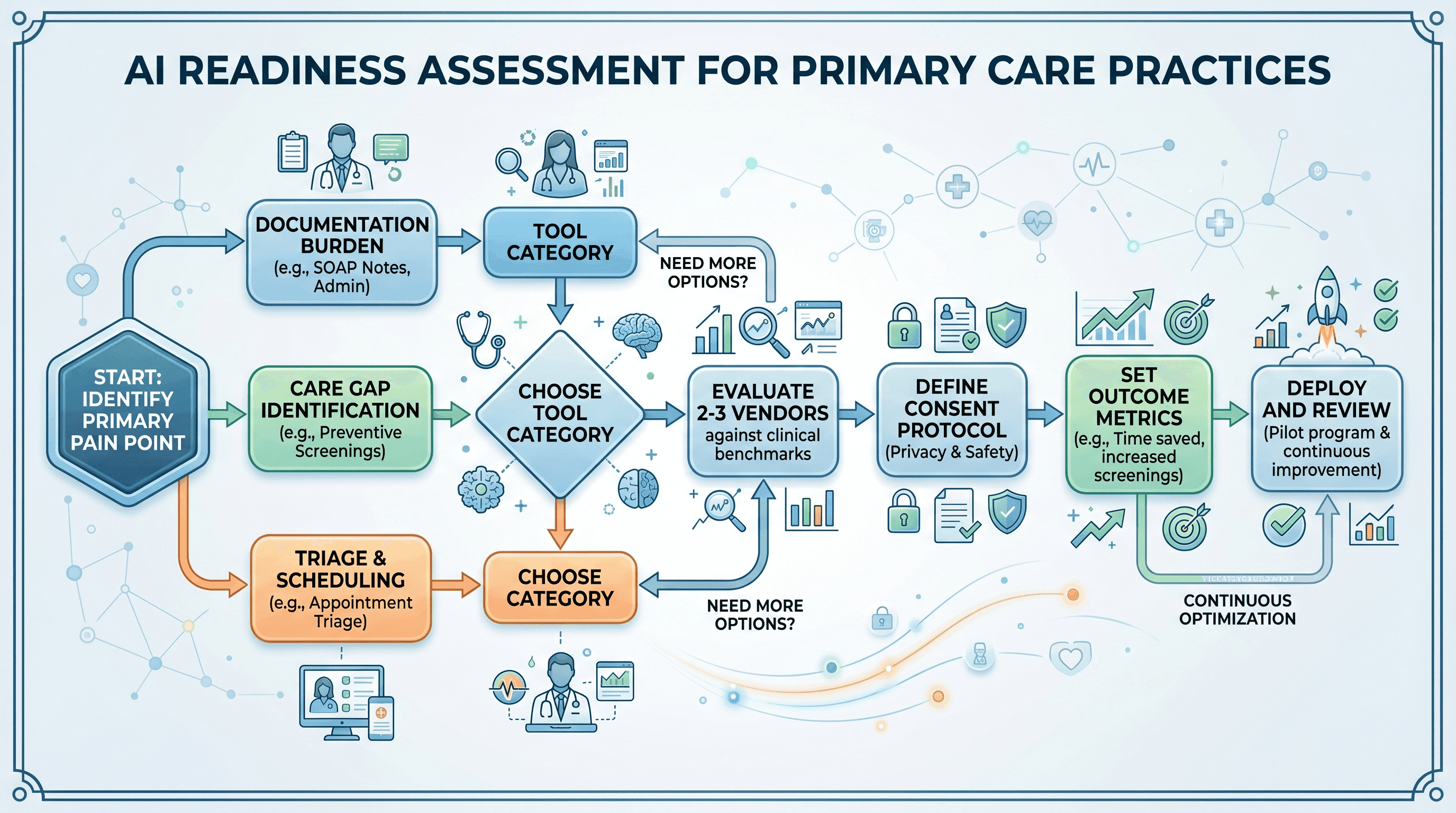
The following framework is not a checklist of generic considerations. It is a sequence of decisions that a practice leader or physician group administrator should make before signing a contract.
Define the Problem You Are Actually Trying to Solve
AI deployed without a clear problem statement wastes budget and creates staff fatigue. The right starting question is not "what AI tools are available?" but "what is the highest-leverage pain point in this practice right now?" For a practice where physicians are staying late to complete notes, ambient scribing is the right priority. For a practice with a high rate of missed follow-ups after abnormal labs, agentic care coordination is. For a rural practice trying to identify high-risk patients before they deteriorate and drive three hours to an ED, predictive screening deserves the first dollar.
Evaluate Vendors With Clinical Rigor, Not Sales Decks
Before selecting a vendor, a practice should ask: What training data was used, and is it demographically comparable to our patient population? Has this tool been validated in a practice setting similar to ours in size, payer mix, and EHR platform? What is the vendor's liability posture when the AI is wrong and a patient is harmed? The accountability vacuum in healthcare AI is real. Most vendor contracts currently assign liability to the clinician, not the tool. That is a material clinical and legal risk that should be negotiated before deployment, not discovered after.
Build a Patient Consent and Transparency Protocol
A plain-language disclosure at intake is the minimum standard. Beyond that, practices should train every patient-facing staff member to explain, in simple terms, what AI does and does not do in the practice. Transparency is not optional in populations with healthcare distrust.
Train Staff to Challenge AI Outputs, Not Just Accept Them
Staff protocols for AI skepticism should be explicit. Reviewing AI-generated notes before they are signed, flagging when a CDSS suggestion does not match the clinical picture, and reporting anomalies to a designated lead are all behaviors that can be built into workflow without adding significant time.
Measure Outcomes, Not Just Adoption
Practices that define success as "we deployed the tool" rather than "documentation time decreased by X minutes per shift" or "patient no-show rate fell by Y percent" cannot improve their AI investment over time. Set a small number of measurable outcome targets before deployment and review them at 30, 90, and 180 days.
The Bottom Line: AI as Co-Clinician, Not Replacement
The question patients and physicians ask most often is direct: will AI replace my family doctor?
The near-term answer is no, and the honest version of why goes beyond reassurance. The conditions that make primary care valuable to patients are not conditions AI currently replicates. The ability to notice that a patient's affect has changed since the last visit. The judgment to weigh competing diagnoses in a patient with five comorbidities, a complicated medication list, and a social history that complicates every standard recommendation. The trust that makes a patient say something they have never told another physician. These are not documentation problems or data problems. They are relationship problems, and they are the core of what primary care does.
What AI changes is the cognitive overhead surrounding that relationship. Documentation, care gap identification, administrative coordination, risk stratification across a full patient panel: these are tasks that consume physician time and attention without requiring the human capacities that define good clinical care. Offloading them to AI systems that are well-validated, well-monitored, and transparently disclosed to patients is a legitimate and evidence-supported use of the technology.
The primary care physician in 2030 will almost certainly spend less time on paperwork, have better real-time awareness of which patients in their panel are drifting toward a preventable hospitalization, and have AI-assisted decision support available for complex cases. That is a different practice environment, not a replacement of the physician's role. The relationship, the judgment, and the ethical responsibility remain human.
FAQ
How is AI used in primary care?
AI in primary care is currently deployed across four main functions. Ambient scribes listen to and transcribe clinical encounters in real time, generating structured notes so clinicians can focus on the patient rather than documentation. Clinical decision support systems surface diagnosis suggestions, flag drug interactions, and support risk stratification during the visit. Agentic AI tools autonomously manage workflows between visits, including scheduling follow-ups, reconciling lab results, and coordinating referrals. Predictive screening platforms analyze longitudinal data from EHRs and wearables to flag patients at elevated risk for chronic disease before symptoms become clinically obvious.
What are the main types of AI used in healthcare settings?
Healthcare AI is typically categorized by function rather than by architecture. The four most relevant types in clinical settings are machine learning systems (which identify patterns in large datasets to generate predictions or risk scores), natural language processing systems (which interpret and generate human language, including ambient scribes and chatbots), computer vision systems (used primarily in radiology and pathology to analyze images), and agentic or robotic process automation systems (which take autonomous actions within defined workflows). Most real-world healthcare AI tools combine more than one of these approaches.
What is the primary purpose of AI in healthcare?
The primary purpose of AI in healthcare, at a system level, is to reduce the gap between available clinical capacity and patient need. This happens through two complementary mechanisms: reducing the administrative and cognitive burden on clinicians so that existing capacity is used more efficiently, and extending preventive and monitoring capabilities so that disease is identified and managed earlier, reducing the volume of acute and high-cost care episodes.
Will AI replace primary care physicians?
No, not in any near-term timeframe the current evidence supports. AI handles cognitive overhead well: documentation, pattern recognition across large datasets, administrative coordination. It does not replicate the relational, ethical, and judgment-based capacities that define primary care at its best. The more accurate frame is that AI is shifting the PCP role away from data entry and toward the clinical functions that require a human.
What is automation bias, and why does it matter in primary care?
Automation bias is the tendency to over-trust AI outputs without applying independent clinical judgment. In primary care, this can manifest as a clinician accepting an AI-generated note without reviewing it carefully, or acting on a CDSS suggestion without considering whether it fits the individual patient's clinical picture. The risk is highest in edge cases and rare presentations, exactly the situations where independent judgment matters most. Active countermeasures include requiring attestation for all AI-generated content and building regular audits of AI suggestions into QA protocols.
How can patients find out if AI is being used in their care?
Patients can ask directly at any appointment. They can also ask at intake whether the practice uses AI-assisted documentation or decision support, and what the physician's role is in reviewing AI outputs before they affect care decisions. Practices that have a clear consent and transparency protocol will be able to answer this question straightforwardly. If a practice cannot explain its AI use in plain language, that is a reasonable basis for requesting more information before proceeding.
If you want to explore your symptoms or understand what questions to bring to your next appointment, Momentary's AI health navigator can help you make sense of what you are experiencing before you see a clinician.
References
- PMC, NIH — Scoping review on AI-assisted chronic disease management and care gap outcomes in primary care settings.
- The Lancet Primary Care — December 2025 Viewpoint on agentic AI and the primary care access crisis.
- Stanford Medicine — Research overview on AI in primary care, including population health and panel management applications.
- JMIR — 2025 study on ambient scribe impact on patient-reported satisfaction and physician attentiveness.
- PMC, NIH — Analysis of multimodal AI risk models and automation bias considerations in clinical settings.
- The Lancet Oncology — 2025 paper on performance stratification and algorithmic bias risks in AI-assisted care.
- AAMC — Physician workforce projections including the projected 87,000 PCP shortage by 2037.
- CDC — National Ambulatory Medical Care Survey data on outpatient visit distribution.
- NIH — Statistics on Americans living with chronic conditions.


