

At a Glance
| Topic | Key Facts |
|---|---|
| What it is | A digital tool that analyzes user-reported symptoms to suggest possible conditions and triage urgency |
| How it works | NLP + probabilistic reasoning + medical ontologies (e.g., SNOMED CT) |
| Accuracy range | Top-10 suggestion accuracy varies from 27% to 71.6% depending on tool and specialty |
| Best use case | Triage and care navigation, not final diagnosis |
| Key risk | AI hallucination, demographic bias, missing physical exam context |
| Red-flag rule | Chest pain, stroke signs, altered consciousness: skip the app, call emergency services |
| Privacy concern | Many tools are not HIPAA-covered entities; read the privacy policy before sharing data |
| Who benefits most | People in underserved, rural, or non-English-speaking areas |
Your Digital Triage Officer
An AI symptom checker is not a doctor. That distinction matters, and the best tools say so up front. What these platforms actually do is something more specific and, in the right context, genuinely useful: they act as a digital triage officer.
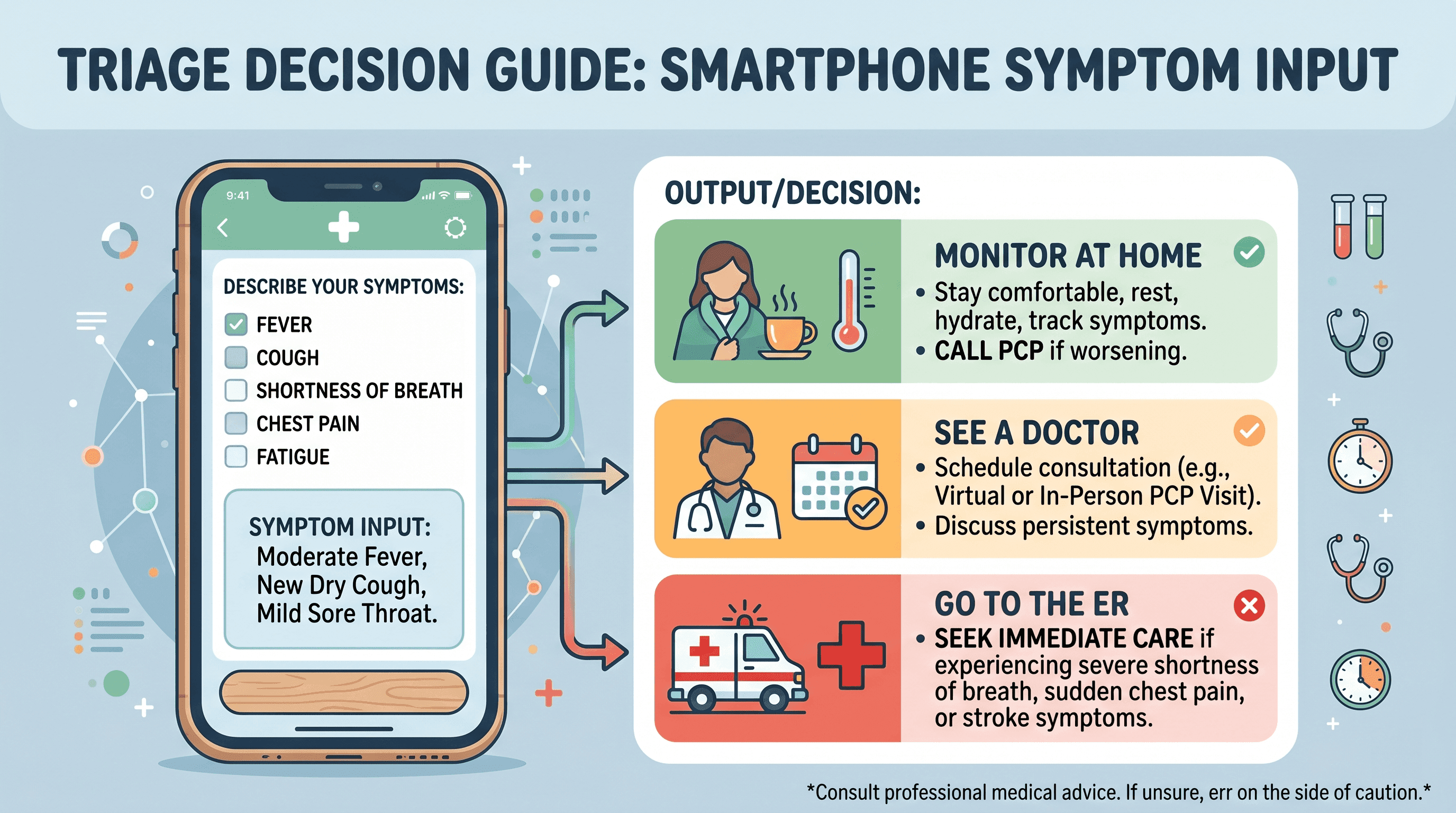
When someone types in "I have a sharp pain behind my right eye, a stiff neck, and sensitivity to light," a well-designed AI symptom checker does not simply return a list of conditions. It analyzes the symptom cluster against a structured medical knowledge base, assigns probabilistic weights to each possible cause, and then tells the user something actionable: go to the ER now, see a doctor within 24 hours, or rest and monitor at home. That guidance, when accurate, can redirect unnecessary ER visits and prevent delayed care in genuinely serious situations.
By 2026, these tools have grown significantly more sophisticated. Real-world use has expanded well beyond curious Googlers. A University of Pennsylvania Annenberg survey found that 79% of US adults now use AI tools for health-related queries, a figure that reflects how deeply this behavior has embedded itself in everyday health decision-making.
The question this guide answers is not whether AI symptom checkers exist or whether people use them. It is whether they deserve the trust people are placing in them, and exactly how to use them intelligently when they do.
How AI Symptom Checkers Actually Work
Most people who use a symptom checker have no idea what is happening behind the interface. That gap matters, because understanding the mechanism helps users know when to trust the output and when to be skeptical.
At the core of every modern AI symptom checker are three interacting systems: natural language processing (NLP) to understand what the user describes, a probabilistic or Bayesian reasoning engine to weigh competing diagnoses, and a structured medical ontology to define the relationships between symptoms, conditions, and clinical terminology.
Natural language processing allows the system to interpret plain-English descriptions like "my chest feels tight when I climb stairs" and map them to clinical terms such as exertional chest pain or angina. Without NLP, users would need to select from rigid dropdown menus, which most would abandon quickly.
Probabilistic reasoning is where the diagnostic intelligence lives. Rather than returning a single answer, these engines calculate likelihoods. Given a 45-year-old male reporting crushing chest pain, diaphoresis, and left-arm radiation, the system calculates the probability distribution across myocardial infarction, musculoskeletal pain, GERD, and anxiety. The conditions ranked highest in that distribution populate the output list.
Medical ontologies such as SNOMED CT (Systematized Nomenclature of Medicine Clinical Terms) give the system a standardized, hierarchical map of medical knowledge. SNOMED CT alone contains over 350,000 active concepts, according to SNOMED International. This database backbone is what allows AI tools to understand that "shortness of breath" and "dyspnea" refer to the same clinical entity, and that both are associated with dozens of possible underlying causes.
Rule-Based vs. Machine Learning Checkers
Not all symptom checkers use the same architecture. Rule-based systems follow hard-coded decision trees: if symptom A and symptom B, then suggest condition C. These tools are transparent and predictable, but they break down with unusual symptom combinations or rare presentations. WebMD's legacy symptom checker is an example of a primarily rule-based system.
Machine learning checkers, by contrast, are trained on large datasets of patient presentations and outcomes. They can generalize to novel combinations and improve over time as more data flows in. Ada Health and Ubie both operate primarily on ML-based frameworks, which partly explains why they outperform rule-based tools in independent evaluations.
General AI Chatbots vs. Dedicated Symptom Checkers
One of the most important distinctions in 2026 is the one between asking a general-purpose AI chatbot about symptoms and using a purpose-built medical symptom checker. The difference is structural, not cosmetic.
When a user asks ChatGPT or Gemini about chest pain and shortness of breath, the model draws on its training data to generate a plausible-sounding response. But it has no dedicated triage logic, no clinical urgency scoring, no physical exam context prompt, and no structured output linked to care pathways. A 2025 Sermo survey of physicians noted that a growing share of patients now arrive at appointments having first consulted ChatGPT, Gemini, or Perplexity, and that this often introduces confusion rather than clarity, particularly when the AI produces confident-sounding but ungrounded responses.
Dedicated symptom checkers like Ada, Ubie, and Symptomate are built specifically for triage. They prompt users for demographic context, duration, severity, and associated symptoms in a structured sequence. Their outputs are linked to care urgency levels. The clinical logic is maintained by medical teams, not generated on the fly.
How Accurate Are AI Symptom Checkers? What the Research Actually Shows
Accuracy in this space is a genuinely contested subject, and the honest answer is: it depends heavily on the tool, the symptom type, and how accuracy is measured.
The most rigorous recent evaluation of AI symptom checkers was a 2024 vignette study examining Ubie, which found a top-10 suggestion accuracy rate of 71.6%. That means the correct diagnosis appeared somewhere in the top-10 suggestions in roughly seven out of ten standardized patient scenarios. For a tool handling general medicine cases, that is a meaningful benchmark. Comparable figures for Ada Health in general medicine settings hover in a similar range in the academic literature.
But that number obscures important variation. A separate evaluation of AI checkers in orthopedic presentations found Ada scoring 54% and Symptoma scoring 27% on condition accuracy, according to a systematic review published in a peer-reviewed medical journal. Specialty performance drops significantly in musculoskeletal, rare disease, pediatric, and mental health contexts.
"Symptom checkers had high accuracy for common conditions but performed poorly for rare or atypical presentations." — PMC / NCBI, Systematic Review of AI Symptom Checkers
What Accuracy Benchmarks Mean (and Do Not Mean)
The "top-3" and "top-10" accuracy metrics used in most studies deserve a closer read. Top-3 accuracy means the correct diagnosis was among the first three suggestions returned. Top-10 means it appeared somewhere in the first ten. A tool that lists 10 conditions and buries the correct one at position 9 is technically accurate by that measure, but not practically useful to the average patient trying to understand their situation.
Vignette-based testing also has limits. These evaluations use standardized, written patient descriptions, not real people with real communication inconsistencies. Real users forget to mention relevant history, describe symptoms imprecisely, or omit medications. Performance in real-world settings tends to be lower than vignette benchmarks suggest.
Where AI Checkers Underperform: Specialty Gaps
Several categories consistently show weaker performance across the published literature. Orthopedic and musculoskeletal presentations are one area, as noted above. Rare diseases are another: these tools are trained primarily on common conditions and tend to anchor on high-probability diagnoses even when the clinical picture warrants considering something rarer. Pediatric presentations pose a separate challenge because symptom expression in children differs from adults in ways that are difficult to encode reliably. Mental health assessment is a related gap: while newer platforms include behavioral health modules, the nuance required to distinguish, say, a major depressive episode from burnout or hypothyroidism is still beyond what most checkers handle reliably.
The 7 Best AI Symptom Checkers Compared
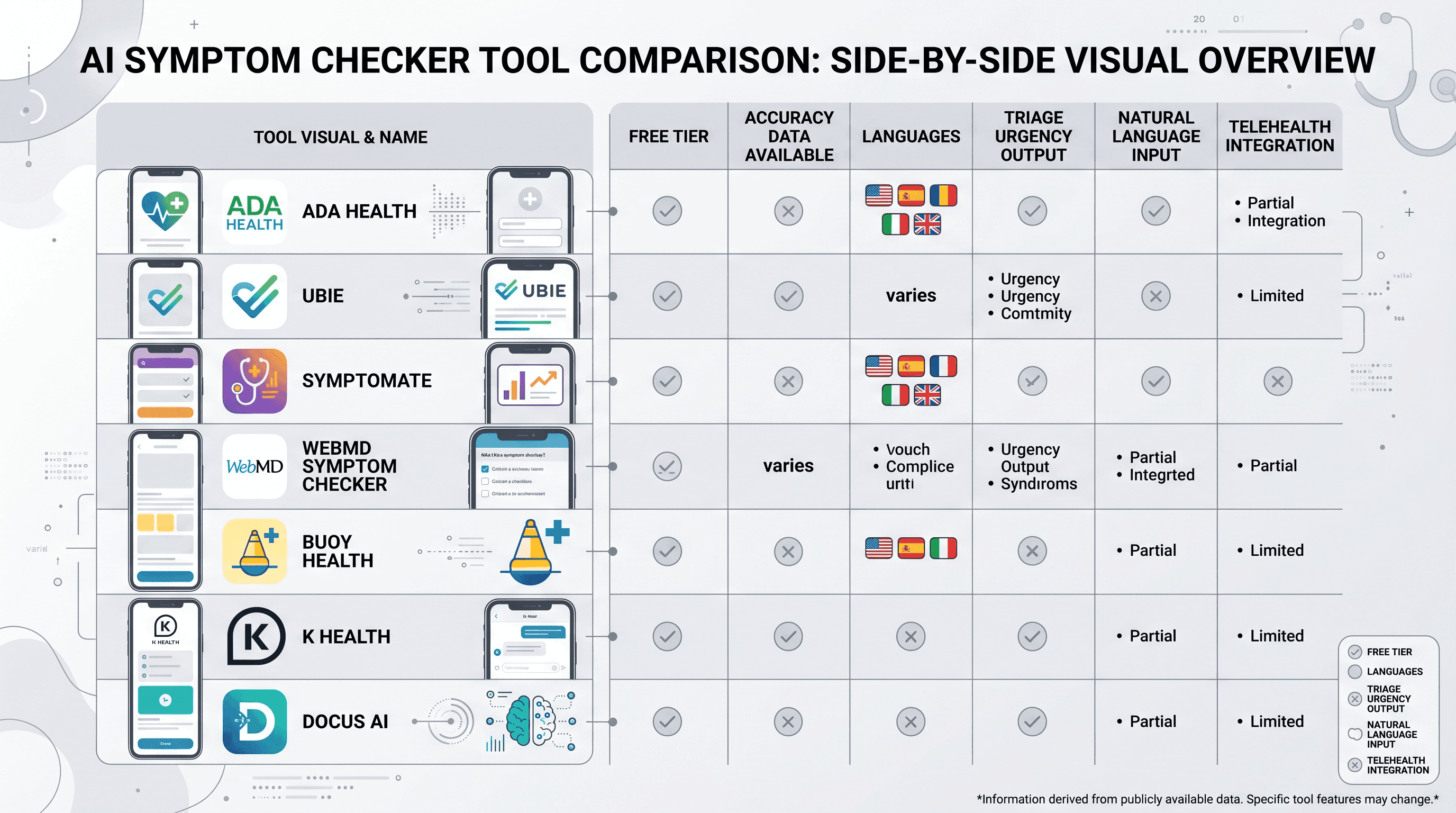
The following comparison is based on published accuracy data, publicly available privacy policies, and feature documentation as of early 2026. No tool paid for placement here.
| Tool | Free Tier | Accuracy Data Available | Languages | Triage Urgency Output | Natural Language Input | Telehealth Integration |
|---|---|---|---|---|---|---|
| Ada Health | Yes | Yes (general medicine) | 130+ | Yes | Yes | Limited |
| Ubie | Yes | Yes (71.6% top-10) | English, Japanese | Yes | Yes | Yes (US) |
| Symptomate | Yes | Partial | 15+ | Yes | Partial | No |
| WebMD Symptom Checker | Yes | Not published | English | Partial | No (checkbox-based) | No |
| Buoy Health | Yes | Not published | English | Yes | Yes | Yes |
| K Health | Freemium | Not published | English | Yes | Yes | Yes (US) |
| Docus AI | Freemium | Not published | English | Yes | Yes | Yes |
Best for General Use
Ubie and Ada Health lead the field for general adult medicine, based on available accuracy data and the depth of their clinical logic. Both support natural language input, generate urgency-level triage outputs, and have published some form of independent evaluation data.
Best for Children
Ada Health includes a pediatric-specific pathway that adjusts its clinical logic based on the patient's age, making it the strongest current option for parents assessing symptoms in children under 12. No current tool has published pediatric-specific accuracy benchmarks, so a doctor's evaluation remains necessary for any pediatric concern of significance.
Best Free Option
Ubie offers the most comprehensive free tier among tools with published accuracy data. Its triage output is clear, its symptom input is conversational, and its US-facing version integrates with care navigation features at no cost.
Is Your Health Data Safe? Privacy and AI Symptom Checkers
This section covers a topic that most symptom checker comparison articles skip entirely: whether it is actually safe to share health information with these tools.
The short answer is: it depends on the platform, and you should verify before sharing anything sensitive.
HIPAA (the Health Insurance Portability and Accountability Act) does not automatically apply to every digital health app. HIPAA covers "covered entities," which are healthcare providers, insurers, and their business associates. A standalone symptom checker app that has no relationship with your insurance plan or physician's office may not be a HIPAA-covered entity, which means it can collect and use your symptom data under its own privacy policy rather than HIPAA's stricter standards. Platforms that integrate directly with health systems or insurers, such as K Health's clinical partnerships, are more likely to operate under HIPAA obligations.
A 2025 study published in Computers and Society found that six major AI developers use chat interaction data to improve their models, a practice that most users are unaware of when they describe their symptoms conversationally in a general-purpose AI interface. Dedicated symptom checkers with published privacy policies that explicitly prohibit training data use from individual health queries offer meaningfully stronger protection.
For readers outside the US, GDPR (the EU's General Data Protection Regulation) provides stronger baseline protections: users have explicit rights to access, correct, and delete their data, and data cannot be used for purposes beyond what was consented to at collection. Ada Health, which is GDPR-compliant and headquartered in Germany, offers one of the more transparent privacy postures in the field.
Before entering symptoms into any tool, check for these red flags in the privacy policy. Look for language about whether data is sold to third parties, whether it is used for training AI models, whether it is shared with advertising networks, and whether the tool provides a clear data deletion mechanism. If those terms are absent or vague, consider that a signal to use the tool with minimal identifying detail.
The Rise of Ambient Health Monitoring
By 2026, the symptom checker has begun its evolution from a text input box to an integrated health data layer. That shift changes what these tools can do and, in some cases, how reliable they are.
Wearable devices including the Apple Watch Series 10, Fitbit Sense 3, and continuous glucose monitors (CGMs) now feed real-time biometric data into select health apps. Heart rate variability, blood oxygen saturation (SpO2), respiratory rate trends, and sleep architecture can all surface anomalies before a user consciously registers a symptom. When that data is passed to a symptom analysis layer, the system can validate or complicate what the user describes. A user who reports mild fatigue but whose wearable shows five consecutive nights of fragmented sleep and a resting heart rate 20 beats above their baseline is presenting a meaningfully different clinical picture than the same complaint without that context.
Federated learning is the privacy architecture that enables this integration without centralizing sensitive health data. In a federated model, the AI learns from patterns across devices without the raw data ever leaving the user's phone. This approach is being adopted by several health platforms as a way to improve model accuracy while addressing the data-sharing concerns outlined in the previous section.
The regulatory trajectory is also shifting. The FDA has begun applying its Software as a Medical Device (SaMD) framework more consistently to AI health tools, and CE marking under the EU's Medical Device Regulation (MDR) is increasingly required for tools making clinical recommendations in European markets. This regulatory pressure is a net positive for users: it creates accountability structures that pure consumer apps currently lack.
If managing a chronic condition such as high blood pressure, the integration of real-time monitoring into symptom assessment tools is particularly relevant. For a deeper look at how hypertension relates to downstream cardiovascular risk, the Momentary Lab guide on hypertension, heart disease, and stroke covers those connections in detail.
Mental Health and Wellness Self-Assessment
One of the more significant expansions in AI symptom checker functionality over the past two years has been in the mental health domain. Tools that previously focused exclusively on physical symptoms now include validated screening modules for anxiety, depression, burnout, and stress-related presentations.
Ada Health, Buoy, and Docus all incorporate behavioral health pathways. Some use validated instruments such as the PHQ-9 (Patient Health Questionnaire) for depression screening or the GAD-7 (Generalized Anxiety Disorder scale) as part of their intake logic. When a user's responses meet the threshold for clinical concern, the tool escalates its recommendation to speak with a mental health professional or, in platforms with telehealth integration, offers a direct booking pathway to a therapist.
The limitations here are real and worth naming plainly. AI checkers cannot detect suicidality with reliability. They cannot assess tone, affect, or the quality of thought the way a trained clinician can. And the cultural and linguistic calibration of mental health instruments matters in ways that current tools do not fully address. What these tools can do well is lower the barrier to recognition. For someone who has normalized high anxiety or low mood over years, a screening module that reflects back a GAD-7 score in the moderate-to-severe range can be a prompt to seek care that the person would not have acted on otherwise.
Global Accessibility and Multilingual Care
One of the strongest arguments for AI symptom checkers is their reach. In regions where physician-to-patient ratios are low, where rural distance makes clinic access impractical, or where English is not the primary language, a well-designed AI tool can provide a level of health guidance that would otherwise be unavailable.
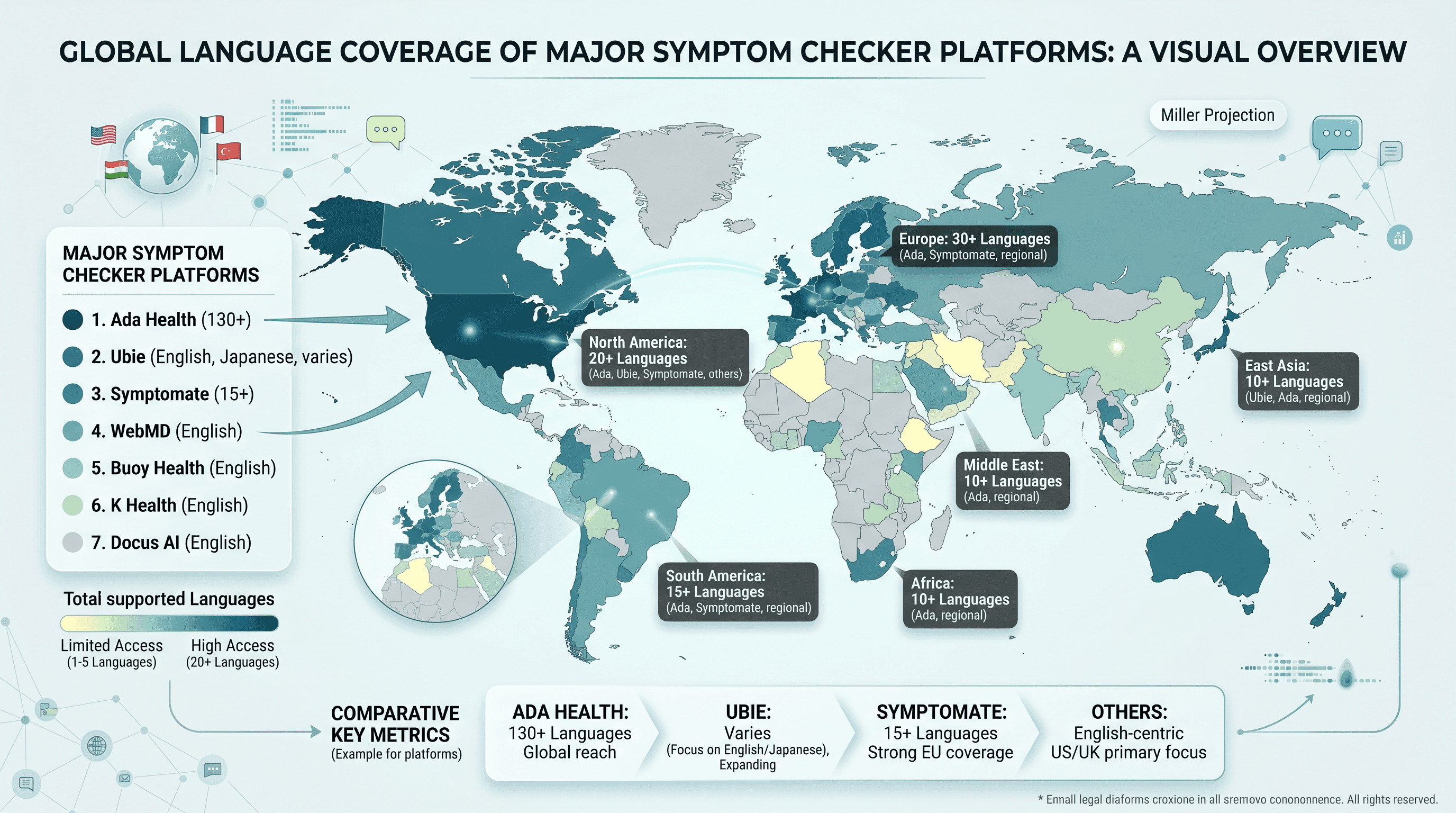
Ada Health operates in 130 languages, a coverage that no primary care network can match. Ubie is expanding its multilingual capacity in Asia-Pacific markets. These tools do not replace in-person care, but for a first-level triage decision in a setting without accessible healthcare, they represent a meaningful resource.
A 2023 analysis in NCBI examining AI-driven health tools in low- and middle-income countries found that symptom checkers, when validated against local disease prevalence data, showed promise as a first-point-of-contact health resource. The caveat is that most current tools were trained predominantly on data from high-income, English-speaking populations. Performance in contexts with different disease epidemiology, different symptom expression norms, and lower digital literacy may not match the benchmarks discussed earlier.
Limitations and Risks: What an AI Checker Simply Cannot Do
Understanding where these tools fall short is as useful as knowing where they perform well. The risks below are structural, not edge cases.
AI hallucination remains a documented problem in health AI contexts. A 2025 study in Communications Medicine found that AI systems in medical applications can generate confident-sounding diagnostic suggestions that have no clinical basis, particularly in atypical or data-sparse presentations. Dedicated symptom checkers constrained by structured medical ontologies are less susceptible than general LLMs, but the risk does not disappear entirely.
The missing physical exam is a problem no digital tool can solve. Blood pressure, heart sounds, lymph node palpation, skin color, gait, affect: these are clinical data points that a text-based or voice-based tool simply cannot access. A symptom checker that flags a low probability of serious illness based on symptom description alone may miss the finding that would have changed the picture entirely.
Demographic bias in training data is a recognized problem in medical AI research. Models trained primarily on data from white, male, or younger populations may underperform for women, older adults, people of color, and those with multiple comorbidities. Symptom presentation for conditions like myocardial infarction, for example, differs by sex in ways that remain underrepresented in training datasets.
Emotional tone and overtrust are a separate category of risk. A 2025 SSRN study found that users tend to share incomplete or modified symptom descriptions with AI tools when the interface feels judgmental or clinical, and that conversational, warm interfaces, while better for engagement, can also generate higher rates of overtrust in the output. Users who feel "diagnosed" by a friendly AI may be less likely to seek in-person follow-up.
When to Skip the Symptom Checker Entirely
Some situations call for immediate emergency action, not digital triage. If any of the following apply, call emergency services or go to the nearest emergency room without using an app first.
Chest pain or pressure, particularly when accompanied by shortness of breath, jaw pain, or left-arm radiation, warrants immediate emergency evaluation. The sudden onset of facial drooping, arm weakness, or slurred speech are the classic signs of stroke, and every minute without treatment increases long-term damage. Altered consciousness or confusion, severe allergic reactions with throat tightening or difficulty breathing, and any head injury with loss of consciousness all fall into this category.
A symptom checker is a triage tool for situations with uncertainty. When there is no uncertainty, skip the app.
How to Get the Most Accurate Results from an AI Symptom Checker
The accuracy numbers cited in research studies are based on complete, well-described symptom presentations. Real-world performance often falls short because users describe their symptoms vaguely, omit relevant history, or anchor on a self-diagnosis and describe symptoms through that lens. These practical steps improve output quality significantly.
Describe what you feel, not what you think is wrong. Instead of "I think I have a sinus infection," enter "I have pressure behind both eyes, thick yellow nasal discharge, and a dull headache above my cheekbones for five days." The more specific the symptom description, the more the tool's probabilistic engine has to work with.
Include onset, duration, and severity. "Chest pain" is far less useful than "a sharp, stabbing pain in the center of my chest that started three hours ago, rated 7 out of 10 in intensity, and gets worse when I breathe in deeply." Duration and trajectory matter clinically.
Add relevant history. Most tools prompt for age, biological sex, and any pre-existing conditions. Provide these accurately. A 60-year-old with type 2 diabetes and a history of hypertension presenting with fatigue has a very different probability distribution than a 22-year-old with the same complaint.
Treat the output as a ranked differential, not a diagnosis. A list of five possible conditions is not a verdict. It is a starting point for a conversation with a clinician. An evaluation of the Isabel Symptom Checker found that patients who brought their symptom checker output to physician appointments reported better-organized conversations and improved outcomes: 91.4% said they would use the tool again.
Book a follow-up. A symptom checker output should inform your next step, not replace it. If the tool suggests a possible condition worth investigating, connect with a primary care provider to discuss findings and determine whether further testing is warranted.
Frequently Asked Questions
What diseases can be detected by AI symptom checkers?
AI symptom checkers can flag hundreds of conditions across general medicine, including respiratory infections, cardiovascular concerns, gastrointestinal issues, and dermatological presentations. They perform best on common conditions with well-defined symptom profiles. They are less reliable for rare diseases, orthopedic conditions, pediatric presentations, and nuanced mental health diagnoses. No symptom checker can definitively diagnose any disease: only a clinician can do that.
Can AI help diagnose symptoms?
AI tools can generate a ranked list of possible conditions based on the symptoms a user describes, which is a form of differential diagnosis support. However, they lack access to physical examination findings, lab results, imaging, and the clinical judgment that comes from years of medical training. Think of AI as a sophisticated filter that narrows the field and guides triage, not as a replacement for a physician's assessment.
Can ChatGPT diagnose disease?
ChatGPT and similar general-purpose AI chatbots can discuss symptoms and suggest possible conditions, but they are not built for clinical triage. They lack structured medical ontologies, urgency-level outputs, and the demographic context prompts that dedicated symptom checkers use. Research from 2025 shows that patients who rely on general AI chatbots for symptom queries often bring confused or misleading self-assessments to appointments. For symptom evaluation, a dedicated tool like Ada or Ubie is more appropriate than a general chatbot.
Is there a free AI for medical diagnosis?
Several tools offer free tiers with meaningful functionality. Ubie, Ada Health, Symptomate, and Buoy all provide free symptom assessment with triage output. None of them constitutes a medical diagnosis, which requires a licensed clinician. Free tools are suitable for initial triage and care navigation. If the output suggests a condition that warrants investigation, that investigation should happen with a healthcare provider. You can also use Momentary's AI health navigator to explore your symptoms, understand possible next steps, and get guidance on the level of care that may be appropriate for your situation.
Are AI symptom checkers safe to use?
For triage and care navigation, yes, with appropriate expectations. The primary safety concern is not that they provide dangerous advice, but that users may overtrust a reassuring output and delay seeking care for something serious. Always treat the output as a starting point, not a conclusion, and follow the red-flag rule: if symptoms are severe, sudden, or involve classic emergency signs, skip the app and call emergency services.
References
- PMC / NCBI: Systematic Review of AI-Based Symptom Checkers — Cited for baseline accuracy benchmarks, vignette methodology limitations, and underrepresented populations in training data.
- PMC / NCBI: Evaluation of AI Symptom Checkers in Orthopedic Presentations — Cited for Ada (54%) and Symptoma (27%) accuracy figures in orthopedic contexts; also cited for AI hallucination risk in medical applications.
- ResearchGate: Artificial Intelligence-Based Symptom Checkers for Disease Diagnosis — Systematic Review — Cited for Ubie's 71.6% top-10 suggestion accuracy.
- PubMed: US Adult AI Health Query Behavior Survey (UPenn Annenberg, 2025) — Cited for the statistic that 79% of US adults use AI tools for health queries; also cited for physician observations on ChatGPT use in patient consultations.
- ScienceDirect: Computers and Society, 2025 — Cited for the finding that six major AI developers use chat interaction data to train their models.
- News Medical: People Share Incomplete Details with AI in Symptom Reports (2026) — Cited for SSRN 2025 research on interface tone, user overtrust, and incomplete symptom disclosure.
- PubMed: Symptom Checker Accuracy and Patient Outcomes — Cited for the Isabel Symptom Checker patient study finding that 91.4% of users would use the tool again after bringing output to physician appointments.


