


For decades, the routine was the same: feel something off, open a browser, type in a symptom, and brace for a wall of alarming possibilities. Today, a growing number of people are skipping that search bar entirely. AI health apps now deliver something the search bar never could: a response that learns from your history, cross-references your biometrics, and adjusts its guidance based on what is actually happening in your body right now.
This guide is not a ranked list of downloads. It is a practical, physician-informed framework for understanding what AI health apps genuinely do well in 2026, where their limits are hard-coded, and how to choose one without handing over your most sensitive data to an algorithm you cannot audit. Whether you are managing a chronic condition, tracking sleep quality, or just trying to decode a strange symptom at 11 p.m., this is the resource that gives you real answers.
At a Glance
| Topic | Key Facts |
|---|---|
| Global mHealth market (2026) | $62.5 billion |
| Projected mHealth market (2033) | $150 billion (13.5% CAGR) |
| FDA-cleared AI/ML medical devices | 1,247 (as of mid-2025) |
| Wearables using AI for health tracking | More than 50% (2025) |
| AI healthcare market growth | $27B (2024) to $188B (2030) |
| Primary privacy risk | Most consumer AI health apps are NOT HIPAA-covered |
| What AI apps cannot do | Physical exams, lab orders, official diagnoses |
Your Health "Operating System": What AI Health Apps Actually Do in 2026
The simplest answer: AI health apps have evolved from passive loggers into proactive health management tools that sit between your body and your doctor.
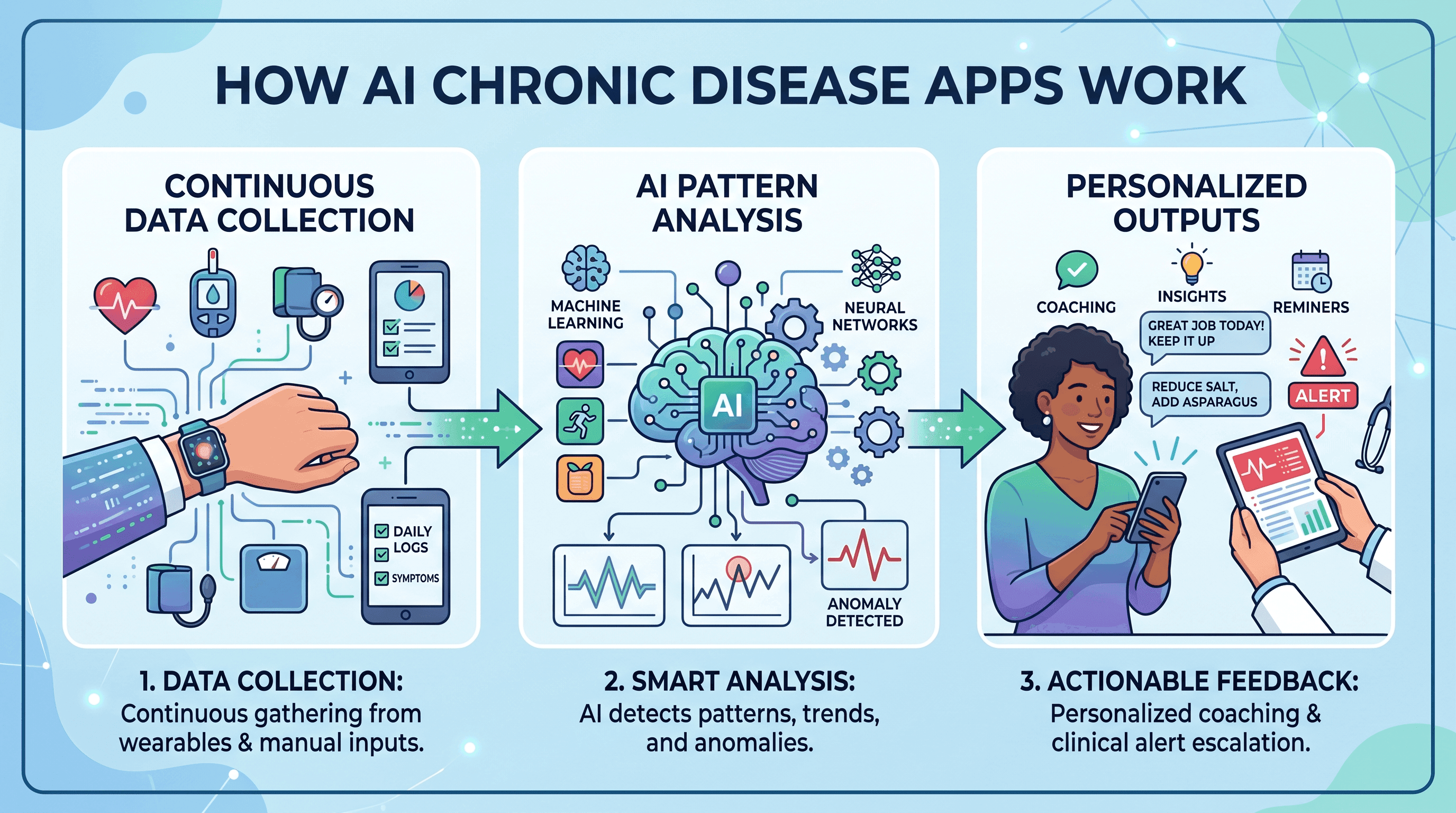
A decade ago, a health app counted your steps and reminded you to drink water. The 2026 version does something fundamentally different. It ingests continuous data streams from wearables, food logs, mood check-ins, and sleep cycles, then uses machine learning to surface patterns that no human could track manually across months of daily inputs. According to research published in the National Institutes of Health, AI-powered health applications are demonstrating meaningful potential in early detection, patient engagement, and chronic disease self-management across multiple conditions.
Three distinct tiers of apps now exist, and understanding them prevents category confusion:
Consumer wellness apps are the largest tier by volume. These include sleep trackers, step counters, mindfulness tools, and nutrition loggers. They do not require FDA clearance because they make no clinical claims. They are regulated as general wellness products.
Clinical decision-support tools are apps that assist in triage, symptom analysis, or chronic condition monitoring. These may carry FDA clearance or fall under Software as a Medical Device (SaMD) frameworks. They are held to a higher evidentiary standard.
GenAI health assistants are the fastest-growing category in 2026. These are large-language-model-based tools (ChatGPT Health, Google's Personal Health LLM, and others) that synthesize health information conversationally. They are powerful but largely unregulated for clinical use.
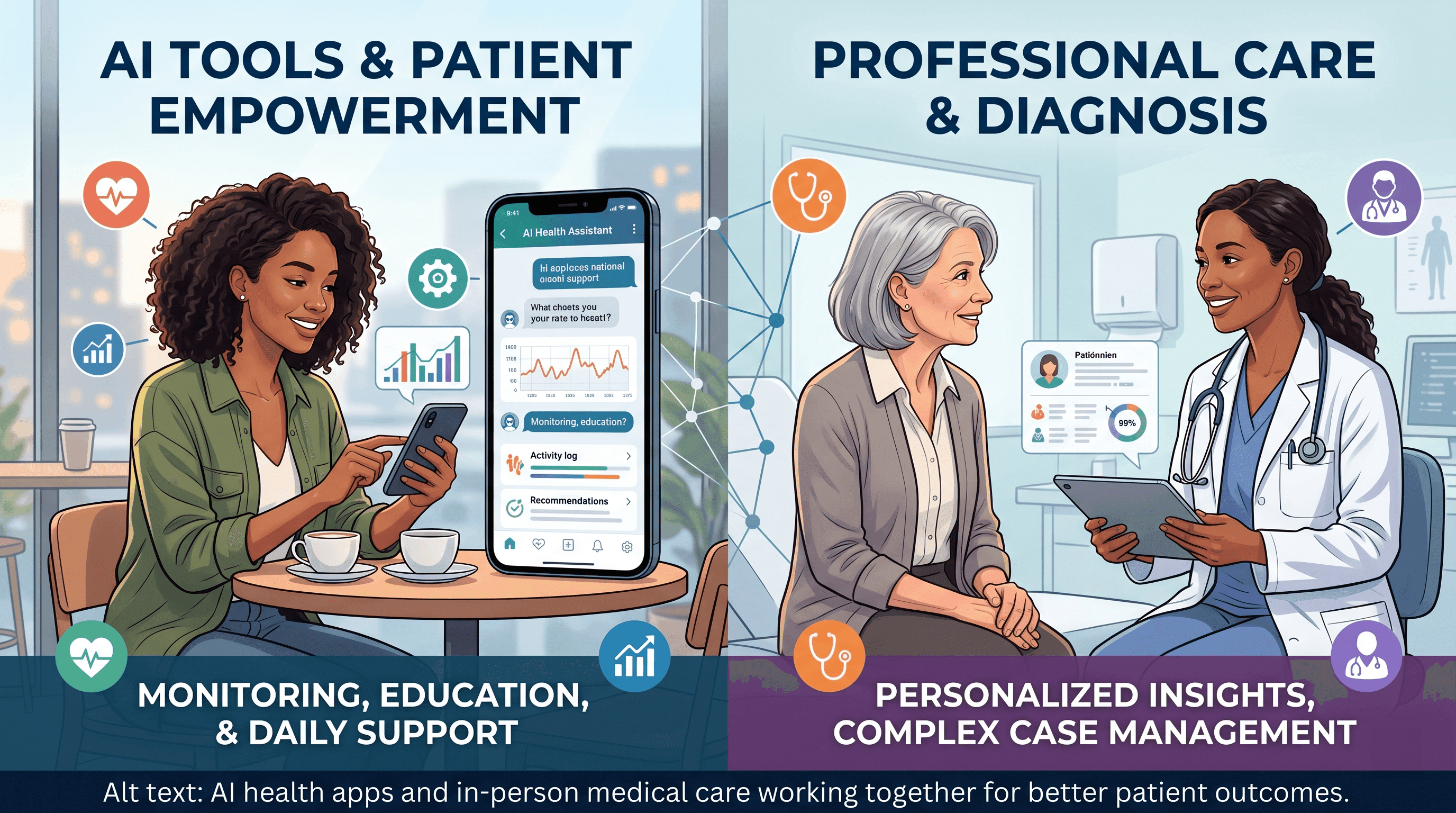
Can an AI health app replace your doctor? No. A doctor can perform a physical examination, order laboratory tests, interpret imaging, and provide an official medical diagnosis. No app can do any of those things, regardless of how sophisticated its underlying model is. What the best AI health apps can do is help you arrive at your next appointment better informed, better prepared, and with more data than you would otherwise have.
Bucket 1: Intelligent Triage and Symptom Analysis
Symptom checker apps do one thing well: they help you decide whether to wait, book an appointment, or seek urgent care.
This is not a small contribution. Mismatched urgency is one of the most common and costly problems in consumer healthcare. People delay care that cannot wait, and they rush to emergency rooms for issues that could be managed at home or with a primary care visit. A well-designed symptom checker reduces both errors.
Ada Health has completed more than 35 million symptom assessments globally. Its clinical-grade AI builds a differential list based on user-reported symptoms, demographic factors, and medical history, then guides users toward an appropriate care setting. Ada does not diagnose; it triages. That distinction matters.
Buoy Health uses a similar conversational AI model and has been integrated into health system websites as a front-door triage tool. Its strength is routing: it helps users navigate whether they need a telehealth visit, an urgent care clinic, or an emergency department.
The key limitation to understand is that triage is not diagnosis. These apps operate on self-reported data. If a user underreports symptoms, misremembers timing, or omits a relevant medical history detail, the output reflects that gap. Clinical accuracy studies have shown variable performance across symptom categories, with higher accuracy in common presentations and lower accuracy in atypical ones. A doctor can advise on individual cases where symptom presentations are complex or overlapping.
Bucket 2: Mental Health and Cognitive Support
AI mental health apps fill a specific and underserved role: providing structured psychological support at times and in places where human therapists are unavailable.
The mental health app landscape has matured considerably. The early crop of mindfulness timers and breathing exercises has given way to clinically grounded tools with published evidence bases.
Wysa is one of the most studied AI mental health apps in this category, with more than 5 million users and FDA Breakthrough Device recognition for its work in supporting users experiencing depression and anxiety. Wysa uses cognitive behavioral therapy (CBT) techniques delivered through an AI chat interface, with optional escalation to human coaches. Its published outcomes data across peer-reviewed settings differentiates it from generic chatbots.
Woebot is a CBT-based app developed out of Stanford University research. It delivers structured therapeutic conversations, mood tracking, and psychoeducation. Woebot Health has published randomized controlled trial data showing measurable reductions in anxiety and depression symptoms, which is a higher evidentiary bar than most wellness apps clear.
Youper, also developed with Stanford clinical input, focuses on emotional health monitoring and CBT-based interventions with a particular emphasis on anxiety management.
What distinguishes these tools from a generic AI chatbot is clinical grounding. A large language model answering mental health questions without a structured therapeutic framework is not the same as an app built specifically to deliver evidence-based interventions. The former can be helpful; the latter has been tested.
For anyone navigating persistent or severe mental health concerns, these apps work best as complements to, not replacements for, a licensed mental health professional.
Bucket 3: Predictive Nutrition and Fitness Coaching
AI nutrition and fitness apps have crossed a threshold: they now personalize in real time rather than offering static plans built on population averages.
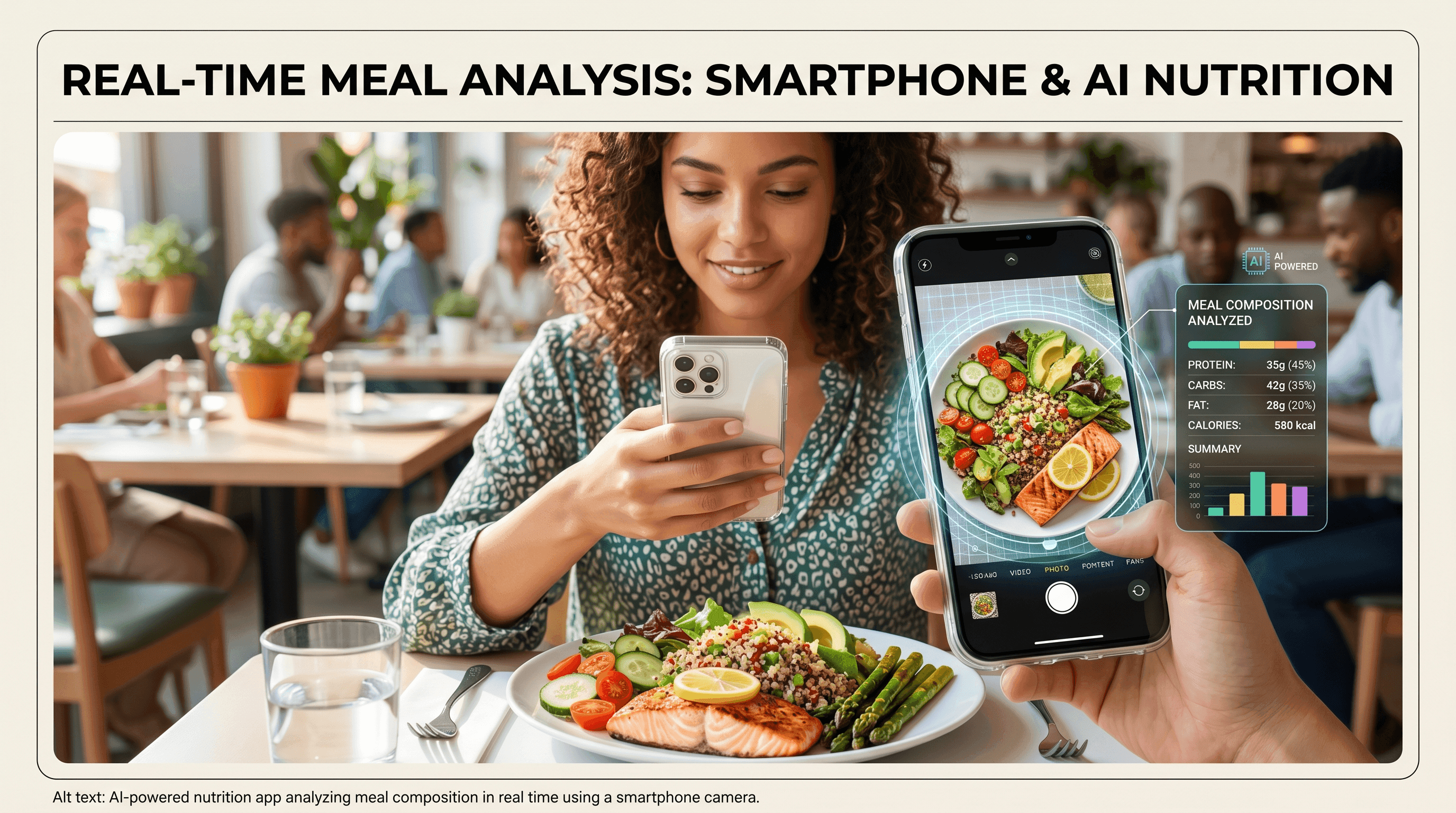
The standard nutrition app of 2020 asked you to log meals manually into a database. The 2026 version can analyze a photo of your plate using computer vision, estimate macronutrients and calories with reasonable accuracy, flag ingredients that conflict with a health goal or condition, and adjust your weekly targets based on how your biometrics have trended.
On the fitness side, apps using smartphone camera-based pose estimation can now analyze exercise form in real time, flag compensatory movement patterns that may lead to injury, and adjust program difficulty based on recovery signals pulled from a connected wearable. This is a genuine functional leap from generic workout plans that cannot account for how your body is actually responding.
A few important caveats: Photo-based calorie estimation carries inherent error margins, particularly for mixed dishes or restaurant portions. These tools are most useful as trend trackers rather than precise counters. And AI fitness coaching, while personalized, cannot replace a physical therapist's hands-on assessment for rehabilitation or injury recovery.
The Power of Passive Data: Wearable Integration
The most significant shift in AI health apps over the past two years is not the apps themselves; it is the continuous biometric data that wearables now feed into them.
Manual data entry has always been the weak link in health apps. People forget to log meals, skip mood check-ins, and underreport symptoms. Wearables solve this problem by making data collection passive and continuous. Research on AI in daily healthcare and fitness tracking shows that continuous passive monitoring substantially improves the quality and completeness of health data compared to self-reporting alone.
More than 50% of wearables now use AI for health tracking and interpretation, operating within a $149 billion smart wearables market.
Oura Ring and its AI-powered companion app track heart rate variability (HRV), skin temperature, respiratory rate, and movement patterns throughout the night and day. Its readiness score, which synthesizes these signals into a single daily metric, has become a reference point for recovery-based training decisions among athletes and non-athletes alike.
Whoop takes a similar approach with a strong emphasis on athletic recovery, strain scoring, and sleep stage analysis. It provides daily coaching recommendations based on the previous night's sleep and accumulated physiological load.
Apple Watch Series 11 continues to expand its clinical-grade feature set. Its FDA-cleared electrocardiogram (ECG) function and AFib detection represent one of the clearest examples of a consumer wearable crossing into regulated medical territory. The Apple Health app synthesizes Watch data, third-party app inputs, and manually entered health records into an increasingly comprehensive personal health profile.
Garmin's health ecosystem targets athletes and active users with detailed training load, body battery, and VO2 max estimations that feed into its Connect IQ platform.
The practical takeaway for users: a wearable without a capable companion app is data without meaning. The analysis layer matters as much as the sensor hardware.
Chronic Condition Management via Smartphone
For people living with ongoing health conditions, AI apps have moved from convenience tools into genuine disease management platforms.
Managing a chronic condition between clinical appointments has always involved guesswork: Is this symptom a flare or normal variation? Should today's medication schedule change? What triggered last week's episode? AI-powered chronic disease management apps now answer some of these questions with data rather than intuition.
Livongo (now part of Teladoc Health) is one of the most established platforms in this space, with programs covering diabetes, hypertension, and weight management. Its AI coaching engine analyzes blood glucose readings, flags concerning patterns, and delivers personalized nudges in real time. Livongo's outcomes data, published across multiple studies, shows meaningful reductions in HbA1c among enrolled diabetes members.
Biofourmis focuses on remote patient monitoring for heart failure, oncology, and post-surgical recovery. Its AI analyzes continuous physiological data from wearable biosensors to predict clinical deterioration before it becomes an emergency, enabling clinical teams to intervene earlier.
Eureka Health enables patient-led study participation and condition tracking through a research-grade app platform, giving users a way to contribute their data to clinical research while receiving structured condition management tools in return.
For people managing conditions like diabetes or hypertension, where daily data has direct clinical consequences, these platforms represent a meaningful evolution from paper logs and quarterly appointments. If you're living with a condition that requires ongoing monitoring and want to explore digital management tools alongside your existing care plan, connecting with a primary care provider through Momentary's virtual care platform is a practical next step to discuss which tools your physician would support.
Privacy, Data Ownership, and What "Secure" Actually Means
This is the section most AI health app articles skip. It is also the most important one.
The overwhelming majority of consumer AI health apps are not covered by HIPAA. The Health Insurance Portability and Accountability Act applies to covered entities: hospitals, insurers, and their business associates. A direct-to-consumer wellness app that you download from an app store and pay for directly is typically not a covered entity, which means the health data you share with it can be sold, licensed, or used for advertising with far fewer legal restrictions than you likely assume.
The 23andMe bankruptcy in 2023 and subsequent sale proceedings put this risk in sharp relief: sensitive genetic health data generated by millions of users became an asset in a corporate acquisition, illustrating concretely that "your health data" held by a private company can change hands in ways users never anticipated when they agreed to terms of service.
For AI health apps specifically, the Center for Democracy and Technology has flagged concerns about how major AI platform providers handle health-related data generated through general-purpose large language models, noting that queries about symptoms, medications, and mental health are often not separated from broader data training pipelines.
Before downloading any AI health app, apply this five-point checklist:
First, check whether the app explicitly states HIPAA compliance or BAA (Business Associate Agreement) availability. If it does not, your data is not protected under federal health privacy law.
Second, read the data-sharing section of the privacy policy, not just the summary. Look specifically for language permitting data sale to third parties, use for advertising, or sharing with parent companies.
Third, determine whether the app offers data deletion. A meaningful deletion option removes your data from the company's servers on request; a hollow one archives it in de-identified form that can be re-identified.
Fourth, look for end-to-end encryption, particularly for apps where you share sensitive mental health information or chronic condition data. Apps that store data in plaintext on accessible servers represent a higher breach risk.
Fifth, check whether the company has published a transparency report or independent security audit. Apps with clinical validation partners or healthcare system integrations are generally held to stricter data governance standards.
How the FDA Regulates AI Health Apps
"FDA-approved" and "FDA-cleared" are not interchangeable, and most consumer AI health apps are neither.
Understanding the regulatory landscape is not technical detail for its own sake. It is the practical tool that lets you distinguish a clinically validated app from one that is, essentially, unregulated software making health-adjacent claims.
The FDA regulates health-related software under its Software as a Medical Device (SaMD) framework. An app qualifies as a medical device if it is intended to diagnose, treat, cure, or prevent disease. Wellness apps that make general health claims rather than disease-specific ones typically fall outside this definition, which is why most consumer health apps you encounter have no FDA oversight.
For apps that do qualify as SaMD, three regulatory pathways exist:
510(k) clearance is the most common pathway. It applies to devices that are substantially equivalent to a legally marketed predicate device. "Cleared" does not mean "approved"; it means the FDA has determined the device is as safe and effective as an existing cleared device. The FDA-cleared ECG on Apple Watch reached the market through this pathway.
De Novo classification applies to novel, low-to-moderate risk devices that have no predicate. This pathway creates a new device classification and is used for genuinely new technology categories.
Premarket Approval (PMA) is the most rigorous pathway, reserved for high-risk devices where general controls and special controls alone are insufficient to provide reasonable assurance of safety and effectiveness.
As of mid-2025, the FDA has cleared 1,247 AI/ML-enabled medical devices across all categories. That is a meaningful number in absolute terms, but a small fraction of the thousands of health apps available in consumer app stores.
A quick test for any app: Does it make a specific disease claim (diagnoses X, detects Y)? If yes, ask whether it has FDA clearance or De Novo designation. If it makes only wellness claims (supports healthy habits, helps you track Z), it likely does not require clearance and you should evaluate it on the quality of its evidence rather than regulatory status.
Red Flags: Signs an AI Health App May Cause More Harm Than Good
Not every AI health app is worth your data, your time, or your trust. These patterns signal problems worth taking seriously.
The app makes diagnostic claims without FDA clearance or De Novo designation. If an app tells you that you "have" a condition based on a questionnaire or photo, without being a regulated medical device, it is operating outside its evidence base. Diagnostic claims require a standard of evidence that wellness apps are not required to meet.
The privacy policy permits data sale or advertising use. If you find language authorizing the company to share your health data with advertisers, marketing partners, or data brokers, any health benefit the app provides comes at a privacy cost that most users would not accept if they read the full terms.
No clinical team is named. Apps developed with genuine clinical oversight name their medical advisory board, clinical research partners, or published study affiliations. An app with no named clinicians and no published accuracy data has not been vetted against the standard that clinical tools require.
The app pressures you to substitute it for professional care. Any app that discourages you from seeing a doctor, frames clinical care as unnecessary, or positions itself as a complete replacement for medical consultation is not operating in your interest. Responsible AI health tools consistently support, not undermine, the patient-provider relationship.
Accuracy data is unpublished or unavailable. For apps making clinical-adjacent claims (symptom analysis, skin condition assessment, cardiac rhythm interpretation), published peer-reviewed accuracy studies should exist. If a company cannot point to independent validation of its accuracy claims, treat those claims as unverified.
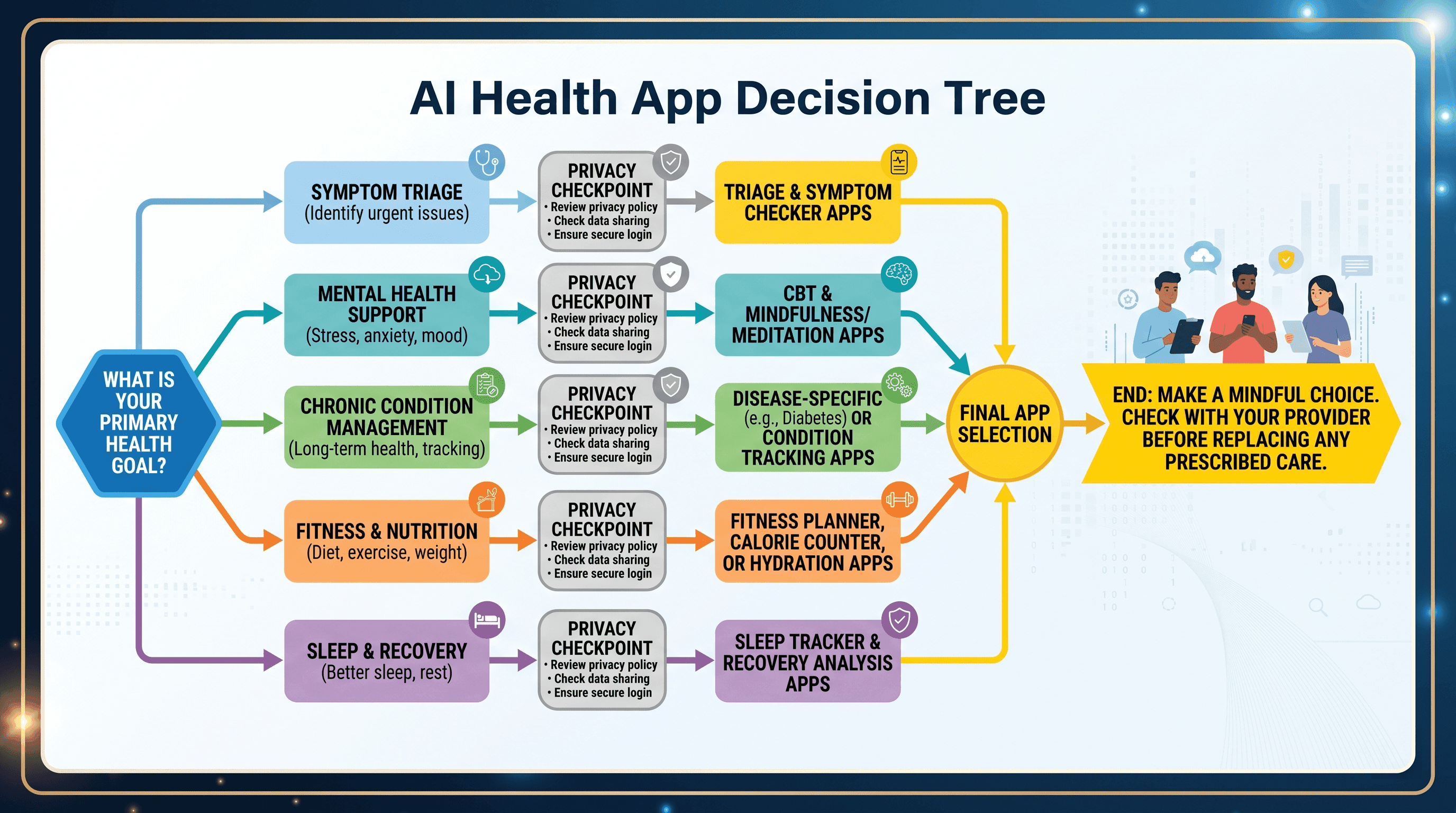
How to Choose the Right AI Health App: A 5-Question Framework
A good app is not the most downloaded one; it is the right tool for your specific health goal, with privacy practices you can live with.
What specific health problem am I solving?
Start with a precise need rather than a general category. "I want to sleep better" leads to a different app than "I want to track whether my sleep quality correlates with my evening heart rate." Specificity helps you avoid feature bloat and find tools built around your actual use case.
Is this app clinically validated, and by whom?
Look for published peer-reviewed studies, clinical trial registration, or named academic institution partnerships. A company blog post citing internal data is not the same as an independent journal publication. Validation by a healthcare system or government health agency carries more weight than endorsement by wellness influencers.
Who owns my data and under what terms?
Run the five-point privacy checklist from the privacy section above before you sign up. If the privacy policy is difficult to locate or written to obscure data-sharing practices, that opacity is itself a signal.
Does it integrate with my existing tools and care team?
An app that siloes your health data from your primary care provider, specialist, or existing wearable creates more fragmentation rather than less. Tools that export data in standard formats (Apple Health, FHIR-compliant exports) or integrate with patient portal systems give your data more continuity across your care ecosystem.
Would my physician support this choice?
This is not a rhetorical question. Physicians increasingly have opinions about specific AI health tools and can advise on which platforms have clinical credibility in their specialty area. An app your doctor has never heard of and cannot interpret data from is an island. An app whose outputs your physician can reference in an appointment has genuine care value.
What Is Next: AI Health Trends Shaping 2026 and Beyond
The apps available today are early versions of a more integrated, predictive, and personalized system that is already taking shape.
Agentic health AI is the most significant near-term development. Rather than answering questions, agentic AI takes actions: scheduling appointments, flagging concerning trends to clinical teams, adjusting medication reminders based on adherence data, and initiating care workflows without requiring user initiation. Several health systems are piloting agentic AI for post-discharge monitoring and chronic disease management.
EHR (electronic health record) integration is becoming a baseline expectation rather than a premium feature. As interoperability standards mature (particularly FHIR-based data exchange), AI health apps that cannot connect to a patient's clinical record are at a functional disadvantage. The best consumer tools in 2027 will likely have bidirectional data flows with major health systems.
Mental health AI is approaching clinical-grade evidence. The early CBT chatbot studies have been followed by longer-duration randomized trials with more robust controls. If current trajectories hold, several AI mental health tools will reach evidentiary thresholds that support insurance reimbursement, which would dramatically expand access.
According to research from Johns Hopkins Engineering, wearable-plus-app convergence represents one of the most consequential shifts in preventive medicine, as continuous physiological monitoring moves from clinical settings into daily life.
The mHealth market is projected to grow from $62.5 billion in 2026 to $150 billion by 2033 at a 13.5% compound annual growth rate. The growth is being driven less by new device categories and more by the deepening sophistication of the AI layers that turn raw health data into actionable personal guidance.
The Limits: The App Is Not the Doctor
Every capability described in this guide comes with a boundary, and knowing that boundary is as important as knowing the capability.
AI health apps cannot perform a physical examination. They cannot palpate an abdomen, auscultate heart sounds, assess muscle tone, or observe gait. Physical examination findings remain a cornerstone of clinical diagnosis that no remote or digital tool currently replicates.
AI health apps cannot order or interpret laboratory tests in a clinical context. An app might display a trend in your manually entered glucose readings, but it cannot order a hemoglobin A1c, interpret a metabolic panel, or adjust a medication dose based on lab values. Those actions require a licensed clinician.
AI health apps cannot provide a legal medical diagnosis. Regardless of how accurate a symptom checker or AI health assistant is, its output is informational guidance, not a diagnosis. A diagnosis carries clinical, legal, and insurance implications that require a licensed provider.
AI health apps can fail silently. Unlike a physician who knows they are uncertain, an AI model may produce a confident-sounding output in a domain where its training data is thin. Calibrating your trust appropriately means treating AI health guidance as a starting point for a clinical conversation, not as a final answer.
The single most useful mindset: AI health apps are outstanding at helping you notice, track, and prepare. Clinicians are responsible for interpreting, diagnosing, and treating. Both have a role. Neither replaces the other.
If you notice a pattern in your health data, a persistent symptom, or a trend that concerns you, the right next step is always a conversation with a clinician. Use Momentary's AI health navigator to explore your symptoms and get guidance on what to discuss with a provider, or to understand what kind of care might be appropriate for what you are experiencing.
Frequently Asked Questions
What is the best AI health app?
There is no single best AI health app because the right app depends entirely on your specific health goal. For symptom triage, Ada Health and Buoy Health are among the most clinically studied options. For mental health support, Wysa and Woebot have published evidence bases. For chronic disease management, Livongo has the most established outcomes data. For wearable-integrated health tracking, Oura Ring and Apple Watch combined with their companion apps offer broad capability. Start by identifying your primary health need, then evaluate apps within that category for clinical validation and privacy practices.
Which AI is good for health overall?
The AI platforms with the strongest clinical grounding in 2026 include Ada Health for symptom analysis, Wysa for mental health, Livongo for chronic condition management, and Apple Health (integrating Apple Watch data) for general wellness monitoring. For conversational health guidance, ChatGPT Health has been developed with input from more than 260 physicians and includes purpose-built data encryption, distinguishing it from general-purpose chat tools.
Are AI health apps safe to use?
Most AI health apps used for wellness tracking and health education are safe. The primary risks are two: privacy risk, where sensitive health data may not be protected under HIPAA if the app is not a covered entity, and over-reliance risk, where a user treats AI guidance as a diagnosis and delays seeking professional care. Choosing apps with transparent privacy policies, published clinical validation, and named clinical advisory teams reduces both risks meaningfully.
Are AI health apps FDA approved?
The FDA does not "approve" most health apps in the traditional pharmaceutical sense. It "clears" or grants "De Novo" designation to apps that qualify as Software as a Medical Device. As of mid-2025, 1,247 AI/ML-enabled medical devices have received FDA clearance, but most consumer wellness apps you find in app stores have not sought or received any FDA authorization. The FDA-cleared ECG on Apple Watch and SkinVision's clinical-grade skin analysis tool are examples of consumer-facing products that have pursued regulatory pathways.
What is the difference between a wellness app and a medical device app?
A wellness app makes general health claims (supports healthy habits, helps track activity) and is not regulated by the FDA as a medical device. A medical device app makes specific disease-related claims (detects atrial fibrillation, assesses skin lesions for potential malignancy) and is subject to FDA oversight under the Software as a Medical Device framework. The regulatory distinction matters because medical device apps are held to evidentiary standards for safety and effectiveness that wellness apps are not.
Can AI health apps help with chronic disease management?
Yes, with an important qualification. AI chronic disease management platforms (Livongo for diabetes and hypertension, Biofourmis for heart failure monitoring) have published outcomes data showing meaningful clinical improvements in enrolled populations. These tools work best as complements to existing clinical care, providing continuous monitoring and personalized coaching between appointments. They do not replace clinical oversight, medication management, or laboratory monitoring, and a doctor can advise on which platforms are appropriate for your specific condition.
References
-
National Institutes of Health, PMC — Artificial Intelligence in Health Apps — Cited for evidence on AI health app potential in early detection, patient engagement, and chronic disease self-management.
-
National Institutes of Health, PMC — AI in Clinical and Consumer Health Applications — Cited for clinical evidence frameworks in AI-assisted health monitoring.
-
ResearchGate — AI in Daily Healthcare Apps: Fitness Trackers, Smart Watches, and Mobile AI Apps for Health Monitoring — Cited for evidence on continuous passive monitoring improving health data quality over self-reporting.
-
Johns Hopkins Engineering — AI in Healthcare: Applications and Impact — Cited for wearable-plus-app convergence and its role in preventive medicine.


