


At a Glance
| Topic | Key Facts |
|---|---|
| Primary audience | Patients, clinicians, admins, medical students |
| Physician AI adoption (2026) | 81% of US physicians now use AI professionally (AMA) |
| Biggest 2026 launch | ChatGPT for Clinicians — free for verified US providers (April 23, 2026) |
| HIPAA warning | Consumer ChatGPT is NOT HIPAA compliant; PHI must not be entered |
| What free AI can do | Symptom triage, documentation drafts, evidence search, wellness coaching |
| What free AI cannot do | Diagnose, prescribe, or replace a licensed clinician |
| Key safety rule | Always verify outputs with a qualified healthcare provider |
The short answer is: free AI healthcare tools are no longer a compromise. In 2026, several enterprise-grade platforms have opened verified free tiers to individual clinicians, patients, and students alike — and the tools built for each audience are genuinely different. A physician looking for evidence citations needs something completely separate from a patient trying to understand their lab results. So does a medical student grinding through USMLE cases.
The question is not "can I afford AI support for my health?" Most people already can. The real question is which free tool was built for your role, and whether you understand the rules around using it safely. This guide walks through that, segment by segment, without the promotional spin.
Why Free AI Tools Are Finally Viable in Healthcare
The landscape shifted in 2026 for a straightforward reason: demand outpaced the economics of paywalls. According to the American Medical Association's 2026 Physician Survey on Augmented Intelligence, over 81% of US physicians now use AI in their professional work, more than double the 38% reported in 2023. When the majority of a profession is already using a technology, vendors face a choice: monetize access, or expand reach to build the network effects that drive long-term revenue.
For the past decade, tools like UpToDate and Dynamed anchored clinical knowledge management behind subscription walls that could run $500 to $600 per clinician annually. The arrival of AI platforms capable of generating cited, evidence-based answers from the same literature changed the calculus. Clinicians began using consumer ChatGPT as an informal alternative, often without recognizing the compliance risks involved.
The response from AI vendors in 2026 was to formalize what was already happening informally. Rather than lose clinicians to consumer tools with no guardrails, platforms like OpenEvidence, Heidi Health, Doximity, and OpenAI itself moved to verified free tiers that offer real clinical utility alongside defensible compliance postures. For patients, ChatGPT Health arrived in January 2026 as the first major consumer health AI with direct EHR integration. The era of "free but risky" is being replaced by "free and purpose-built."
What Changed in 2026
Three launches define the 2026 moment for free AI healthcare tools and are absent from most existing coverage.
ChatGPT for Clinicians launched on April 23, 2026 as a free workspace for verified US physicians, nurse practitioners, physician assistants, pharmacists, and psychologists. Eligibility requires an NPI and third-party license verification. The platform runs on GPT-5.4, includes real-time cited clinical search from peer-reviewed sources, reusable workflow skills for prior authorizations and referral letters, deep research for literature reviews, and CME credit tracking. According to OpenAI's official launch post, conversations are not used to train models, and HIPAA-supporting Business Associate Agreements are available for eligible individual accounts. The tool is designed for solo clinicians whose hospitals have not yet deployed a centralized AI system.
ChatGPT Health launched January 7, 2026 as a dedicated consumer-facing tab within ChatGPT. According to OpenAI's announcement, users on Free, Go, Plus, and Pro plans can connect medical records via a partnership with health data aggregator b.well, sync Apple Health, and link apps including MyFitnessPal and Function. The system stores health chats, memories, and files separately from main ChatGPT, and health data is not used to train foundation models. It is available to US users outside the EEA, Switzerland, and UK. Note that ChatGPT Health is a consumer wellness product and HIPAA does not apply to it.
OpenEvidence Coding Intelligence launched on March 24, 2026, extending OpenEvidence's free clinical AI platform into automated billing. The new capability delivers automatic ICD-10 diagnosis suggestions, evaluation and management level recommendations with full medical decision-making rationale written into the note, and CPT code suggestions with automatic sequencing for Medicare's Multiple Procedure Payment Reduction rules. OpenEvidence's announcement describes it as available in OpenEvidence Visits for all verified clinicians at no additional cost.
How to Evaluate a Free Healthcare AI Tool Before You Install Anything
Not every free AI healthcare tool deserves a place in a clinical or personal health workflow. Before signing up, run each tool through this checklist.
Clinical accuracy and citation standards matter most for anything used near patient care. A tool that generates confident answers without traceable sources is a liability in clinical settings. Look for tools that link citations to specific journals, authors, and publication dates.
HIPAA and BAA availability on the free tier determines whether protected health information can legally be entered. Most free tools do not offer a BAA at no cost. Understand exactly what tier you are on and what data you are permitted to input.
Data retention and training policies vary significantly. Consumer AI products may use chat data to train future models unless opted out. Purpose-built clinical tools typically prohibit this by default. Read the actual privacy policy, not the marketing summary.
Professional verification requirements serve two functions: they gate access to clinicians who have accepted clinical responsibility for how they use the tool, and they often unlock BAA eligibility. Verified tools tend to have stronger compliance commitments than open-access platforms.
Session and note limits on free tiers determine whether a tool is a genuine workflow option or a trial vehicle. Some platforms offer unlimited basic notes with caps on advanced features. Others allow a fixed number of sessions before requiring an upgrade.
Specialty fit and geographic availability affect whether a tool's outputs align with your clinical context and local guidelines.
The HIPAA Problem with Free AI Tools
This is the question clinicians ask most often, and it deserves a direct answer.
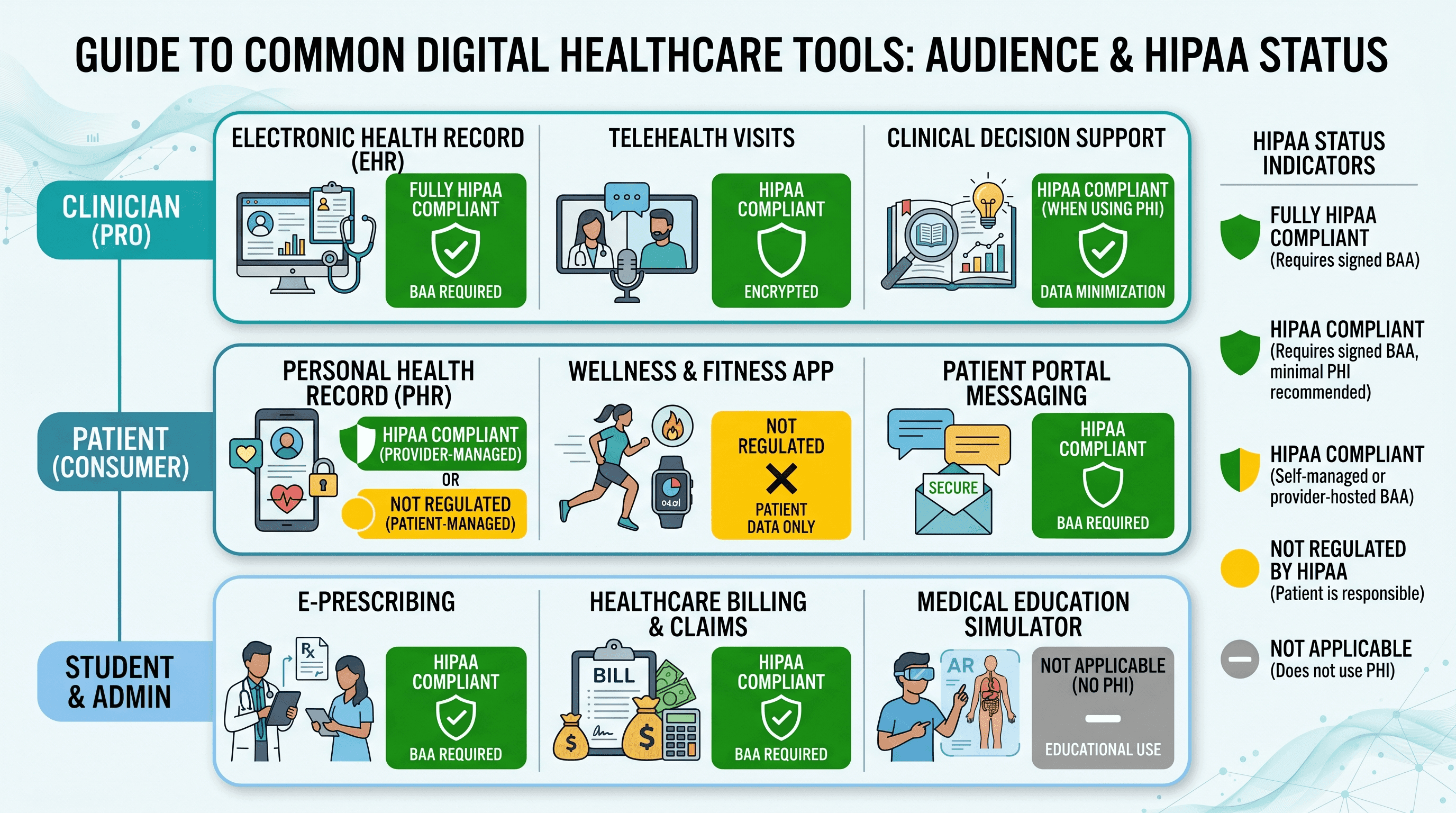
Consumer ChatGPT products, including ChatGPT Free, Plus, Team, and Pro, are not HIPAA compliant. OpenAI does not offer a Business Associate Agreement for these plans. Entering patient information into standard ChatGPT is a compliance violation, regardless of whether the information appears "de-identified" on the surface. As HIPAA Journal's 2026 analysis clarifies, consumer-grade ChatGPT services lack the administrative, physical, and technical safeguards required by the HIPAA Security Rule.
ChatGPT for Clinicians, the verified professional tier, is different. Individual clinicians can request a BAA for their account, which allows input of PHI under specific conditions. But this is the individual's responsibility to configure before entering any patient data.
OpenEvidence operates on a BAA model for verified US healthcare professionals. Heidi Health is HIPAA compliant with BAA availability, SOC 2 Type II certified, and ISO 27001 certified, though BAA coverage depends on the plan tier. Doximity Scribe is HIPAA compliant with BAA coverage included for all verified users at no cost.
The most important rule to internalize: vendor responsibility and user responsibility are separate. A tool that offers a BAA does not make you compliant automatically. The clinician must configure the BAA, understand what data inputs are permitted, and ensure that workflows match the terms of the agreement.
For de-identified or non-PHI clinical tasks like literature reviews, differential diagnosis brainstorming using hypothetical cases, or documentation templates without patient identifiers, many free tools can be used without a BAA. A doctor can advise on the specifics of individual compliance situations.
Best Free AI Tools for Clinicians
The tools that serve clinicians fall into three sub-categories: documentation and scribing, clinical evidence and decision support, and the newly launched dedicated workspace for individual providers. Each has a different HIPAA posture, free tier scope, and specialty fit.
AI Scribing and Documentation Tools
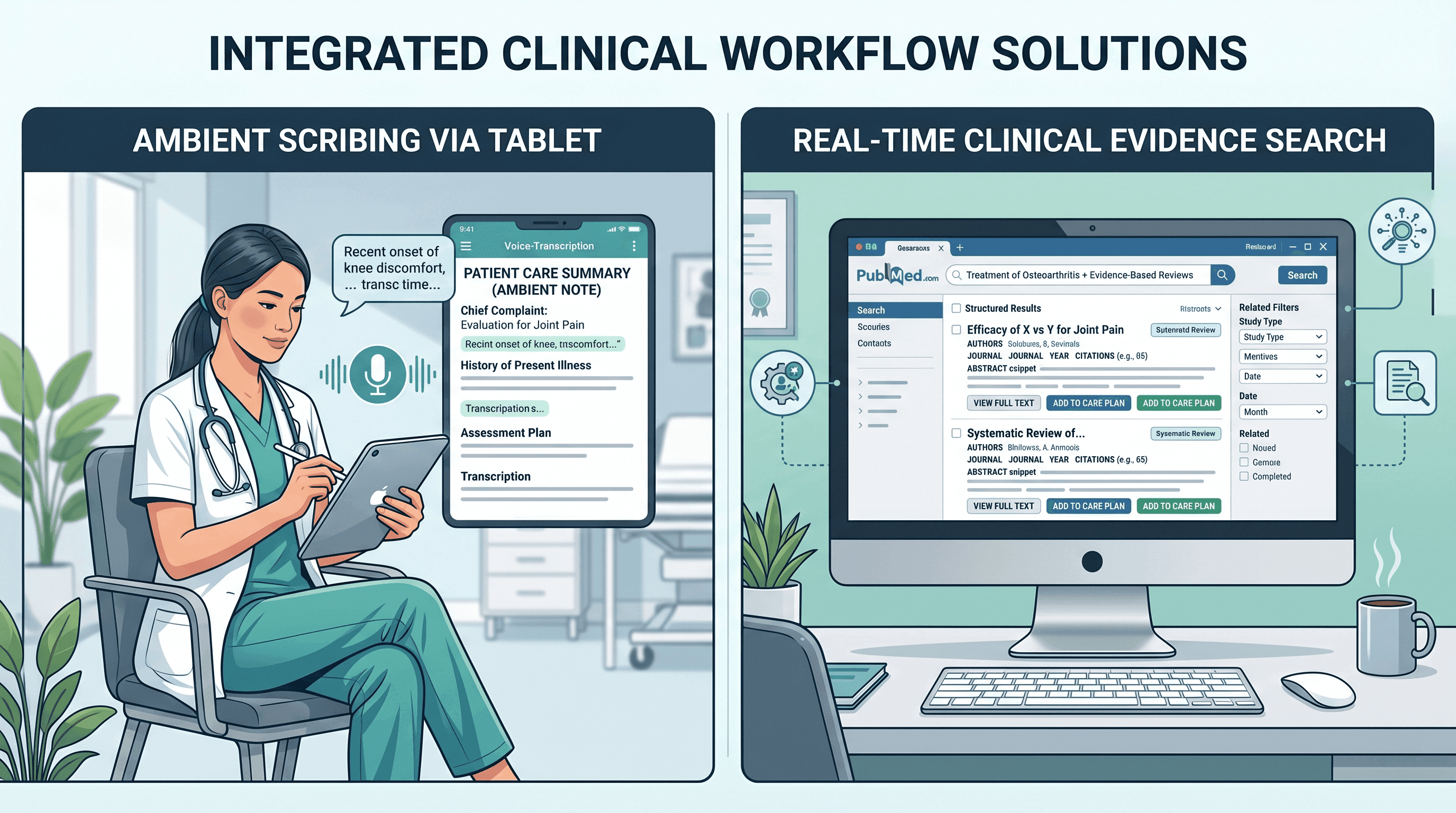
Heidi Health offers one of the few ongoing free plans in the AI scribe category. According to multiple clinical tool reviews, the free plan includes unlimited transcription and notes using standard templates, with a capped number of "Pro Actions" per month for advanced features including custom templates, document templates, and the "Ask Heidi" AI assistant. When the Pro Action cap is reached, clinicians can still generate notes using standard templates. Audio recordings are not stored at any tier: Heidi processes audio in real time, transcribes it, and deletes the audio immediately. The platform is HIPAA compliant, SOC 2 Type II certified, and ISO 27001 certified, with US-hosted data. BAA availability depends on the plan tier; clinicians should verify current BAA terms before inputting PHI. Heidi is particularly strong for multilingual documentation and covers more than 200 specialties.
Doximity Scribe is free with no usage limits beyond a 140-minute per-session recording cap, available to any verified US physician, NP, PA, or medical student through the Doximity platform. More than 80% of US physicians hold existing Doximity accounts, making this one of the lowest-friction entry points to free AI scribing. The tool is HIPAA compliant with a BAA covering all users, SOC 2 Type II certified, and supports H&P, progress note, consult, and custom template formats. It does not require a credit card or separate signup beyond Doximity verification.
Clinical Evidence and Decision Support
OpenEvidence is free for verified US healthcare professionals and is routinely cited as the most feature-rich free clinical AI platform available to US clinicians. The evidence-grounded search pulls citations from peer-reviewed literature including sources indexed by major medical journals. OpenEvidence Visits provides ambient note generation with HIPAA-compliant patient call support via its Doctor Dialer feature. As of March 2026, the Coding Intelligence feature adds automatic ICD-10, evaluation and management, and CPT code suggestions directly from clinical documentation. OpenEvidence was named "best AI tool for medical information" by NEJM Journal Watch. Access requires verification as a US healthcare professional.
Medscape AI is free for registered members globally. It provides broad clinical reference with specialty personalization and real-time medical news integration. Geographic availability is broader than most US-specific platforms, making it one of the better options for international clinicians.
Glass Health is a clinical decision support tool designed by physicians that allows clinicians to input patient symptoms and history in natural language and receive a ranked differential diagnosis with citations. By 2026, the platform had been adopted across thousands of physician practices and hospitals. It is designed as a support tool, not a replacement for clinical judgment, and requires medical credentials for full access. Medical students and residents have also found it useful as a learning tool for developing differential diagnosis reasoning skills.
ChatGPT for Clinicians: The Newest Free Option
ChatGPT for Clinicians, launched April 23, 2026, is the most significant new entrant in this category and the tool most likely to reshape individual clinician workflows over the next 12 months.
The platform is free for verified US physicians (MD/DO), nurse practitioners, physician assistants, pharmacists, and psychologists. Verification requires a valid NPI and license confirmation through a third-party verification provider. International expansion is planned but not yet announced.
What the platform includes at no cost: access to GPT-5.4 for clinical use cases, trusted clinical search with real-time citations from peer-reviewed sources (including journal author, publication date, and title for each result), deep research mode for delegated literature reviews, reusable workflow skills for prior authorizations, patient instructions, and referral letters, clinician-specific starter prompts, and CME credit tracking for eligible clinical questions.
What the free tier does not include: EHR integration, which requires the enterprise-level ChatGPT for Healthcare product designed for health system deployment. The free individual tier is copy-paste into the EHR. For clinicians whose hospitals do not yet offer a centralized AI tool, this is still a meaningful step forward.
On HIPAA: individual BAA setup is available for eligible accounts, but PHI must not be entered until a BAA is in place. OpenAI's help documentation is explicit that for multi-user BAA coverage or centralized controls, the enterprise ChatGPT for Healthcare product is required.
The HealthBench Professional benchmark, released alongside the launch, found GPT-5.4 in the Clinicians workspace scored 59.0 on real-world clinician chat tasks, above the human physician baseline of 43.7. The benchmark was developed by OpenAI, which is worth noting as a limitation when interpreting those figures.
If symptoms or clinical questions require in-person evaluation, or if a patient needs a prescription or treatment plan, see a doctor online through Momentary's virtual primary care service as a first step before relying on any AI output.
Best Free AI Tools for Patients
This is the segment most articles on AI healthcare tools leave out entirely, and it may be the one with the broadest real-world impact. More than 40 million people ask ChatGPT a health-related question every day, according to OpenAI's launch data for ChatGPT Health. Most of them are patients, not clinicians. And the tools built specifically for patients behave very differently from general-purpose chatbots.
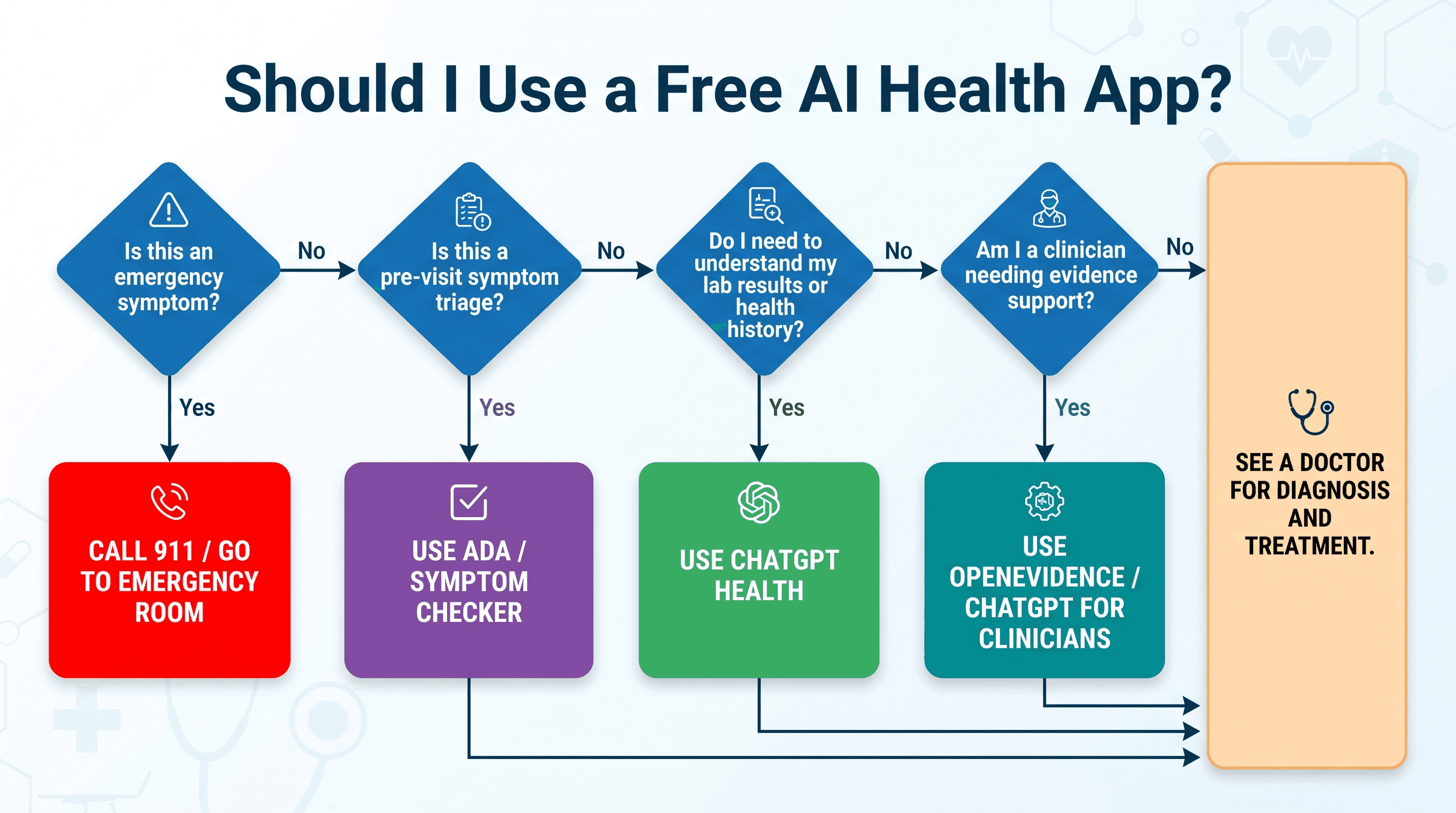
A note that applies to everything in this section: no free AI tool for patients can provide a medical diagnosis, prescribe treatment, or replace clinical judgment. If someone is experiencing chest pain, difficulty breathing, sudden severe headache, signs of stroke, or any other emergency symptom, the appropriate action is to call 911 or go to the nearest emergency room immediately, not to open an app.
AI Symptom Checkers vs. AI Health Companions: What's the Difference?
Two meaningfully different categories of patient-facing AI tools are often lumped together, and confusing them leads to misuse.
AI symptom checkers are triage tools designed for a single, pre-visit use case. They take symptom inputs and return a probability-weighted list of possible conditions with a recommended urgency level: self-manage, see a doctor soon, or seek emergency care. They are built for one-time use before a clinical encounter. Ada Health and Ubie are the clearest examples.
AI health companions are longitudinal tools that connect to ongoing health data, learn from past interactions, and respond to health questions in context over time. ChatGPT Health is the most prominent example in 2026. It is not a symptom checker: it is a platform for understanding your health history, preparing for appointments, and navigating complex health information with your own records as context.
Using a symptom checker for longitudinal health management, or treating a health companion as an emergency diagnostic tool, produces poor outcomes in both directions. Matching the tool to the need is the first step.
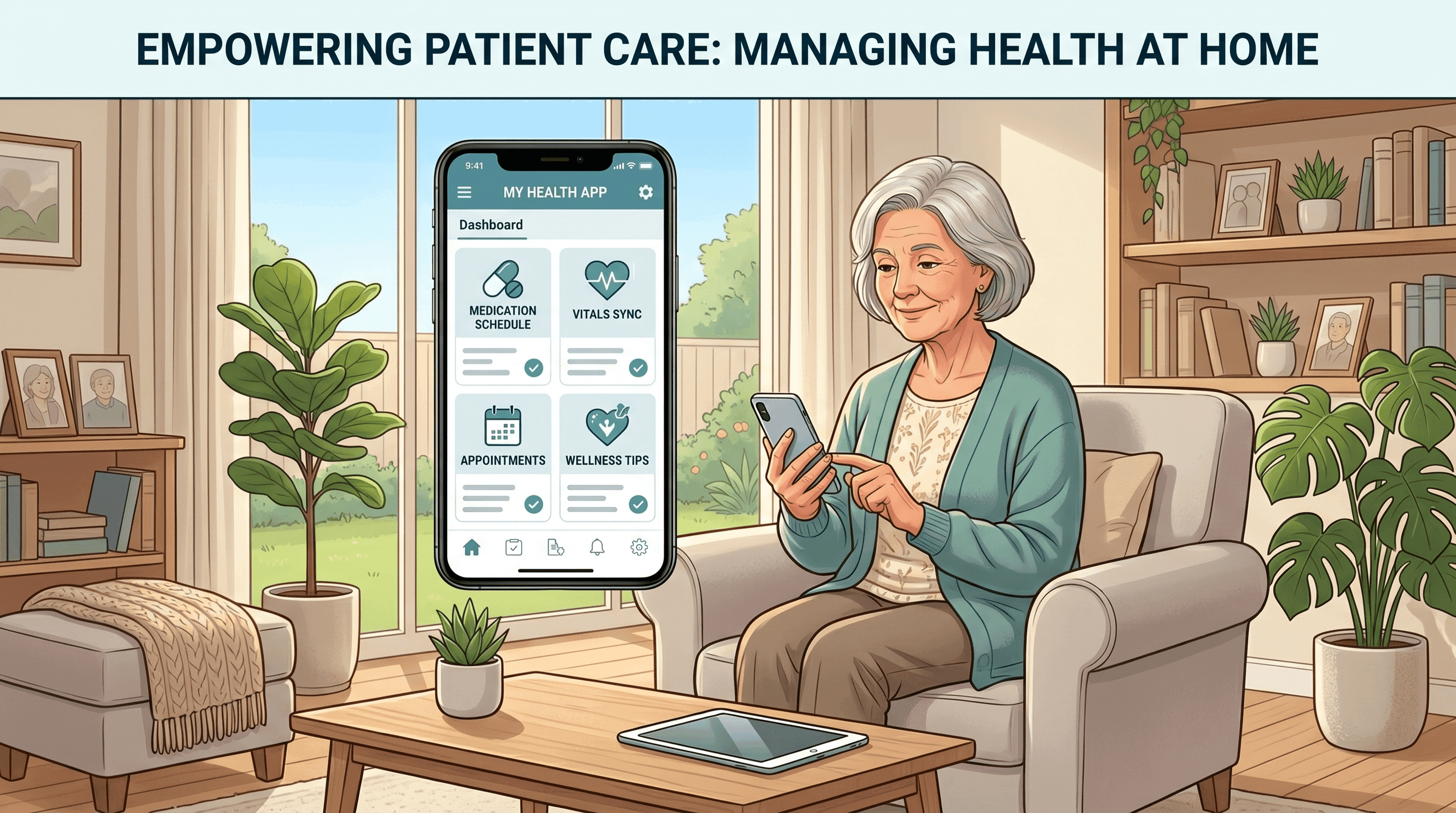
ChatGPT Health launched January 7, 2026 and is available within the ChatGPT app to users on Free, Go, Plus, and Pro plans in the US (outside EEA, Switzerland, and UK). Users can connect electronic health records via b.well, which aggregates data from approximately 2.2 million US healthcare providers, sync Apple Health on iOS, and connect wellness apps including MyFitnessPal, Function, and Peloton. Health chats, files, and memories are stored in a separate space from main ChatGPT and are not used to train foundation models. Users can summarize lab results in plain language, prepare appointment questions, compare insurance options based on their coverage history, and get guidance on diet and exercise grounded in their own records. ChatGPT Health is not intended for diagnosis or treatment. EHR integration is US-only and requires users to be over 18.
Ada Health is one of the most widely used free symptom checker apps globally and has guided over 15 million assessments. It walks users through a structured question flow that adapts based on their answers and returns a ranked list of possible conditions with urgency guidance. A 2026 update added natural language symptom input for US users, allowing conversational descriptions rather than structured menu selections. Ada explicitly does not provide a medical diagnosis; it produces an assessment to help users decide whether and how urgently to seek care. The app is free on iOS and Android with no registration required for basic use.
A Note on AI Mental Health Support Apps
Several free AI-driven tools offer mental health and wellness support through CBT-based exercises, mood tracking, and structured check-ins. Woebot, Wysa, and Calm's AI features fall into this category. These tools can be useful between appointments or in moments of stress, but they are not a substitute for licensed mental health care. If someone is experiencing a mental health crisis, is having thoughts of harming themselves or others, or requires medication management, a licensed provider is necessary. Free tools in this space work best as supplementary support rather than primary care.
Best Free AI Tools for Healthcare Administrators and Medical Students
Most articles on AI healthcare tools address clinicians and patients. Two large groups are routinely skipped: healthcare administrators who manage coding, documentation workflows, and operational logistics, and medical students who need exam preparation and clinical reasoning development alongside factual recall.
For healthcare administrators, OpenEvidence's Coding Intelligence feature is the standout 2026 addition. It delivers automatic ICD-10 diagnosis suggestions, E/M level recommendations with supporting medical decision-making rationale written directly into the note, CPT code suggestions, and automatic CPT sequencing under Medicare's Multiple Procedure Payment Reduction rules, all derived from clinical documentation at no additional cost for verified clinicians. For documentation workflow support, ChatGPT for Clinicians also serves administrative workflows including prior authorizations, patient instruction generation, and referral letter drafting through its reusable skills feature.
For medical students, the clearest free option is iatroX, which is globally free and offers an adaptive question bank mapped to UKMLA, USMLE, and MRCGP exam formats, alongside clinical reasoning exercises and guideline reference. Unlike most clinical AI tools that focus on practicing providers, iatroX was built explicitly for students at any point in training. Arkangel AI offers clinical case-based learning and structured exam preparation with scenarios designed to develop diagnostic reasoning rather than rote memorization. Glass Health, covered in the clinician section above, is also widely used by residents and students for differential diagnosis practice, with medical credential requirements for full access.
Side-by-Side Comparison: Free Tier Features at a Glance
| Tool | Use Case | Free Tier | HIPAA/BAA on Free | Verification Required | Note/Session Limits | Geographic Availability |
|---|---|---|---|---|---|---|
| ChatGPT for Clinicians | Evidence, documentation, workflows | Yes | BAA available (individual setup) | Yes (NPI + license) | None stated | US only at launch |
| OpenEvidence | Evidence, scribing, coding | Yes | HIPAA compliant, BAA available | Yes (US HCP) | None stated | US primarily |
| Heidi Health | AI scribing | Yes (limited Pro Actions) | HIPAA compliant; BAA depends on tier | No | 10 Pro Actions/month; unlimited standard notes | Global (116 countries) |
| Doximity Scribe | AI scribing | Yes (unlimited) | HIPAA compliant, BAA for all | Yes (US clinician) | 140 min/session | US only |
| Glass Health | Differential diagnosis | Yes | Not stated; verify before PHI entry | Yes (medical credentials) | Not stated | US primarily |
| Medscape AI | Clinical reference | Yes | Not stated | Yes (registration) | None stated | Global |
| ChatGPT Health | Patient health companion | Yes (Free plan) | Not HIPAA; consumer wellness product | No | None stated | US, select plans |
| Ada Health | Patient symptom checker | Yes | Not applicable (consumer) | No | None stated | Global |
| iatroX | Medical student Q-bank | Yes | Not applicable | No | Not stated | Global |
When to Upgrade From Free to Paid
Free tools cover a remarkable amount of the clinical and consumer health AI workflow in 2026. But three specific scenarios consistently push users toward paid tiers, and recognizing them early saves time and frustration.
The first is high-volume exam preparation. Free Q-banks and clinical reasoning tools offer meaningful depth for orientation and targeted review, but large curated question pools with peer benchmarking and detailed performance analytics, the kind offered by PassMedicine, Pastest, and UWorld, require paid access. Students approaching board exams in the final 60 to 90 days before the test date will typically need a paid resource for the question volume required at that stage.
The second is ambient scribing at clinical scale. Heidi Health's free tier works well for a moderate visit volume, but the cap on Pro Actions, which include custom templates and the Ask Heidi AI assistant, becomes a ceiling for high-volume clinicians. Practices seeing 20 or more patients per day, or those requiring specialty-specific templates across multiple providers, will find that the free tier is an evaluation mode rather than a sustainable workflow.
The third is institutional compliance with enterprise audit requirements. Individual BAAs on tools like ChatGPT for Clinicians work for solo clinicians, but health systems that require centralized administration, audit log access, organizational data connections, and multi-user BAA coverage need the enterprise product. That is ChatGPT for Healthcare, ChatGPT Enterprise, or equivalent platforms from other vendors. The operational overhead and governance requirements of enterprise compliance are what justify the cost, not the AI capabilities themselves.
Privacy Checklist for Free Health AI
Before entering health information into any free AI tool, run through this list.
Look for a SOC 2 Type II certification, which confirms the vendor's security controls have been independently audited. Look for HIPAA compliance documentation and verify whether a BAA is available on your specific plan tier, not just a higher-tier plan. Check whether the tool uses your inputs to train future models: this is often opt-out by default on consumer platforms and requires actively reviewing account settings. Verify the tool's audio and data retention policy if it involves voice recording: legitimate clinical scribes delete audio immediately after transcription. Review the privacy policy for health-specific data separately from the general terms of service, particularly for consumer health apps that connect to wearables or EHRs.
For any tool handling patient information, the safest approach is to confirm with a compliance officer or legal counsel before beginning clinical use, even on verified platforms. De-identified or hypothetical inputs carry substantially lower risk than real PHI and can be used across a wider range of free tools without BAA requirements.
The Limits: When Free AI Is Not Enough
Every free AI healthcare tool in 2026, regardless of how capable, shares the same hard limits. Clearly understanding those limits is what makes the tools safe.
Free AI tools cannot prescribe medication or order tests. They cannot perform a physical examination. They cannot provide a legal medical diagnosis. They cannot replace clinical judgment in emergency situations. And they cannot guarantee accuracy on every output: even the most capable clinical AI platforms, including GPT-5.4 in the ChatGPT for Clinicians workspace, are designed to support professional judgment rather than substitute for it. OpenAI's own documentation states that clinicians remain responsible for all clinical decisions and should independently verify information as appropriate.
For patients, the clearest rule is this: if symptoms are severe, sudden, or worsening, no free AI tool is the right first step. Chest pain, difficulty breathing, signs of stroke, severe abdominal pain, sudden changes in vision or speech, or any symptom that feels like an emergency should be directed to emergency services, not an app.
For clinicians, the parallel rule is that AI output is a draft, not a decision. The value of free clinical AI tools is in reducing the time it takes to reach the right answer, not in replacing the clinical reasoning process that makes the answer trustworthy.
Frequently Asked Questions
What is the free AI in healthcare program for clinicians?
The most prominent free AI program for US clinicians in 2026 is ChatGPT for Clinicians, launched by OpenAI on April 23, 2026. It provides free access to GPT-5.4 for verified US physicians, nurse practitioners, physician assistants, pharmacists, and psychologists. Features include trusted clinical search with citations, deep research for literature reviews, reusable workflow skills, CME credit tracking, and access to frontier models for clinical use cases. Verification requires an NPI and license confirmation. OpenEvidence is also free for verified US healthcare professionals and includes clinical evidence search, ambient scribing, and the newly launched Coding Intelligence for automated ICD-10 and CPT suggestions.
What types of AI are used in healthcare?
Healthcare AI in 2026 spans several distinct categories. Large language models power clinical documentation tools like Heidi Health and ChatGPT for Clinicians by transcribing conversations and generating structured notes. Evidence retrieval AI, used by OpenEvidence and Glass Health, indexes peer-reviewed medical literature to return cited answers to clinical questions. Symptom assessment AI, used by Ada Health, applies probabilistic reasoning to structured symptom input to estimate possible conditions and urgency. Health companion AI, used by ChatGPT Health, integrates personal health data including EHR records and wearable data to provide context-aware responses over time. Coding AI, newly launched in OpenEvidence Visits, applies clinical documentation to automatically suggest ICD-10, E/M, and CPT codes. Collectively, these categories address documentation burden, evidence access, patient navigation, and administrative efficiency.
What is the safest practice when using free AI healthcare tools?
The core safety practices apply differently depending on the user. For patients: never use a free AI tool in place of emergency care; treat symptom checkers as pre-visit preparation rather than diagnosis; and review privacy policies before connecting health records. For clinicians: verify whether a BAA is in place before entering PHI; treat AI outputs as drafts requiring independent clinical review; cite outputs from tools with traceable citations rather than those generating unverified summaries; and stay current on your institution's policies regarding bring-your-own AI tools. For both groups: use tools built for your role, not general-purpose chatbots substituting for purpose-built health AI.
What AI tools do doctors actually use for free in 2026?
Based on current adoption data, the most widely used free AI tools among US physicians include OpenEvidence for evidence search and clinical documentation, ChatGPT for Clinicians for research and documentation workflows, Doximity Scribe for HIPAA-compliant ambient note generation, and Medscape AI for broad clinical reference. Heidi Health's free tier is also widely adopted, particularly among primary care clinicians and allied health professionals outside the US. Glass Health is commonly used for differential diagnosis support, especially among residents and early-career physicians.
Do free AI healthcare tools work outside the US?
Coverage varies by tool and country. OpenEvidence and ChatGPT for Clinicians are currently limited to US healthcare professionals, with international expansion planned. ChatGPT Health is available in the US and most markets outside the EEA, Switzerland, and UK. Medscape AI and Ada Health are globally available. Heidi Health operates in 116 countries and supports more than 110 languages, making it one of the strongest options for international clinicians. iatroX is globally free and supports exam preparation aligned with UKMLA, USMLE, and MRCGP formats. For clinicians outside the US, the practical free toolkit tends to center on Heidi, Medscape AI, and iatroX while waiting for US-gated platforms to expand.
Is it safe to use free AI tools to understand my own health data?
ChatGPT Health is the most purpose-built option for this in 2026. It is designed to accept connected medical records and Apple Health data in an encrypted, compartmentalized space separate from main ChatGPT, with health data not used for model training. The tool is designed to support, not replace, clinical care. For complex results, chronic conditions, or any finding that raises concern, the appropriate follow-up is a conversation with a licensed provider. If you want to explore what your symptoms might mean or get guidance on next steps, you can use Momentary's AI health navigator to get personalized guidance before your next appointment.
References
- American Medical Association — AI Usage Among Doctors Doubles — 2026 AMA Physician Survey findings: 81% of US physicians now use AI professionally.
- OpenAI — Making ChatGPT Better for Clinicians — Official launch post for ChatGPT for Clinicians (April 23, 2026), features, verification, and BAA details.
- OpenAI Help Center — ChatGPT for Clinicians — Eligibility, signup steps, BAA configuration, and feature details.
- OpenEvidence — Coding Intelligence Launch — March 24, 2026 launch of automatic ICD-10, E/M, and CPT suggestions for verified clinicians.
- OpenAI — Introducing ChatGPT Health — January 7, 2026 launch of ChatGPT Health with EHR, Apple Health, and wellness app integration.
- HIPAA Journal — Is ChatGPT HIPAA Compliant? — 2026 analysis of consumer ChatGPT HIPAA compliance status, BAA availability, and PHI handling.
- NIH/PMC — AI in Healthcare: An Updated Overview — Clinical overview of AI tool categories, use cases, and evidence standards in healthcare settings.


